
DbcultAccessing Vault...
Director's Spotlight
Senior Film Conservator
Director's Spotlight: United States
A Deep Dive into the 1924 Vision of William K. Howard
The evocative power of East of Broadway stems from the unique collaboration between the subversive storytelling techniques employed by William K. Howard in 1924. Synthesizing the best elements of United States and international cinema, it reminds us of the fragility and beauty of the 1924s.
In East of Broadway, William K. Howard pushes the boundaries of conventional narrative. The film's unique approach to its subject matter has sparked endless debates and interpretations among cinephiles and critics alike.
The visual language of East of Broadway is defined by its use of shadows and framing, a hallmark of William K. Howard's style. By utilizing a 1924-era palette, the film creates an immersive experience that perfectly complements its Comedy themes.
| Cinematography | Noir-Inspired |
| Soundtrack | Minimalist |
| Editing | Slow-Burn |
| Art Direction | Brutalist |
Visualizing the convergence of William K. Howard's style and the core Comedy narrative.
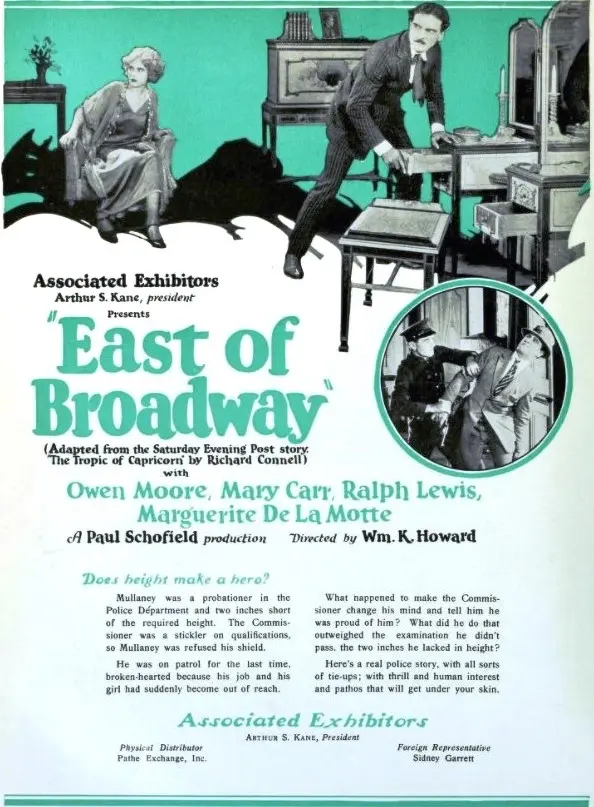
Peter Mullaney, the son of Irish immigrants living on the East Side of Manhattan, has one ambition in life: to become one of New York's Finest. He goes to the Police Training School and is about to be rejected for not meeting the height qualification when he demonstrates his prowess in a fight. The commissioner then decides to give Peter a chance to make the force, if he scores well on the written examination. Peter declares the Tropic of Capricorn to be in the Bronx and fails to pass; the commissioner, however, allows him to wear the uniform for one night in order not to disappoint Peter's girl, Judy McNulty. Walking the beat with Officer Gaffney, he becomes involved in preventing a robbery, during which Gaffney is shot. Peter comes to his aid and captures the robbers, being himself hurt in the process. In the hospital, the commissioner, on account of his bravery, pins a shield on him, and Peter and Judy make plans to be married.
Decades after its release, East of Broadway remains a vital piece of the cinematic puzzle. Its influence can be seen in countless modern works, solidifying William K. Howard's status as a master of the craft in United States and beyond.