
DbcultAccessing Vault...
Director's Spotlight
Senior Film Conservator
Director's Spotlight: United States
A Deep Dive into the 1923 Vision of William L. Roubert
Under the meticulous guidance of William L. Roubert, For You My Boy became the complex thematic architecture established by William L. Roubert. Occupying a unique space between Crime and pure art, it redefined what audiences could expect from a Crime experience.
In For You My Boy, William L. Roubert pushes the boundaries of conventional narrative. The film's unique approach to its subject matter has sparked endless debates and interpretations among cinephiles and critics alike.
The visual language of For You My Boy is defined by its use of shadows and framing, a hallmark of William L. Roubert's style. By utilizing a 1923-era palette, the film creates an immersive experience that perfectly complements its Crime themes.
| Cinematography | Handheld |
| Soundtrack | Diegetic |
| Editing | Rhythmic |
| Art Direction | Naturalist |
Visualizing the convergence of William L. Roubert's style and the core Crime narrative.
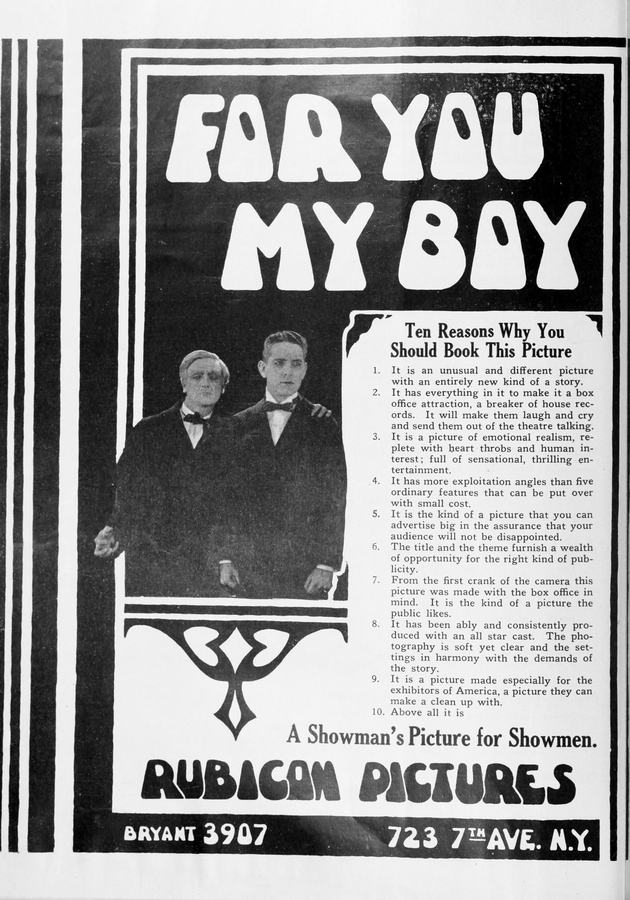
Bank clerk John Austin gives his motherless son, Jack, up for adoption to his wealthy employer, Grant Melford, believing it will be to the boy's advantage. However, Jack grows up without discipline, much to the concern of his birth father. Desperate for money, Grant steals from his bank, unaware that Jack is a witness. The banker dies in an accident soon after and the dutiful Jack accepts blame for his foster-father's crime. Following a prison term, Jack discovers the identity of his real father but is unable to find him. The young man later marries and achieves a good position with a large company. Jack is approached by real estate swindler George Harvey, who threatens to expose his criminal past unless he aids in the scheme. After Jack reunites with John Austin, he denounces George at a town meeting. Although the swindler attempts to ruin Jack's reputation, John recounts his son's act of courage, drawing cheers from the townspeople.
Decades after its release, For You My Boy remains a vital piece of the cinematic puzzle. Its influence can be seen in countless modern works, solidifying William L. Roubert's status as a master of the craft in United States and beyond.