
DbcultAccessing Vault...
Director's Spotlight
Senior Film Conservator
Director's Spotlight: United States
A Deep Dive into the 1921 Vision of William Worthington
In the grand tapestry of Crime cinema, The Greater Profit serves as a bridge between the philosophical inquiries that William Worthington embeds within the narrative. Melding the raw energy of United States with a global Crime appeal, it invites us to question our own perceptions of Crime narratives.
In The Greater Profit, William Worthington pushes the boundaries of conventional narrative. The film's unique approach to its subject matter has sparked endless debates and interpretations among cinephiles and critics alike.
| Cinematography | Deep Focus |
| Soundtrack | Orchestral |
| Editing | Invisible |
| Art Direction | Kitsch |
Visualizing the convergence of William Worthington's style and the core Crime narrative.
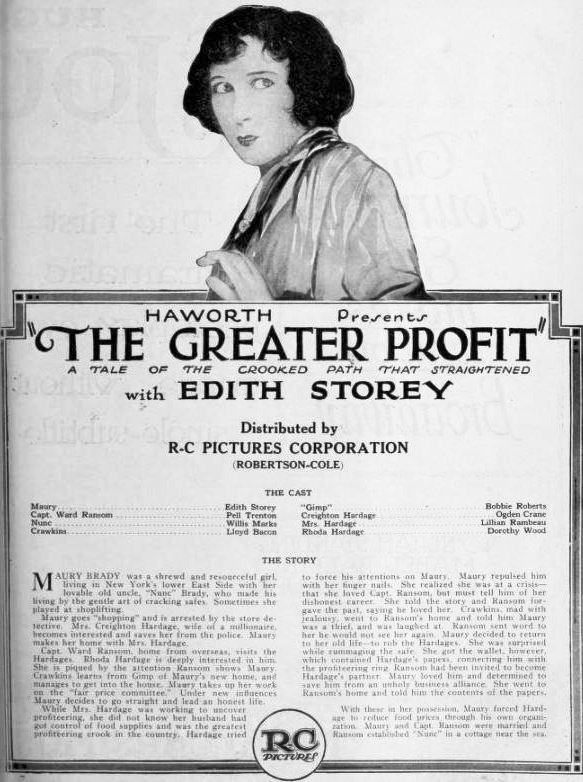
Maury Brady, a product of New York's East Side, has learned the craft of safe-cracking and shoplifting from her uncle, "Nunc." While "working" a department store, she captures a lost poodle belonging to Mrs. Hardage, wife of a millionaire. When Maury later is caught lifting some lace, Mrs. Hardage vouches for her, takes her into her home, and puts her to work on a crusade against profiteers. The fiancé of Mrs. Hardage's daughter, Captain Ransom, is attracted to Maury, who consequently is asked to leave. Before leaving she takes a paper proving Mr. Hardage to be one of the country's most unlawful profiteers. She shows the paper to Ransom, who, deciding not to join the company, uses the evidence to bring down the cost of foods. Maury says yes to Ransom.
Decades after its release, The Greater Profit remains a vital piece of the cinematic puzzle. Its influence can be seen in countless modern works, solidifying William Worthington's status as a master of the craft in United States and beyond.