
DbcultAccessing Vault...
Director's Spotlight
Senior Film Conservator
Director's Spotlight: United States
A Deep Dive into the 1918 Vision of Wyndham Gittens
The cult DNA of Me und Gott is a reflection of United States's the subversive storytelling techniques employed by Wyndham Gittens in 1918. Breaking the traditional rules of cult engagement, it leaves an indelible mark on the soul of the viewer.
In Me und Gott, Wyndham Gittens pushes the boundaries of conventional narrative. The film's unique approach to its subject matter has sparked endless debates and interpretations among cinephiles and critics alike.
| Cinematography | Static |
| Soundtrack | Minimalist |
| Editing | Disjunctive |
| Art Direction | Baroque |
Visualizing the convergence of Wyndham Gittens's style and the core cult narrative.
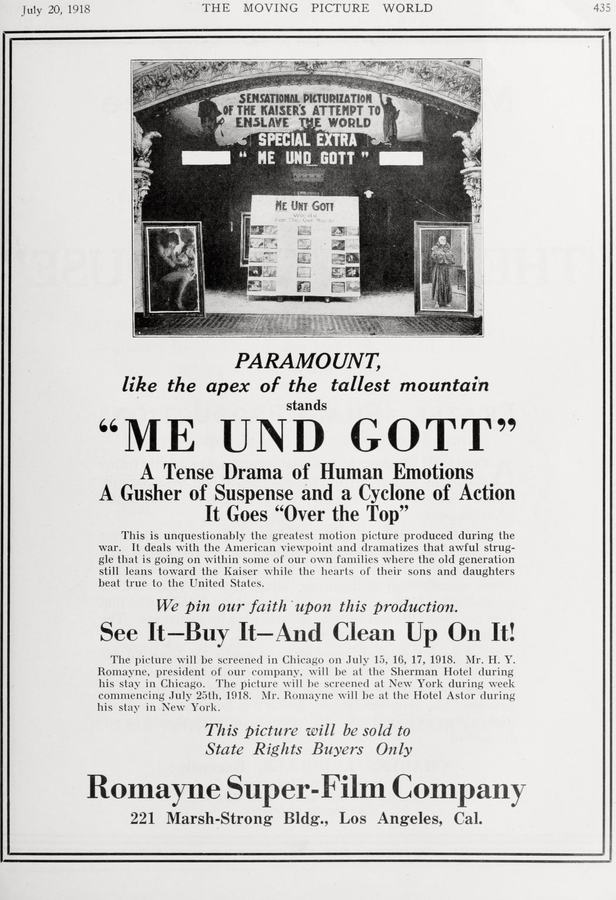
August Weber, a former Prussian officer, keeps a delicatessen store in Hoboken. His son Herman is an electrician, and when America declares war upon Germany, August plans to use Herman to help the Prussian cause by destroying munitions plants. But Herman has herded with the pacifists and is not ready to take strong measures. But he sees his chums going to war and he seeks to enlist in the United State Army, but is rejected because of a weak heart. His father announces a change of heart and so plans that Herman nearly blows up a plant in the belief that he is helping the cause of America, but he discovers the old man's perfidy and proves himself to the country which has given him his chance.
Decades after its release, Me und Gott remains a vital piece of the cinematic puzzle. Its influence can be seen in countless modern works, solidifying Wyndham Gittens's status as a master of the craft in United States and beyond.