
DbcultAccessing Vault...
Director's Spotlight
Senior Film Conservator
Director's Spotlight: France
A Deep Dive into the 1936 Vision of Yves Mirande
As we revisit the 1936 masterpiece Symphonie D'Amour, we are struck by the atmospheric immersion that Yves Mirande achieves throughout Symphonie D'Amour. Exploring the nuances of the human condition with Comedy flair, it solidifies Yves Mirande's reputation as a master of the craft.
In Symphonie D'Amour, Yves Mirande pushes the boundaries of conventional narrative. The film's unique approach to its subject matter has sparked endless debates and interpretations among cinephiles and critics alike.
The visual language of Symphonie D'Amour is defined by its use of shadows and framing, a hallmark of Yves Mirande's style. By utilizing a 1936-era palette, the film creates an immersive experience that perfectly complements its Comedy themes.
| Cinematography | Deep Focus |
| Soundtrack | Diegetic |
| Editing | Elliptical |
| Art Direction | Expressionist |
Visualizing the convergence of Yves Mirande's style and the core Comedy narrative.
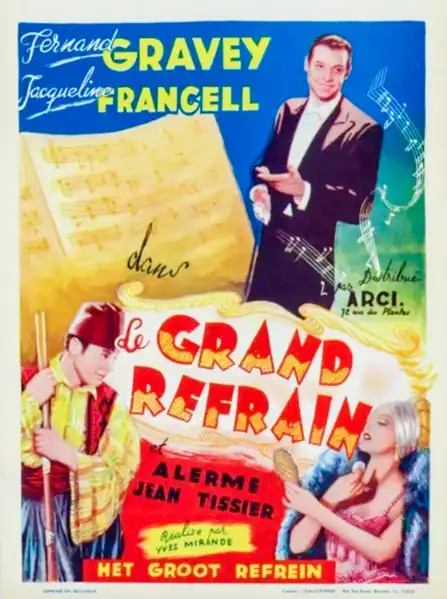
A ten-year old film when it was first released in the USA as "Symphonie D'Amour" in 1946. Panard (Fernand Gravet) is a talented composer who is having little success in his musical career. He is reduced to hiring out as a sandwich-board man to advertise what proves to be his own show. His girl, Jacqueline Francell, interests a Marquis in backing the show. She and Panard are happily reunited after the successful opening of his operetta.
Decades after its release, Symphonie D'Amour remains a vital piece of the cinematic puzzle. Its influence can be seen in countless modern works, solidifying Yves Mirande's status as a master of the craft in France and beyond.