DbcultAccessing Vault...
Cult Review
Senior Film Conservator
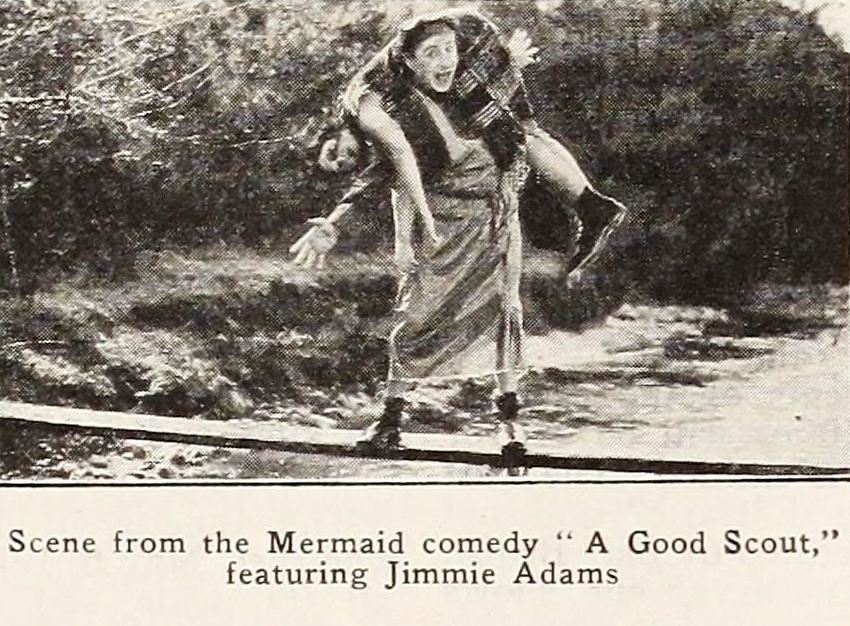
Imagine, if you can, a marital death spiral plated like a three-course tragedy: under-salted oatmeal, eggs cremated beyond recognition, coffee tasting of rusted nail. Into this culinary crime scene barges Jimmie Adams—grin wide enough to shame a piano keyboard—peddling volumes no one ordered, optimism no one wants. The missus of the house, already half poisoned by her own spatula, unleashes first a poodle (glorified powder-puff) and then a bulldog that looks like it moonlights as a cinder block. Exit Adams, stage left, sprinting across a countryside the color of stale straw.
Cue two cops whose IQs appear to have been measured in megaphone decibels rather than points. They gallop after our harried huckster through hayricks that billow like ruptured clouds. The camera, drunk on wide shots, never met a horizon it couldn’t tilt. Dialogue cards pop up with the urgency of telegrams from the front: “STOP!” “HELP!” “OH!”—each one more exhausted than the last. The first reel ends as breathlessly as it began, only with fewer reasons to keep watching.
Abrupt splice, and we’re dumped into the scout camp promised by the title. Uniformed lads march in geometric confusion, neckerchiefs starched into origami. The film suddenly remembers it needs a moral compass, but can’t decide which way is north. Cue a swamp that gulps down boots, egos, and whatever narrative momentum survived the hayfield. Characters fling themselves into the muck with the resignation of people who realize the paycheck clears either way. The End—no badge, no punch line, no lesson.
In 1922 slapstick was approaching its baroque phase: Keaton had perfected architectural gags in The Electric House, Lloyd dangled from skyscrapers, and even lesser lights were experimenting with structure and payoff. First National Pictures, distributor of A Good Scout, banked on Jimmie Adams’s rubberized face to carry a format that was, by then, growing whiskers. Alas, director (uncredited in surviving prints) mistakes velocity for wit, stuffing the runtime with Keystone-redux chases minus the Mack Sennett clockwork timing.
Compare this to The Master Cracksman released the same year, which at least flirted with character arcs amid its safecracking set pieces, or Marionetki roka, a Polish import that laced puppetry symbolism into its crime caper. A Good Scout offers neither subtext nor competent pratfalls—only the cinematic equivalent of a treadmill powered by inertia.
Adams, whose vaudeville pedigree once earned him billing as “the human hand-grenade,” spends the entire picture cycling through three expressions: manic grin, terror gape, and the thousand-yard stare of a man who just read the box-office returns. Kalla Pasha and Tom Woods appear as the pursuing policemen, their combined girth almost justifying the 1.33:1 aspect ratio, yet they remain as interchangeable as their helmets. Virginia Warwick floats through two scenes as “the wife,” saddled with domestic histrionics rather than jokes; she exits before the swamp, perhaps wisely.
John Brown and Cliff Bowes portray scout leaders who seem to have wandered in from a separate picture—possibly an educational short about knot-tying. Their screen time is so abrupt one suspects a reel went missing; the only evidence of their authority is the ability to march minors directly into a bog.
Silent comedy survives on escalation: a stumble becomes a somersault becomes a building collapse. A Good Scout never escalates; it merely elongates. The straw-field sequence could have birthed ingenious hide-and-seek, but every shot restates the same beat—dog, cop, agent, dust cloud—like a stuck record. Sound would have helped, paradoxically: the absence of audible barks, pants, and squelches reveals how much physical humor leans on audio cues. Yet even without spoken dialogue, Keaton proved silence could be symphonic. Here it’s static.
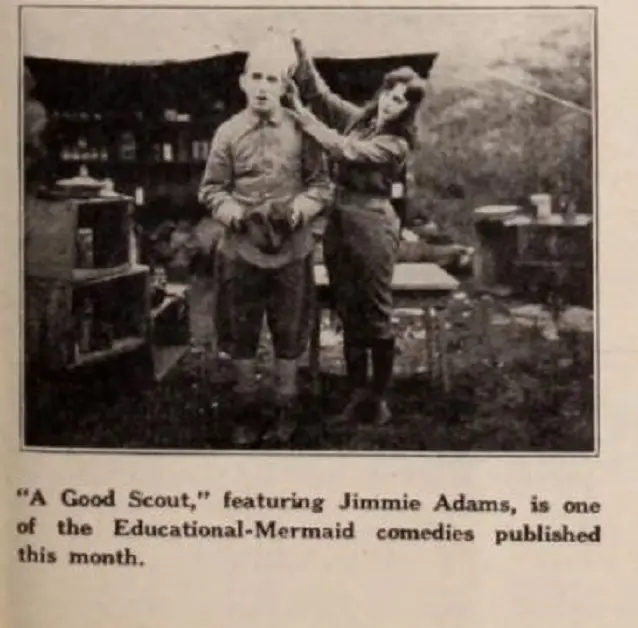
The swamp segment, theoretically fertile ground for soggy slapstick, coughs up exactly one half-hearted gag: Adams loses a shoe and fishes out a boot three sizes too large. Cut to next scene. Compare that to the torrential ingenuity of Brownie, the Peacemaker, where every splash carries consequence, or even the custard-pie mayhem of Bobby’s Baby, which times each splatter like a metronome.
Early scenes hinge on the punchline that the wife’s cooking is lethal. A decade earlier such misogyny might have passed as situational; by 1922 audiences had seen Cinderella riffs that allowed women agency beyond the stove. Warwick’s character wields a skillet more often than dialogue, and her sole victory is siccing canines on a stranger. The film thus doubles down on domestic clichés without subversion, unlike Her Condoned Sin, where female appetite—culinary and otherwise—becomes the engine of plot rather than the butt of joke.
Surviving prints—likely 16 mm reduction—bear the scars of neglect: scratches like lightning forks, contrast flattened to oatmeal gray. Yet even allowing for decay, the mise-en-scène feels apathetic. Shot–reverse-shot patterns during the chase ignore axis rules not for anarchic energy but for sloppiness. The swamp’s opaque water could have hidden wires, trapdoors, comedic fauna; instead we get murky long shots where actors bob like driftwood.
Compare the expressionist backlight of Black Roses, or the aerial optimism of Ikarus, der fliegende Mensch. Those films milked limited tech for visual poetry. A Good Scout treats its own negative as a mere evidence ledger.
Archival records suggest regional exhibitors paired the short with jaunty Wurlitzer improvisations—think “The Pony March” mashed into “Maple Leaf Rag.” A smarter musical supervisor might have contrasted the onscreen tedium with waltz irony, the way Chaplin later weaponized pathos through melody. Absent such commentary, audiences of the day likely laughed out of courtesy, the way one applauds a child’s atonal recital.
Trade papers of 1922 offered the cinematic shrug: “suitably lively for undiscriminating houses,” sniffed Motion Picture News. By 1925 Adams’s star had dimmed, eclipsed by Harold Lloyd’s spectacled go-getters and the existential poise of Keaton. The Library of Congress holds no prints; collectors circulate a 9-minute fragment rumored to derive from a Canadian TV truncation in 1968. Even hardy slapstick revivalists bypass it, preferring the surreal gender-bending of The Charm School or the ethnographic curiosity of Denny from Ireland.
For historians, A Good Scout is a cautionary fable: chase is not comedy, straw is not setting, scouts are not inherently hilarious. For casual viewers, it’s 20 minutes you could spend rewatching Cops (1922) or learning to tie a sheepshank, both more rewarding. The film’s greatest achievement is reminding us how fragile laughter is—how easily the recipe collapses without measured ingredients of character, rhythm, surprise.
So here’s the scout salute: two fingers, palm outward, held at visual distance—perfect symbol for a short that waves goodbye to its own potential and sinks, unlamented, into the celluloid swamp.
IMDb 5.2
1935
Community
Log in to comment.