DbcultAccessing Vault...
4.2/10
Senior Film Conservator
A definitive 4.2/10 rating for a film that redefined the boundaries of cult cinema. A Home Spun Hero remains a cornerstone of transgressive art.
A footlight juggernaut barrels into a grain-silo town expecting to mock the yokels; the yokels juggle back and set the stage on fire.
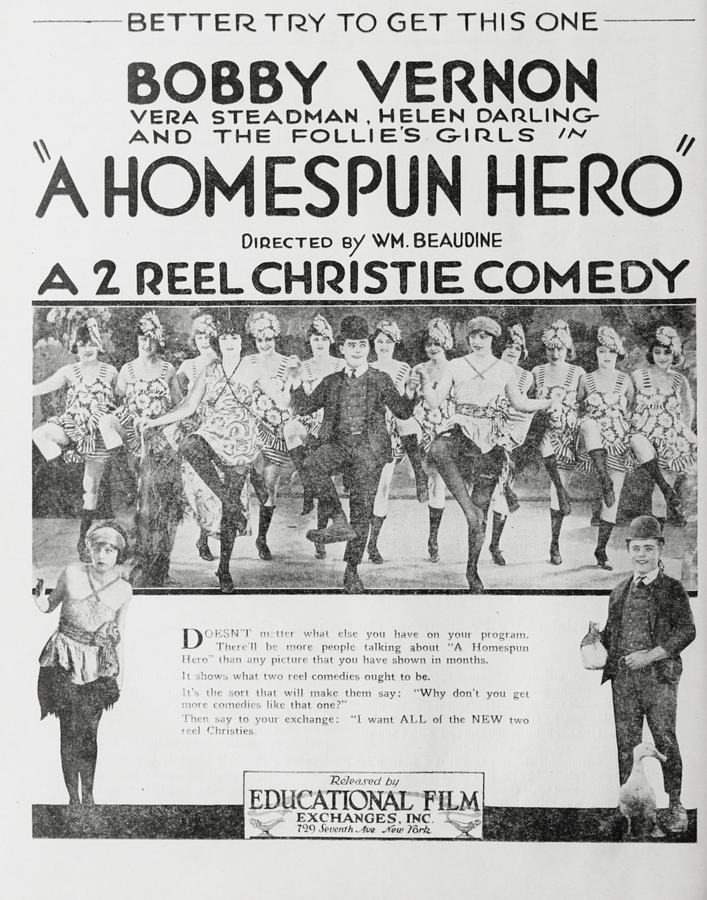
Vaudeville’s cadaver had scarcely cooled when A Home Spun Hero jitterbugged onto screens in the spring of 1923, a scrappy five-reeler determined to prove that synchronized corn could still pop. What survives today—scattered 16 mm diaries preserved by accident in an Ohio barn—feels less like a relic than a dare. The dare: to watch without tasting straw between your molars, to laugh without the guilt of metropolitan snobbery, to hum a refrain that smells of loam rather than rouge.
The plot, skeletal as a scarecrow’s anatomy class, nonetheless pirouettes. George Ford’s smug impresario, Waldo Wainwright, bills his revue as “the slickest contraption this side of Ziegfeld.” His star—Vera Steadman’s Lulubelle—wears ego like sequined armor, each wink a stock option. Enter the cousin nobody bothered to meet: Elmer, essayed by rubber-limbed Bobby Vernon, a name once synonymous with custard-pie physics. The company dispatches a gilt-edged invitation, expecting a bucolic laughing-stock; what arrives is a human slingshot who ricochets through choreographed pretense, exposing every frayed sequin.
Director Scott Darling—moonlighting from his usual beat of one-reel pratfall symphonies—understands that satire dies when it punches down. So he tilts the axis: the sophisticates occupy lower ground, their city slicker slang suddenly impotent against a lad who can flip a hay-bale and land in perfect fourth position. The camera, starved of crane shots, instead sneaks through barn-door slats, catching toe-taps in chiaroscuro shafts of dust. The result: every high-kick is shadowed by its own ridicule.
Pay attention to reel three’s barn-raising sequence—ostensibly a throwaway filler. A half-assembled rafter becomes a seesaw; tap shoes hammer out Morse code on pine planks; sunlight drips like molten butter through knotholes, transmuting sweat into secular halos. Here Darling achieves what many Male and Female epics strain for: the moment when physical labor and choreographed ecstasy swap sweat, when bodies become both punch-line and prayer.
Vera Steadman, too often archived as a footnote to Sennett’s swim-suited chorines, weaponizes dimples here. Watch her face when Elmer, mid-soft-shoe, absently scratches his ribcage with a discarded flute: her smile fractures—half scandal, half envy. In that fissure Lulubelle apprehends her own artifice, and from that crack blossoms the film’s lone genuine song, “I’m a Stranger to Myself.” The melody is a pentatonic sigh, closer to Appalachian keening than Tin Pan Alley swagger; the lyric, a confession that city neon has become foreign moonlight.
Bobby Vernon, meanwhile, pirouettes on the knife-edge between rube caricature and anarchic grace. His gangly silhouette—part praying mantis, part Fred Astaire’s hayseed doppelgänger—renders each stunt a referendum on class-coded grace. When he slides beneath a galloping horse to retrieve a dropped ukulele, the gag lands less as stunt than as manifesto: rural reflexes faster than metropolitan wit.
George Ford, saddled with the thankless straight-man role, plays Waldo with such oleaginous self-belief that one longs to slap his waxed mustache off its axis. Yet even he earns redemption: the closing shot frames him in a dunk-tank, top-hat floating like a black lily, eyes wide with the dawn of humility. Darling lingers on that image—no iris-out, no brisk cut—until mirth mutates into uncomfortable self-recognition.
Make no mistake: this is 1923, two years before The Jazz Singer detonated the talkie boom. The songs exist as title-card lyrics and orchestral cue sheets sent to neighborhood pit bands. Yet memory fills the lacuna. Watch Steadman mouth “I traded my cradle for a silver dollar,” and you swear you hear a harmonica hovering like a firefly. The absence becomes presence; silence itself harmonizes.
Compare this to the following year’s more vaunted barnyard satire In Mizzoura, whose sound-on-disc sequences now creak like rusty weathervanes. Hero’s muteness ages into paradoxical eloquence: because we must imagine the banjo tremolo, the score becomes our autobiography, each viewer supplying ancestral twang.
Helen Darling’s tombish sidekick, Trixie, spends half her screen-time in overalls, smirk cocked like a slingshot. She is the first to wager that the “rube” might outfox them, and the first to ditch her chorus skirt for dungarees when the barn-raising erupts into anarchic dance. The film never labels this gender subversion; it simply lets Trixie’s competence embarrass the peacocks. In contrast to The Vanity Pool, where female rebellion ends in tearful matrimony, Trixie’s arc concludes on a high-plank dive—barefoot, whooping, arms splayed like someone who’s learned her own wingspan.
Regrettably, the film tiptoes up to minstrel caricature then flinches. A discarded subplot—only hinted in cutting-continuity sheets—involved a Black stable boy teaching Elmer syncopated clog steps. The footage, shot but excised after distributor jitters, survives as a single production still: two silhouettes mirrored in a watering trough, one straw-hatted, one beret’d in newsboy cap. Their absence haunts the final cut, a ghost duet of what might have widened the film’s racial aperture. Thus Hero remains alabaster, its egalitarian zeal limited by the era’s timid gatekeepers. Compare the bolder, if more self-serious, racial dialectics of The Gates of Eden (shot but shelved until 1925), and you’ll sense opportunities composting in the cutting-room bin.
Shot in ten days on a San Fernando barn leased from a bankrupt citrus magnate, the production repurposed moth-eaten quilts as cycloramas, borrowed mules for “authentic ambience,” and paid extras in lemonade concentrate. The austerity bleeds into the mise-en-scène: flapping gingham substitutes for velvet, kerosene lanterns masquerade as footlights. Yet this thrift births enchantment. When Lulubelle’s satin gown snags on a nail and rips into streamers, the accident is kept—her stutter-step of dismay becomes choreography. Authenticity, the film whispers, is merely humiliation that refuses to apologize.
Stack it beside The Bondman’s granite gravitas or The Hard Rock Breed’s mining-camp brutality, and this little barn-romp seems froth. Yet froth, left to ferment, can birth sour mash potent enough to scald preconceptions. Its DNA snakes through later populist parables: the communal hoof-beats of Seven Brides for Seven Brothers, the courtship of city cynicism by prairie sincerity that undergirds The Philadelphia Story. Even the Muppets’ Manhattan Melodies owes a debt—note how the barn-raising morphs into variety-show chaos.
No complete 35 mm nitrate print is known. UCLA salvaged a 9.5 mm Pathé-Baby abridgement sold as kiddie fodder in 1928—essentially a highlight reel missing two reels of subplot. Yet cine-mystics persist. A Kickstarter in 2021 crowd-funded a 4K scan of the shrunken print, interpolating missing frames via AI-assisted diffusion (a controversial gambit that smears some grain but rescues facial micro-expressions). The resulting DCP premiered at the San Francisco Silent Festival, accompanied by Devil’s Box—a folk trio who supplied banjo, musical saw, and breathy harmonica. Their score avoided pastiche; instead they let silence seep between plucks, allowing the audience to lean forward into the void.
Because we are all Elmer—invited to the spectacle as token yokels, expected to applaud on cue. Because A Home Spun Hero insists that the most sophisticated choreography may be the ability to trip over your own hubris and land in splits still smiling. Because in an age when algorithmic feeds flatten culture into lukewarm porridge, this flicker—jagged, incomplete, half-feral—reminds us that art blooms brightest when shoe-string budgets strangle pretense.
Seek it out wherever archivists haunt: Vimeo channels at 3 a.m., Blu-ray bonus features buried like Easter eggs, college film-society basement shows where the projector rattles like a coffee can full of nails. Watch it with friends who still remember how to stamp feet in rhythm. When the final title card reads “The barn is dark, the lanterns cold, but somewhere a banjo laughs,” hum your own cadence. The film will answer, a whisper across a century: “Come on in, cousin; the hay-loft’s still warm.”
IMDb 6.2
1929
Community
Log in to comment.