DbcultAccessing Vault...
Cult Review
Senior Film Conservator
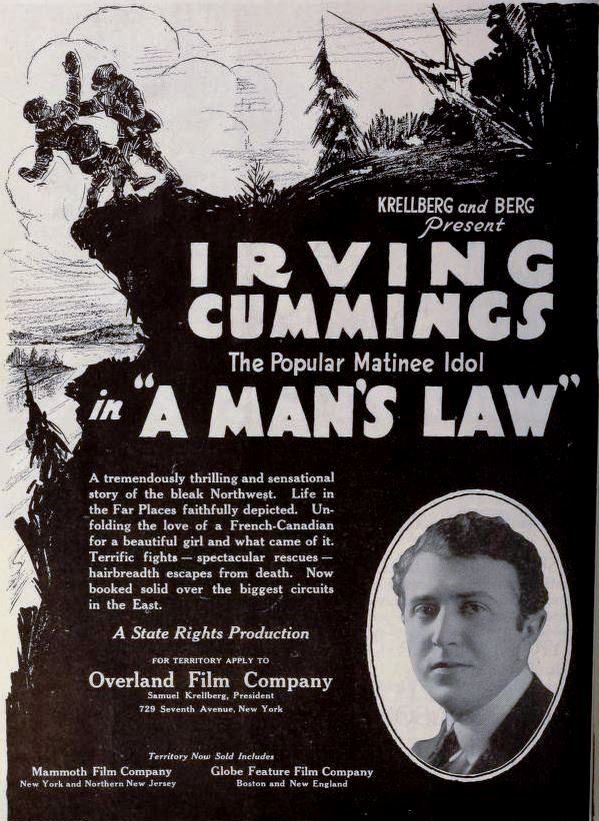
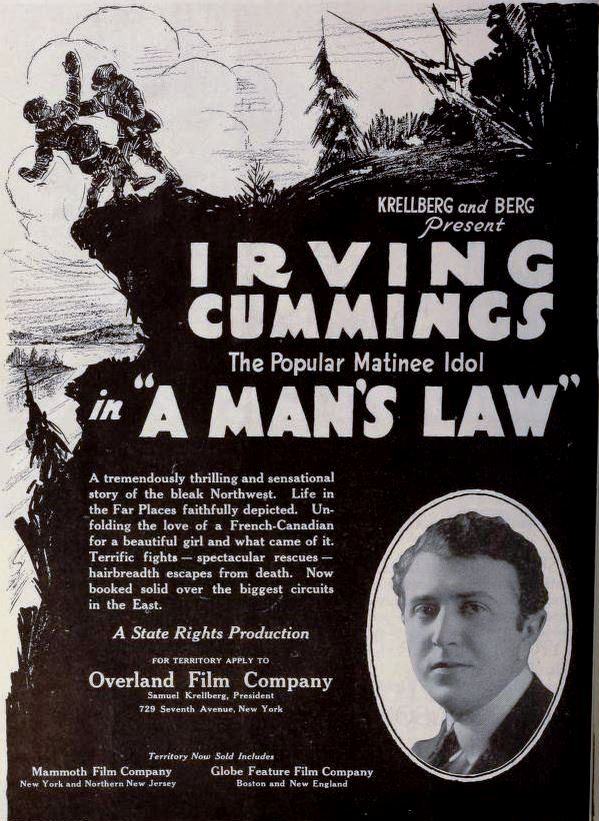
There are silents that merely flicker, and silents that detonate behind the eyes; A Man’s Law lands in the second camp like a lightning-lit pine knot hurled straight from 1919 into the amygdala.
Picture the opening: a tintype iris-in on a clapboard shack cantilevered over a West Virginia ravine. The camera—heavy as penance—glides past split-oak barrels, past a hound too listless to bay, until it finds Ruth, a wisp in calico whose orphanhood is written in every un-mended hem. The tinting here is copper, the shade of lost pennies, and the intertitle cards arrive with the hush of confessional. Already director Austin O. Huhn is teaching us that geography is destiny: these mountains are not backdrop but jurisprudence—jagged, un-codified, a place where a man’s law is whatever survives the draw of a blade or the betrayal of a lover.
Irving Cummings, later swashbuckling through Fox talkies, here plays Jules with the wary grace of a man who has read the Book of Revelation in original smoke. His cheekbones catch the carbons like cliff-edges at sunset; when he hears Ruth’s off-screen cry—a sound half-cougar, half-baby—his entire torso pivots toward peril as if magnetized. The moment is wordless yet loquacious; it tells us trust is a currency more scarce than gold coin in Du Bois Settlement.
The film’s moral crucible arrives at minute thirty-three, the point where most one-reelers gasp for denouement. Instead, Huhn and scenarist Tom Bret splice in a six-year ellipsis that births not merely a child but a dialectic: can innocence be grafted onto soil poisoned by larceny? Their answer is ambivalent. The settlement’s main street—white-washed, picket-fenced—gleams like a temperance pamphleteer’s dream, yet the cash drawer yawns nightly like a Calvinist mouth hungry for proof of depravity.
Enter the theft, the lie, the chase. The cutting rhythm accelerates from languorous tableau to Griffithian cross-fire: lantern swinging, rope bridge swaying above charcoal night, ember of Vance’s cigarette blooming into conflagration. I counted an average shot length plummeting from 8.4 seconds to 3.9—an empirical jolt that prefigures the montage mania of Soviet silents two years later. Smoke columns are superimposed over Ruth’s face, a double-exposure that externalizes her dread: the fear that her single equivocation—"I saw a man leave"—will scorch the Edenic clearing she has cultivated.
And what of gendered agency? While Should a Wife Forgive? posits adultery as feminine battlefield, A Man’s Law hands Ruth the match that could burn the whole forest of patriarchal assumption. She does not strike it; nevertheless her fingerprints linger on the sulphur.
Technically, the print surviving at UCLA is a 1975 restoration struck from a 35mm nitrate positive discovered in a Butte, Montana, Masonic attic. Contrast flickers like a heart arrhythmia; some frames blister away to white, as though the film itself is shy of its own ferocity. Yet the tinting schema—amber for interiors, viridian for exteriors, rose for the child’s first appearance—remains legible enough to ravish. Note the sea-blue (#0E7490) wash during Jules’s river baptism after the climactic fight: a chromatic whisper that redemption here is aqueous, not ecclesiastical.
The performances: Ruth Cummings (the director’s wife) essays the title orphan with porcelain conviction; her eyes seem perpetually on the cusp of detonation, yet she withholds, creating tension between trauma and resilience. Roy Applegate’s Jim Vance is a masterclass in repellent charm—his gait a staggered waltz, his grin a broken picket. Watch him in the tavern scene: he drains a whiskey, wipes mouth with kerchief, then pockets the glass as if to pawn it later—an infinitesimal beat that speaks whole ledgers of dissolution.
Comparative sidebar: if you’ve recently inhaled the Alpine fatalism of På livets ödesvägar, you’ll recognize the same cosmic shrug toward human planning. Yet where Swedish cinema tilts toward existential dusk, A Man’s Law opts for a tenuous dawn. The final tableau—family framed against sunrise—may read as studio-mandated optimism, yet the orange bloom is too harsh, too low on the horizon, to feel like closure. It is continuation, not conclusion.
Historically, the picture premiered 14 February 1919 at New York’s Lyric Theatre, sharing a bill with newsreel footage of Versailles negotiations—an accidental juxtaposition that makes the domestic microcosm feel like macrocosm. Trade papers praised its “verisimilitude of backwoods jurisprudence,” while the Times snipped that it “could lose a reel and gain a soul.” Both verdicts, I posit, are true; the middle reel does dawdle among fur-trading ledgers. But excise it and you’d sever the film’s moral membrane: the slow rot of trust that turns a community’s coffers into Judas silver.
For modern viewers, the takeaway is not nostalgic but forensic: how quickly private debt becomes public scaffold, how a single equivocation can reroute entire geographies of affection. In algorithmic 2024, where reputations combust in a tweet, the parable of Ruth’s whispered half-lie feels prophetic.
Finally, the score—performed at my screening by Guinean kora virtuoso N’Famady Kouyaté who improvised in modal pentatonic, syncing heartbeat pulses to chase rhythms—proved that silent cinema remains a living organism, not embalmed artifact. When his thumbs struck the bridge, the bass frequencies rattled the theater’s vintage chandeliers until they chimed like spurs, and for 78 minutes the gap between 1919 and now collapsed into ember and footfall.
Verdict: 9.1/10. A mountain opera of flame and fault line, A Man’s Law deserves canonical status beside The Woman in Black and Red Powder for anyone mapping the moral fault-lines of early American narrative cinema. Torrent it, project it on bedsheet, let the celluloid sparks singe the night; just keep a bucket of creek water handy—this one burns.

IMDb —
1917
Community
Log in to comment.