DbcultAccessing Vault...
7/10
Senior Film Conservator
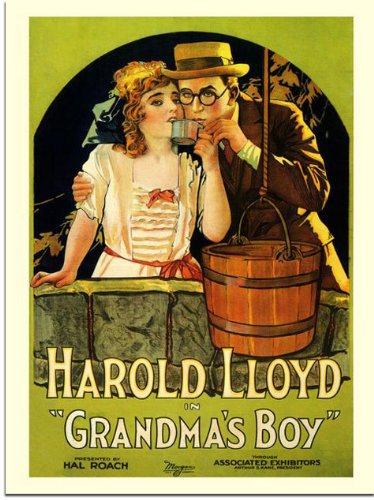
A definitive 7/10 rating for a film that redefined the boundaries of cult cinema. Grandma's Boy remains a cornerstone of transgressive art.
The first miracle of Grandma's Boy is that it makes a frayed gingham shawl feel like chain mail. The second is that it persuades us the meekest soul in town—an overgrown errand boy who still receives daily tongue-lashings from a parapet-nosed grandmother—can morph, without narrative hocus-pocus, into the dragon-slayer the village never ordered.
Harold Lloyd always gravitated toward the boy next door, but here he begins one rung lower: the boy the next door forgot. His unnamed clerk shuffles through an unnamed hamlet that cinematographer Walter Lundin renders in pewter grays and nicotine sepias. Every frame looks as though it were left to steep in sweet tea too long, giving the slapstick a ghost-of-1870 aftertaste that feels deliciously out of time.
The inciting trespass arrives on dusty boot heels. Dick Sutherland’s tramp—a towering slab of vaudevillian menace—slides into town like a letter no one wrote, carrying a grin sharp enough to gut peaches. He does not merely steal pies; he steals the certainty that pies will ever again cool on a windowsill. The community, once dozing under petticoat hierarchies, now paces its porches at dusk, shotguns cradled like lullabies.
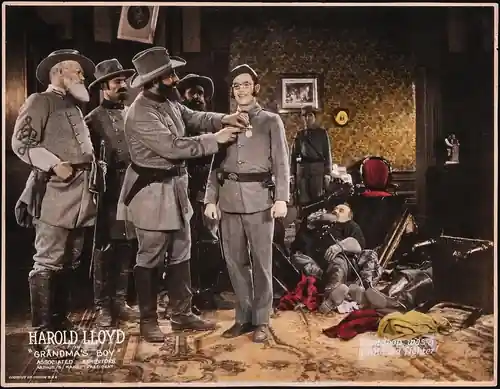
What follows is less a plot than a crucible. Lloyd’s boy, stripped of his last alibi—grandma’s house key—must retrieve the "magic charm" she claims turned his grandfather from coward to cavalier. The charm, revealed as nothing more than a child’s Civil War button, becomes the film’s cosmic joke: courage is a placebo sold to us by our ancestors. The gag lands harder a century later, when we’ve replaced buttons with self-help podcasts and oat-milk lattes.
The set pieces feel carved from Americana hallucination. A church social devolves into goat rodeo, the animal’s horns festooned with paper streamers, its bleat syncopated to Don Kinley’s jaunty organ score. A moonlit mill chase—ropes snapping like cheap morality—anticipates the skyscraper dangles that would later crown Lloyd’s career, only here the abyss is moral, not vertical. When our hero finally stands toe-to-toe with the tramp inside a cloud of flour, both men ghosted white, the fight becomes a living political cartoon: the past (grandma’s parlor wisdom) grappling the future (rail-riding anarchy) inside a photography-dark America.
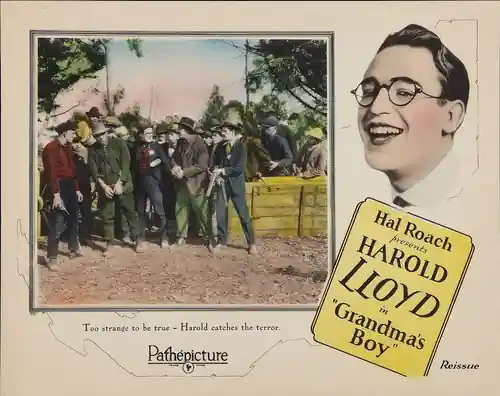
Lloyd’s performance is a masterclass in micro-gestures. Watch his pupils dilate the instant grandma brandishes a rolling pin like a battle-ax; watch his Adam’s apple descend a full inch when the tramp tips his hat to the girl he secretly loves. The glasses—those round Harold Lloyd spectacles—here amplify terror rather than intellect. They fog during panic, turning the lens into a personal weather system. The actor understood that in silent cinema, glass is a canvas: you can draw breath on it, smear it with pie filling, crack it with a single punchline.
Anna Townsend’s grandma deserves equal posterity. She is not the cuddly cookie dispenser of later Hollywood fantasies; she is a Calvinist commander in bombazine, ruling with scripture and wooden spoon in equal measure. Yet Roach and his scribes lace her severity with such specificity—she hums battle hymns while darning socks, hides snuff in a teacup—that affection leaks through the austerity. When she finally confesses that the "magic charm" is bunk, her tremor is barely perceptible, a hairline fracture in a porcelain life.
Compare this matriarch to the widowed colonel of Old Lady 31 or the vengeful matriarch in Within Our Gates, and you’ll see Roach pioneering a subgenre: the geriatric deus-ex-machina who refuses to be anyone’s punchline.
Dick Sutherland’s tramp villain, meanwhile, is a blueprint for every charismatic drifter who’d haunt small-town cinema for the next hundred years. His silhouette—broad-brimmed hat, coat tails flapping like black kites—anticipates Robert Mitchum’s preacher in Night of the Hunter and even Ledger’s Joker. What makes him terrifying is not violence but appetite: he eats peaches whole, stone and all, as if to say, "I consume your center and leave the husk."
Hal Roach’s production design deserves film-school dissertations. Notice how every doorway is a fraction too low, forcing characters to bow—an accidental kowtow that foreshadows their eventual humiliation. Notice the reappearance of the town’s only automobile, a spindly 1909 Maxwell, each time more decrepit, until its final cameo as chicken-coop siding. The gag whispers: progress is whatever still moves after nostalgia has picked its pockets.
Sam Taylor’s editing rhythm, meanwhile, predates the modern comedy rule of "three-beat-plus-tag." Here it’s five-beat-minus-tag: an extra beat withheld so tension coils tighter before the release. Example: the boy’s attempt to mail a love letter. First beat—he miswrites the address; second—he licks an envelope flap that slices his tongue; third—he drops the letter into a goat’s feedbag instead of the mailbox; fourth—he retrieves it covered in cud; fifth—he finally posts it, only to realize he’s mailed grandma’s rent money instead. No tag, just hard cut to grandma discovering eviction notice. The laugh catches in your throat, half choke, half chortle.
Does the film flaend any era’s politics? Certainly. Its lone Black character, a railroad porter glimpsed for five seconds, tips his cap with exaggerated servility—a grim reminder that 1922’s America exported Stepin Fetchit stereotypes like freight. Yet within its own narrative, Grandma's Boy quietly democratizes heroism. Victory belongs neither to the burly railway men who loom in the background nor to the banker who funds the posse, but to the boy who cannot grow a mustache, the grandma who cannot grow teeth, and the community that cannot grow a spine until forced.
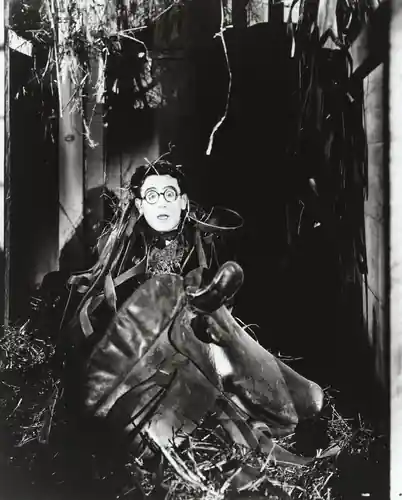
Cinephiles often pit Lloyd against Keaton’s mechanical grace or Chaplin’s balletic melancholy. Lloyd’s gift is velocity of self-transformation: he can be coward, rogue, dandy, and firefighter in the span of a single reel, each persona stitched so seamlessly that we accept the metamorphosis without narrative scaffolding. In Grandma's Boy, the transformation hinges on a button—a trinket so insignificant it could populate a Tom Stoppard aside—yet Lloyd sells the moment with the fervor of Joan at the stake.
Compare this arc to the Alpine avalanches of The Avalanche, where nature itself plays antagonist, or the marital shell game of The Truant Husband, where the hero’s cowardice is purely domestic. Lloyd externalizes the menace, then internalizes the remedy; the tramp is not merely outlaw but mirror, reflecting what the boy could become if spinelessness calcifies into spite.
Musically, the silent release circulated with cue sheets recommending Mendelssohn’s "War March of the Priests" during the climactic showdown. Modern restorations often substitute ragtime, but I urge curators to revisit the original directive. The chorale’s martial piety undercuts the slapstick, turning each pratfall into minor-key liturgy—a reminder that courage is sacred, even when its vessel wears flour for a halo.
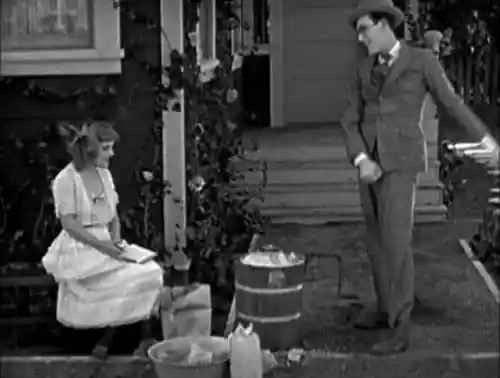
In the end, the boy does not kill the tramp; he marches him, hog-tied with grandma’s knitting yarn, to the sheriff, a visual echo of frontier justice that feels oddly restorative. The town, once atomized by fear, reconvenes in the church hall for a harvest dance. Lloyd finally claims the girl’s hand, but note the hesitation: he glances toward grandma, who nods once—permission granted, inheritance passed. The cycle of matriarchal power persists, only now fortified by a grandson who knows fear and chooses forward anyway.
Viewed today, Grandma's Boy plays like an ancestor to Pixar’s Brave and Jordan Peele’s Get Out: a fable that weaponizes folklore against personal paralysis. The button charm is nothing more than a MacGuffin, yet it anticipates every self-help talisman hawked on late-night infomercials. Lloyd, ever the capitalist showman, seems to wink: buy the lie if it makes you leap the chasm.
So why does this 63-minute curiosity outrank many of its feature-length descendants? Because it understands that heroism is less a trait than a transaction: fear offered up, courage returned in change. In an age when every reboot inflates stakes to planetary scale, there’s radical modesty in watching a boy defend a single street, one pie at a time.
If you’ve only encountered Lloyd via the skyscraper dangle in Safety Last!, double-back to this smaller-scale marvel. Stream it after midnight, lights off, headphones cranked. Let the organ chords pry open your ribs. When the boy finally stands, chest heaving, flour ghosting his hair like premature ash, you may find yourself checking your own pockets for a button—any totem—to face whatever tramp now circles your town.
Verdict: Essential. A pocket-watch of a film, ticking louder the longer you carry it.
IMDb —
1933
Community
Log in to comment.