DbcultAccessing Vault...
Cult Review
Senior Film Conservator
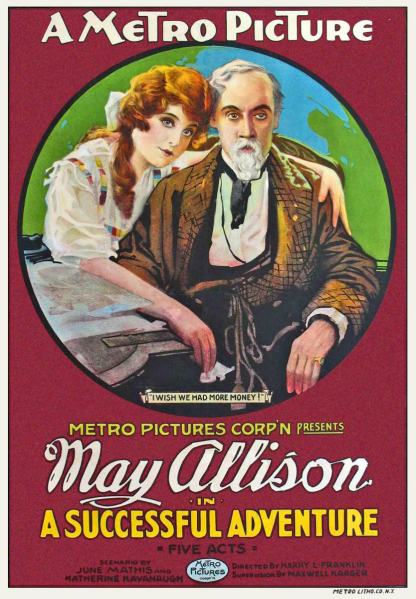
The silent era of cinema frequently grappled with the dichotomy of the American spirit: the tension between the agrarian, sentimental values of the South and the burgeoning, often ruthless, industrialism of the North. In the 1918 production A Successful Adventure, this thematic conflict is personified through the Houston brothers, whose interpersonal fallout serves as a microcosm for a nation in transition. Directed with a keen eye for social mores, the film stands as a testament to the narrative prowess of screenwriters Katharine Kavanaugh and June Mathis, the latter of whom would later become one of the most powerful figures in Hollywood history.
The film opens with a sequence that establishes the idyllic, if fragile, equilibrium of the Houston family. The performance of Frank Currier and Edward Connelly as the brothers Lionel and Daniel provides a gravitas that anchors the subsequent melodrama. When the elder Virginia chooses Daniel, the resulting fracture is not merely emotional but geographical. Lionel’s migration to the North is depicted as a soul-stripping endeavor. Unlike the thematic explorations in The Writing on the Wall, where social decay is systemic, Lionel’s decay is self-imposed—a fortress built of stock certificates and mahogany to keep out the warmth of his past.
The cinematography utilizes shadows and expansive, sterile interior sets to emphasize Lionel’s isolation. His luxurious estate is a gilded cage, a visual motif often explored in contemporary works like Money Magic. Here, wealth is not a reward but a defense mechanism. The script cleverly juxtaposes this with Daniel’s modest but emotionally rich life, setting the stage for a collision of values that only the next generation can resolve.
At the heart of the film’s second act is May Allison, who portrays the younger Virginia with a luminous vitality that cuts through the film’s darker undertones. Her decision to answer Lionel’s advertisement for a cook is a narrative device that allows the film to explore class dynamics with a light, yet incisive, touch. This trope of the high-born woman navigating the world of labor was a popular convention of the era, seen in variations within The Social Secretary. However, Allison brings a specific brand of Southern tenacity to the role that elevates it beyond mere farce.
The "cook" persona allows Virginia to observe Lionel without the baggage of their familial history. It is a brilliant psychological gambit; she feeds the man while simultaneously nourishing his starved conscience. The scenes in the kitchen, often overlooked in silent film analysis, are choreographed with a rhythmic precision that highlights the labor involved in maintaining the facade of the upper class. Allison’s performance is a masterclass in subtlety, using micro-expressions to convey her internal conflict as she falls for Perry Arnold, Lionel’s adopted son, played with earnest charm by Harry Hilliard.
No melodrama of this period would be complete without a formidable antagonist, and Christine Mayo’s Rose Mason delivers in spades. Rose represents the predatory nature of the city, a sharp contrast to Virginia’s provincial sincerity. Her objective—the theft of Lionel’s secret stock market papers—introduces a proto-noir element to the story. This infusion of corporate espionage adds a layer of tension that prevents the film from descending into pure sentimentality. In many ways, Rose is the mirror image of Lionel’s younger self: driven by acquisition at the expense of human connection.
The rivalry between Virginia and Rose is not merely over the affections of Perry, but over the soul of the Houston household. While Virginia seeks to rebuild the family, Rose seeks to dismantle it for profit. This dynamic echoes the moral complexities found in The Foolish Virgin, where the protagonist must navigate a world of deception to find her own truth. The eventual unmasking of Rose is handled with a cinematic flair that utilizes the era's fondness for dramatic reveals and physical theater.
From a technical standpoint, A Successful Adventure benefits from the sophisticated editing techniques that were becoming standard by 1918. The cross-cutting between Daniel’s humble abode and Lionel’s mansion builds a sense of inevitable convergence. The lighting, particularly in the scenes involving the stolen papers, foreshadows the expressionistic tendencies that would soon dominate European cinema in works like Kreutzer Sonata.
The film also operates as a subtle piece of propaganda for family unity during a time of global upheaval. Released in the final year of World War I, its emphasis on reconciliation and the healing of old wounds likely resonated deeply with an audience weary of conflict. While not overtly political like The Battle Cry of Peace or Civilization, it advocates for a domestic peace that serves as the foundation for a stable society. The script by June Mathis ensures that the pacing remains brisk, avoiding the stagnation that often plagued long-form silent dramas.
When comparing this film to others of its ilk, such as Suzanne or Stolen Goods, one finds that A Successful Adventure possesses a unique warmth. It lacks the cynicism found in Winner Takes All, opting instead for a narrative arc that rewards vulnerability. The character of the "rich aunt" who triggers the plot is a classic deus ex machina, yet it feels earned because it forces the characters to confront the pride that has stagnated their lives for twenty years.
The film’s resolution, wherein Virginia reunites her father and uncle, is a cathartic moment of cinematic symmetry. The use of the name "Virginia" for both the lost love and the daughter who restores that love is a poetic touch that underscores the cyclical nature of time and forgiveness. In the broader context of silent cinema, this film occupies a space similar to The Voice of Love, prioritizing emotional resonance over avant-garde experimentation.
To view A Successful Adventure today is to witness the birth of the modern family dramedy. It balances stakes—both financial and romantic—with a deftness that many contemporary films struggle to emulate. The ensemble cast, including Dion Muse and Howard Oppenheim, provide a rich tapestry of supporting performances that flesh out the world beyond the central Houston conflict. The film’s exploration of the "Southern beauty" archetype, while perhaps dated in its gender politics, is handled with a degree of agency for the female lead that is refreshing for 1918.
In conclusion, the film is far more than a simple story of a girl winning a boy and a family finding peace. It is an intricate examination of how the pursuit of wealth can ossify the heart, and how the courageous act of "serving" others—symbolized by Virginia’s stint as a cook—can be the ultimate catalyst for liberation. It shares the thematic DNA of Le nabab in its critique of the nouveau riche, yet it maintains an optimistic spirit that is uniquely American. For those interested in the evolution of narrative structure in silent film, or for those who simply appreciate a well-told story of redemption, A Successful Adventure remains a vital and engaging piece of cinema history. It reminds us that the greatest adventures are not those found in the acquisition of gold, but in the arduous journey back to those we have lost.
Note: For further exploration of similar themes of familial strife and social climbing, readers are encouraged to view The Eternal Strife and Blodets röst.
IMDb —
1916
Community
Log in to comment.