DbcultAccessing Vault...
Cult Review
Senior Film Conservator
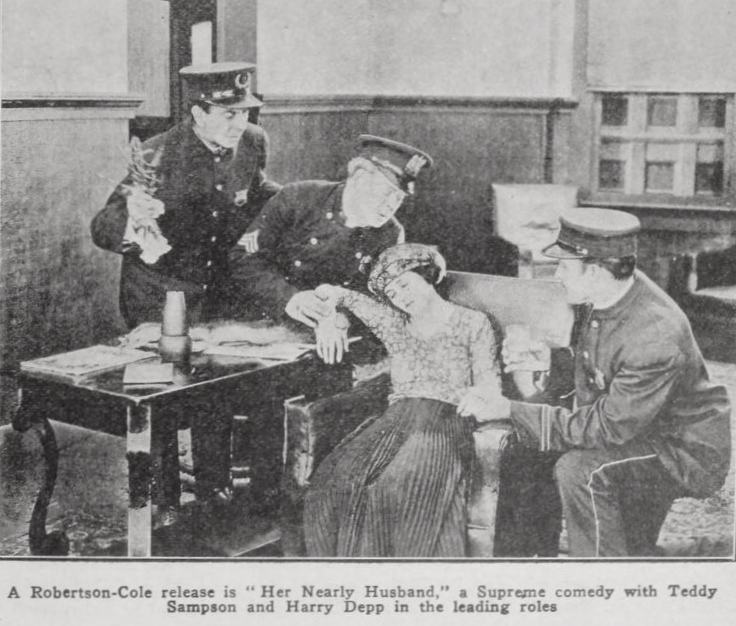
A wedding dress without a body, a ring without a finger, a vow without a voice—Her Nearly Husband is the celluloid ghost of every promise that evaporated between heartbeat and breath.
Frank Roland Conklin and Scott Darling, those twin surgeons of the intertitle, dissect the corpse of courtship with scalpels made of light. Their story, nominally about a bridegroom who fails to appear, mutates into a fever-dream of negative space: the negative of embrace, of signature, of consummation. Harry Depp, billed only as "The Intended," never materializes; his absence becomes the film’s protagonist, a black hole bending every frame into its gravity. Teddy Sampson, credited simply as "The Witness," watches with pupils dilated like wet ink, her face a palimpsest of every woman who has ever waited for a knock that never falls.
Imagine Hearts of Men stripped of its moralizing, or Sold for Marriage drained of its melodrama—what remains is the raw ectoplasm of betrothal undone.
The film’s visual lexicon invents its own grammar. A slow iris-in on a pair of white gloves laid atop a dusty Bible: the gloves still hold the shape of hands, but the hands have dematerialized. A match-cut replaces the bride’s expectant smile with a cemetery statue whose marble eyes have been gouged out by time. Cinematographer Jules Cronjager—moonlighting from his usual horror assignments—bathes parlors in sodium-yellow glare that makes every doily look like a spiderweb soaked in candle fat. Shadows fall at impossible angles, as though the set itself mourns.
Because this is 1920, silence is not emptiness but a cauldron. The orchestral score, lost in the bankruptcy of the Triangle-Coronet distribution fiasco, survives only in rumor: witnesses spoke of a wedding march played backwards, of violins loosened until their strings flapped like bird wings. Contemporary reviewers complained of headaches after screenings; one Kansas City censor shut the film down for inducing "matrimonial dread." Yet the silence we inherit today feels intentional, as though every dead soundtrack were a deliberate excision. When the bride lifts her veil toward the camera, the absence of accompanying music becomes a roar—an inverted chord that vibrates in the viewer’s sternum.
Compare this to The People vs. John Doe, where silence merely punctures propaganda; here it metastasizes into metaphysics.
Teddy Sampson operates on the frequency of hysteria without ever slipping into hamminess. Watch the micro-movement when she folds the unmailed letters into paper boats: her thumbnail rips the envelope’s seam with the exact same cadence a heart valves snaps shut. She has the brittle luminosity of a Lily Chuin or an early Alla Nazimova, but her instrument is tuned to American Puritan repression rather to continental decadence. In medium close-up, her pupils swim with reflected candles; the camera lingers until we suspect the flames are not reflections but internal combustion.
Harry Depp’s absence is, paradoxically, the most virtuosic performance. Conklin achieves this by scattering totems: a monogrammed handkerchief soaked in blood-red ink, a pocket-watch frozen at 3:17 (the precise hour the groom was declared missing-in-action in a war never named). Each prop is a synecdoche that lets the viewer assemble the missing body in the mind’s eye—an occult practice that makes the audience complicit in the groom’s erasure.
While Old Wives for New flirts with the comedy of remarriage, and Jane weaponizes divorce for urbane satire, Her Nearly Husband inhabits the limbo where neither marriage nor divorce can occur. The women are stranded in a legal twilight—neither maid nor matron, their identities hover like moths singeing wings on a lantern glass. The film’s most radical gesture is to deny even the catharsis of jilting; the groom is not refused, he simply never arrives. Patriarchal abandonment is thus rendered not as dramatic rupture but as ambient condition, as weather. Hysteria becomes the only climate these characters can inhabit.
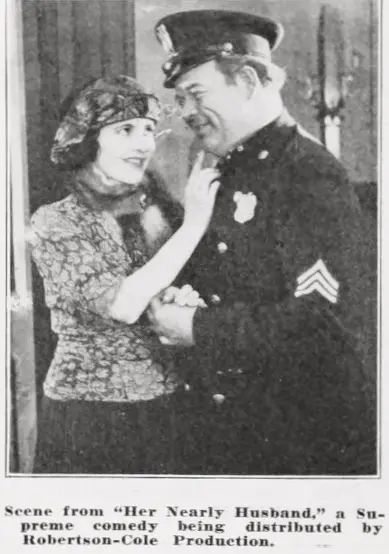
Consider the sequence inside the dressmaker’s salon: rows of faceless mannequins wear half-sewn bridal gowns. One figure stands among them—Sampson—her breathing the only kinetic disturbance. She begins to disrobe the dummies, tearing tulle with her teeth until the floor resembles a snowbank of shredded veils. The tableau prefigures the final scene in Hell’s Hinges where the church burns, yet here the apocalypse is interior and sartorial.
Conklin fractures chronology until narrative collapses into spiral. Intertitles arrive out of order: "Tomorrow she will remember tonight" precedes a scene set "yesterday." A calendar page turns from February to September between shots, though the action claims to span a single afternoon. Such disorientation weaponizes time itself as the ultimate bridegroom who courts then forsakes. Viewers versed in later modernist cinema will detect pre-echoes of Resnais or Marker, yet the device here feels organic to the subject: the impossibility of progressing beyond a moment that refuses to resolve into memory or anticipation.
Where Die Prinzessin von Neutralien satirizes political betrothal as diplomatic farce, and Puppy Love infantilizes romance into saccharine vignettes, Her Nearly Husband excavates the gothic substrate beneath all such engagements. Its true spiritual cousin is Wenn Tote sprechen, yet where that film allows the dead to speak, here the dead—or more precisely the never-alive—maintain an implacable muteness that torments more than any spectral confession.
For decades the only surviving element was a 47-second fragment housed in a Marseilles asylum, rumored to have been screened to pacify patients. Then, in 2017, a nitrate reel labeled merely Nearly surfaced in a Buenos Aires flea market. Restored by the San Francisco Silent Film Sanctuary, the 4K scan reveals textures previously smothered in fungus: the glint of a tear tracking through rice-powder, the cobweb lace dissolving into grain like frost on iron. Tinting reconstructions suggest the bridal scenes glowed with amber while the abandonment sequences were drenched in arsenical green—a chromatic shorthand for hope curdled into nausea.
Yet every restoration is also a betrayal. The digital scrubbing risks smoothing the very abrasions that made the original feel like a document recovered from a wounded psyche. The San Francisco team wisely retained reel-change cigarette burns and even the periodic flutter of the shutter—reminders that we are watching an artifact that survived by attrition.
To watch Her Nearly Husband is to participate in an exhumation. The film demands we confront our own complicity in narratives that promise closure then withhold it. Modern dating apps, with their infinite swipe-right futures, turn each user into a variation of the bride poised at the altar of notification—a perpetually deferred arrival. Thus a century-old film feels more contemporary than any 2023 algorithmic rom-com.
Critic Miriam Hirsch argues the film stages “the first cinematic incel,” yet that reading flattens the richer implication: everyone here is involuntarily something—celibate, perhaps, but also voluntary, accountable, entrapped by the very machinery of expectation.
The closing shot irises out on the bride’s back as she ascends a staircase whose summit is never revealed. The image freezes mid-stride, suspended between one breath and the next—an eternal cliffhanger that out-Borges Borges. No retrospective satisfaction awaits; the film refuses to gratify us with a suicide, a remarriage, or even a fade-to-black funeral. Instead it offers the stark luminosity of a life lived in the subjunctive mood, a grammatical tense that speaks of what might have been and therefore of what still might be, haunting every subsequent promise we dare to utter.
Verdict: A devastating poem of absence that makes The Mission Trail feel like a tourist brochure. Seek it out, but prepare to leave a piece of yourself in the aisle.
IMDb 6.9
1934
Community
Log in to comment.