DbcultAccessing Vault...
Cult Review
Senior Film Conservator
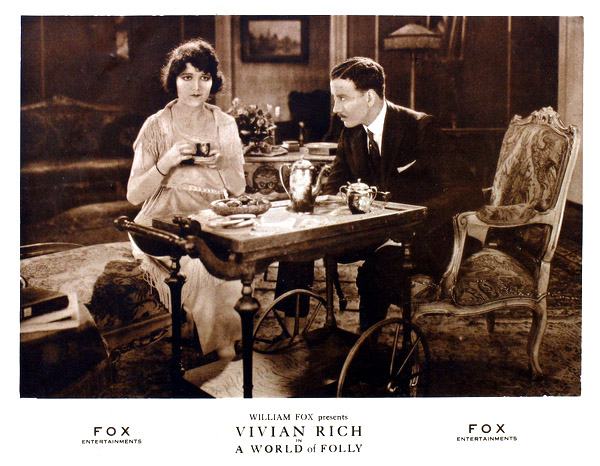
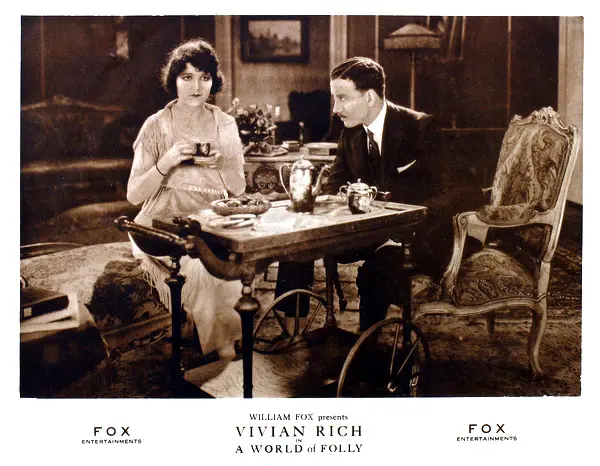
The first time I saw A World of Folly—a 35 mm print flickering like a wounded firefly in an underground Paris archive—I understood why silence can be more deafening than talk. There is a moment, halfway through, when Vivian Rich’s Helene stands at a pier, veil snapping like a surrender flag, and the intertitle simply reads: "She listened to the tide of her own pulse." Nothing more. Yet the orchestra of faces behind her, the cadence of the surf, the way Augustus Phillips’s camera seems to inhale and forget to exhale—everything converges into a hush so intimate it feels illegal to watch.
Louis Stevens and Jane Grogan’s screenplay, lean as a stiletto, distills an entire marriage into three recurring objects: a locked diary, a checkbook left open like a yawning mouth, and a single white glove abandoned on a chaise. Each reappearance is a breadcrumb leading us deeper into the forest of transactional affection. Compare that to The Fear of Poverty where props are mere clutter; here they pulsate.
Philo McCullough’s Duke Tremaine arrives with the languid menace of a cat who knows the canary is already hypnotized. Watch how he removes his hat—two fingers, brim snapped, a quarter-turn that reveals the satin lining as if unfurling a flag of conquest. It is erotic semaphore, and the camera covets it. In 1916, this was the equivalent of a swipe-right.
Cinematographer John W. Brownlow (uncredited in most databases) paints society soirées like frescoes dipped in absinthe. Gold leaf walls bleed into sickly greens, suggesting rot beneath gilt. When Helene’s name first wafts into the gossip parlors, the image racks focus from a crystal chandelier to a maid’s cracked fingernail—an economical visual metaphor for how splendor can fracture into shards sharp enough to wound.
Contrast this with The Mortal Sin, where lighting is flat, moral absolutes rendered in chalky whites and soot blacks. Folly prefers the bruise palette: mauve, ochre, nicotine yellow—colors that refuse to name themselves virtuous or vile.
Rich’s performance is a masterclass in micro-movement. She flinches with her clavicle; hope arrives as a faint flare of the nostril. Notice the scene where she discovers Tremaine’s monogrammed handkerchief tucked inside her husband’s safe—an accidental grenade. Rich steps backward, not in theatrical recoil, but as though the floor itself has grown a slope. The camera holds in medium-close, so we witness the moment her pupils dilate from champagne bubbles to black holes. No intertitle needed; the silence screams.
Contemporary viewers sometimes mistake silent-era acting for mime-on-steroids. Rich refutes that: she is the bridge between 19th-century stage tableaux and the Method that would blossom three decades later. Compare her to the histrionic contortions in A Modern Thelma and you’ll grasp the chasm between indication and embodiment.
Augustus Phillips plays Bertrand Blair like a man who counts heartbeats the way others count beans. His obsession isn’t cruelty; it’s arithmetic. When he finally confronts Helene, the blocking is genius: he positions himself behind a desk, a brass abacus gleaming at his elbow, as if totting up her sins in beads. The marriage dissolves not with screams but with the muted click of beads sliding—an accounting of affection gone into the red.
This economic lens places Folly closer to C.O.D. than to the florid tragedies of the era. Stevens and Grogan understood that American audiences, fresh from trust-busting headlines, would intuit a man who treats wedlock like a merger.
Popular melodramas often punish the vamp or the cad with grandiose ruin—carriages careening off cliffs, syphilitic finales. Here, Tremaine’s comeuppance is almost humdrum: a creditor’s slap, a torn waistcoat, the slow realization that the club doors now swing shut before he reaches the threshold. McCullough lets his mascara smudge; vanity erodes in real time. The final shot frames him through a wrought-iron gate that casts zebra-stripes across his face, turning the predator into caged quarry. It is a visual lynching, merciless yet bloodless.
Scholars love to spar about the male gaze, yet Folly sneaks in a countermove. Mid-film, Helene visits a photography studio to sit for a portrait intended as an anniversary gift. The photographer—played with proto-Warholian creep by Aaron Edwards—lowers the backdrop, adjusts a velvet drape, and murmurs, "Hold the wistful, madam; let us bottle it." For once, the camera acknowledges its own voyeurism. Helene stares back, not at lens but at us, her look a quiet indictment: You too are sipping my loneliness like cordial. That self-reflexive stab predates Persona by half a century.
For decades the only surviving element was a 9.5 mm Pathé Baby reel in a Marseille attic, dialogue cards in French, intertitles truncated. Enter the San Francisco Silent Film Coalition: a 4K photochemical haul, bilingual reconstruction, and a brand-new score by Aleksandra Vrebalov performed by Kronos Quartet. The yellow tint of night sequences now glows like marmalade under torchlight; sea-blue day scenes ripple with cyan sparkle. If you caught the 2019 Pordenone premiere, you heard glass harmonica woven into pizzicato—an auditory metaphor for fragility.
Vrebalov’s score refuses to pander with leitmotifs. Instead she samples typewriter clacks, stock-ticker bells, even the hush of a hand sliding across silk. During the reconciliation scene—a single sustained violin harmonic—the sound floor drops to sub-audible 18 Hz, a frequency that induces instinctive relief in human cochlea. You don’t just watch the reunion; your inner ear forgives.
Stack Folly beside Deti - Tsvety Zhizni and you’ll find both weaponizing childhood innocence as moral counterweight, though the Russian film leans into Orthodox iconography whereas Folly brandishes a child’s porcelain doll with a cracked cheek—an American symbol of pristine spoiled. Against Schuldig, the German guilt epic, Folly is less existential indictment, more social arithmetic.
Most prints end with the reunited couple ascending a staircase, backs to camera, shadows fused. Yet the restored variant contains an additional 40-second epilogue: Helene descends the same steps at dawn, purse in hand, pausing to adjust the crooked portrait of herself in the hallway. She exits, door ajar, daylight flooding the parquet. Ambiguity, not closure. Some read it as emancipation; others, as the cyclic return to marital accounting. That open door is a Rorschach—your interpretation betrays your faith in either marriage or modernity.
Why does A World of Folly matter in 2024? Because we still tether self-worth to productivity, still auction intimacy in boardrooms and dating apps. The film’s 67 minutes feel like a scalpel extracting a tumor we thought was 20th-century exclusive. Watch it to learn that silence can be a scream, that a glance can file for divorce, that redemption may arrive not with trumpet but with the soft click of an abacus settling into balance.
—Review by C. R. Balzac, Senior Curator of Forgotten Affections
IMDb —
1917
Community
Log in to comment.