DbcultAccessing Vault...
Cult Review
Senior Film Conservator
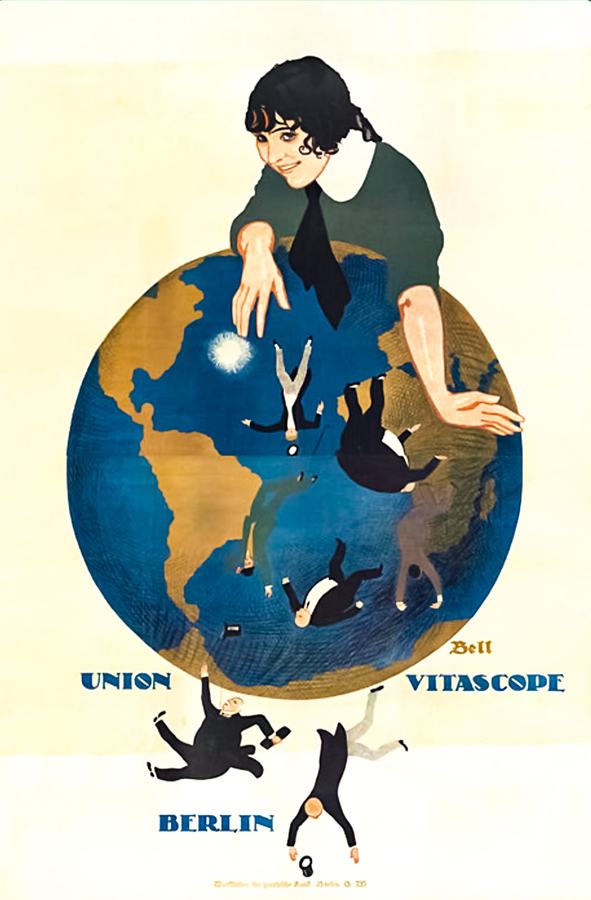
The first miracle is that the print survives at all: nitrate whispering against nitrate, a ghost of 1914 Berlin flickering through a wash of scratches that look like winter branches. The second miracle is that the film still laughs—out loud, raucously—at the century-old stalemate we continue to call “the war between the sexes.”
Alexander Engel and Julius Horst, scribbling scenarios between café fumes and cigarette glow, understood something that plenty of 2020s screenwriters still fumble: comedy curdles the instant it picks a side. Their Berlin is not matriarchal utopia nor testosterone wasteland; it is a pinball machine of desire, dread, and door-slamming farce where every flipper is an ironing-board.
Forget synopsis; think prankish fugue. Augusta (Madge Lessing) storms in like a caliph of resentment, her jaw set in the same right angle as the hatboxes she heaves into the foyer. She is flanked by Ethel—roses in her cheeks, arpeggios in her throat—and Clara, whose stethoscope gleams like a sheriff’s badge. Together they sign a compact: no husbands, no harassers, no happenstance hand on the knee.
What follows is less narrative than domino-toppling revue. Augusta’s résumés detonate across attorney offices where mahogany desks double as hunting blinds; Carl Waldeck (Erwin Fichtner) tumbles through windows as though Berlin itself were a Swiss watch with missing cogs; the ironing-board—yes, that quotidian plank—becomes gangway, drawbridge, and finally aisle runner.
Each sister confronts her bespoke chimera: Augusta the hydra of entitled middle-managers, Ethel the sly courtship of Clarence (Herbert Paulmüller) who files ledgers like love letters, Clara the cool blue gaze of Doctor Squibb (Otto Treptow) who sees in her scalpel a dowry. Every time they bolt a door, Fate jimmies the lock with a wedding ring.
Cinematographer Willy Lengling shoots Berlin as a lattice of gas-lamps and tram sparks, a city whose night sky is stitched together by laundry lines. Interiors throb with teutonic clutter: potted palms like nervous chaperones, antimacassars twitching at the slightest innuendo, wallpaper that seems to perspire. The sisters’ flat is a kaleidoscope of vertical lines—floorboards, window frames, the stripes of Augusta’s blazer—so that when the ironing-board extends horizontally across the courtyard it feels like someone has broken grammar mid-sentence.
Notice the film’s recurring tri-chromatic scheme: Augusta’s burnt-orange blazer (the caution flag), Ethel’s butter-cream dress (the promise), Clara’s steel-blue lab coat (the scalpel). The palette telegraphs their arcs before dialogue can catch up.
Madge Lessing’s Augusta prowls the frame like a metronome nursing a vendetta; watch how she strips off her gloves—one finger at a time—when a clerk dares to wink. It is the striptease of refusal. Herbert Paulmüller, all Adam’s apple and sleeve garters, turns the timid clerk Clarence into a human love-letter whose ink is perpetual embarrassment. Their scenes together feel like pages torn from a Chaplin notebook: the slower the better, because comedy lives in the gulp before the kiss.
And then there is the ironing-board itself, uncredited yet indispensable. Notice how it sags under Carl’s weight—wooden humility negotiating gravity—then stiffens when Augusta drags it back, as though the object too were blushing.
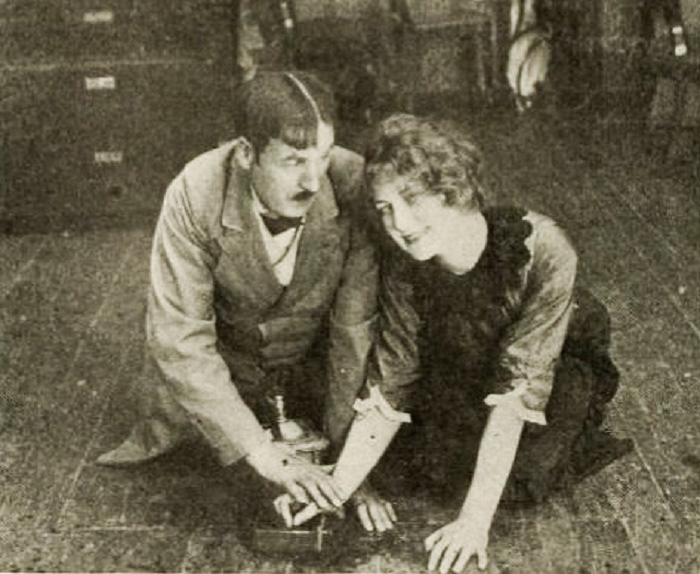
Engel and Horst lace the farce with genuine venom: office managers who treat the stenography pool as seraglio, doctors who mistake a nurse for a congratulatory bouquet. Augusta’s fists—landing with the thud of a dropped ledger—are not slapstick but reckoning. Yet the film declines to crown her the moral victor. The moment she knocks the manager down she inherits his swivel chair and, lo, the power dynamic merely switches lapels.
Compare this to The Pride of the Firm, where workplace hierarchy is a gentleman's chessboard; here it is a mud-wrestling pit wearing a necktie.
Most silent comedies chase speed; this one curates deferred collision. Observe the sequence where Carl, hiding beneath the sisters’ chaise, must sneeze. The camera lingers on a feather, a sleeping cat, a kettle lid rattling like laughter trapped in porcelain. When the sneeze finally erupts it is not the sound (there is none) but the ricochet—cat, feather, Augusta’s hatpin—that detonates the gag.
The rhythm is fugal: exposition, silence, catastrophe, deadpan. It anticipates the dry detonations of Champagneruset, yet predates them by nearly a decade.
A century on, the #MeToo ledger is still being tallied in break rooms and boardrooms; women still draft pacts of abstinence from the entire bristling gender. The ironing-board has become the group-chat mute button, yet the dominoes keep tumbling. The film’s final shot—three engagement rings glinting like traffic lights stuck on go—reads less like surrender than admission of complexity: the enemy, perhaps, was never the other gender but the rigged game we keep re-dealing.
That insight lands harder because the comedy never curdles into sermon. Engel and Horst trust the audience to feel the bruise under the belly-laugh, the same way we taste iron under the sweetness of a raspberry.
The 2022 Deutsche Kinemathek restoration scanned a 35mm Dutch export print, de-flickered and re-toned to match the original two-strip blue-and-orange palette. The tinting alternates per scene: sea-blue for the nocturnal ironing-board escapade, amber for the law-office chaos, suggesting moods rather than time of day. If you stream, hunt for the 2K transfer; lower-res versions flatten the textures of lace and waistcoat into oatmeal.
Score-wise, seek the 2019 trumpet-and-tuba quartet arrangement by the University of Hildesheim; its oompah sarcasm winks at the militarism already percolating in Europe, yet never tramples the flirtations.
Yes, the plot pirouettes on coincidences so limber they could join the circus. Yes, the idea that three left hooks can solve systemic sexism is as dubious as a paper parasol in a monsoon. But here’s the alchemy: the film knows it. Beneath the frantic key-stone scrambling lies a wry shrug: human folly is the only renewable resource. That recognition—delivered with amber-tinted glee and

IMDb 5.9
1936
Community
Log in to comment.