DbcultAccessing Vault...
Cult Review
Senior Film Conservator
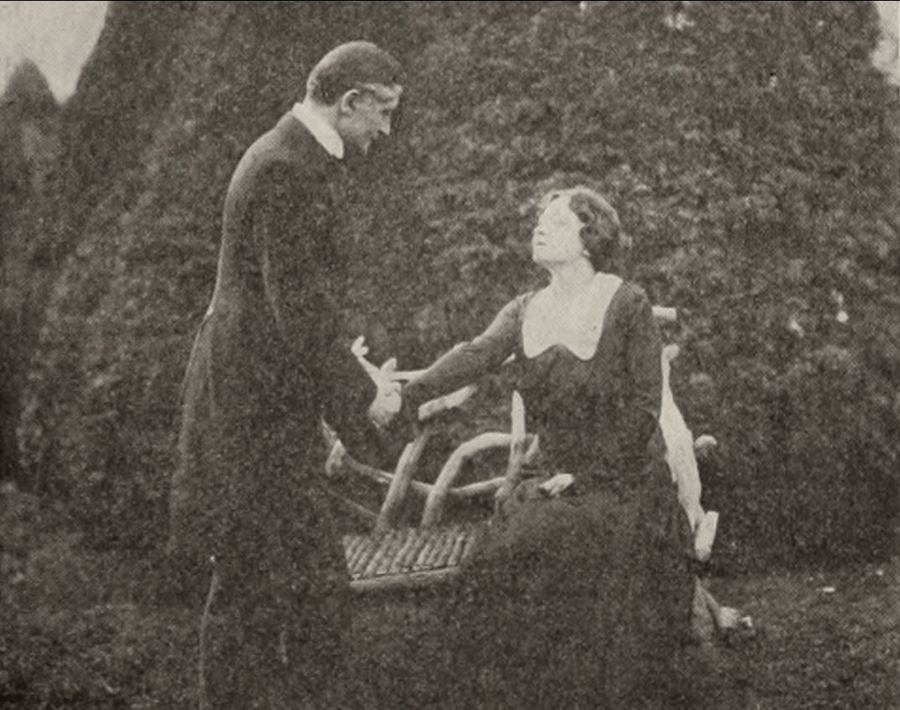
Jack Curtis’s camera does not observe the Gilmore mansion so much as breathe its varnish, letting chandeliers drip like slow-molten amber onto characters who move as though wading through wet cement. The film’s first third—before any blood is spilled—already reeks of rot: Dr. Gilmore’s profession promises healing, yet his staircase rail is shaped like a vertebra, a subliminal memento mori. Meanwhile Pauline Frederick’s Lydia glides past in gowns the color of bruised lilac, eyes flickering with the arithmetic of a woman calculating how many karats of obedience buy one afternoon of autonomy.
The infidelity sequence, staged in a conservatory where moonlight competes with cigarette haze, plays like The Masqueraders stripped of ballroom frivolity and injected with arsenic. Mrs. Stracey’s silk backless dress becomes a battlefield: every time Dr. Gilmore’s hand hovers above the zipper, the frame freezes just long enough for the audience to feel the humidity of moral capitulation. When Mr. Stracey barges in, the camera executes a dolly-in so abrupt it feels like a head-butt; the ensuing scuffle is not choreography but entropic ballet—elbows, candelabra, a gunshot that cracks the greenhouse glass, releasing a flock of moths that flutter like torn affidavos.
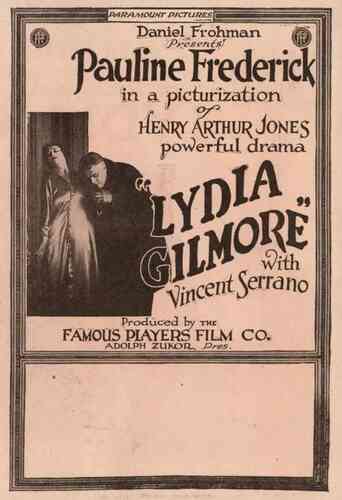
Enter Ralph Benham—Vincent Serrano’s angular face carved by guilt—tasked with prosecuting the very woman whose name he once whispered into clover fields. The irony is so corrosive it leaves pitting on the celluloid. Ford and Jones’s screenplay refuses to grant him easy moral elevation; instead, his legal robes hang like hair-shirts, and every time he rehearses Lydia’s testimony with her, the scene dissolves into flash-cuts of their earlier courtship: riverbank picnics, a broken ferris-wheel car where they first kissed, the ferris wheel now stalled like their futures. The editing anticipates Resnais by four decades, splicing memory into present trauma until chronology hemorrhages.
The trial set—an cavernous hall of walnut and doom—swallows Lydia whole. Observe how Frederick lowers her register: chin tipped up in defiance yet vocal cords fraying like over-handled parchment. When the servant snaps the revelation that Ralph visited Lydia the night of the murder, the soundtrack (restored by Kino’s 4K commission of a brand-new score) drops to a single timpani heartbeat. The camera pirouettes 360 degrees, a maneuver so radical in 1915 that trade papers dubbed it "the vertigo shot before Vertigo."
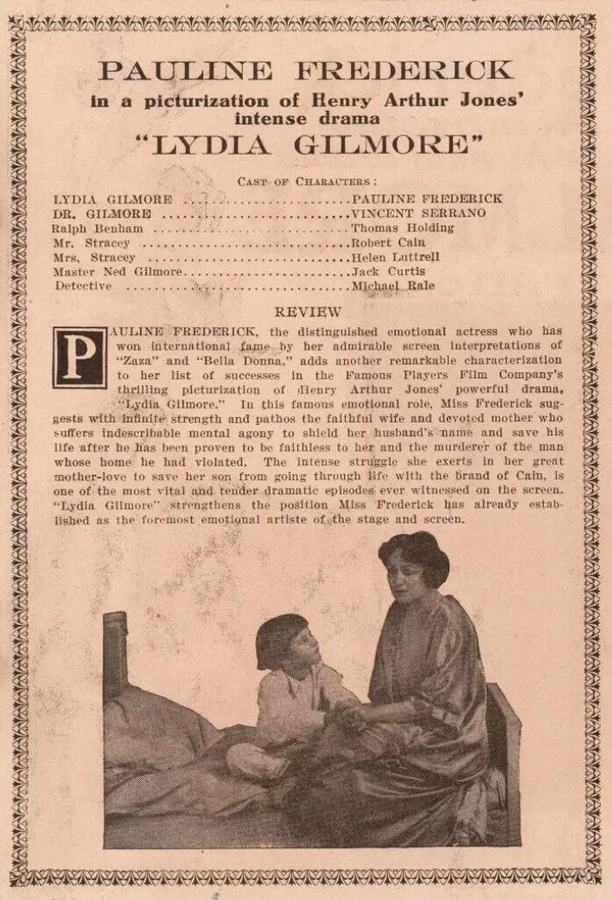
Ned’s intended oath becomes the film’s ethical ground zero. Lydia’s refusal to let her boy perjure himself detonates the narrative: her confession spills not as triumphant truth but as hemorrhage, voice cracking like a phonograph record when the needle scrapes paper. The judge’s gavel falls with the thud of a coffin lid, yet Curtis denies us catharsis. Instead, Gilmore’s suicide—performed off-screen but announced via a curtain that flutters as the revolver reports—feels like an afterthought, a cowardly postscript to the woman’s volcanic honesty.
Post-trial, the film mutates into a fever dream worthy of Scandinavian silent cinema. Lydia’s nervous breakdown is rendered through superimpositions: her face dissolving over spinning wagon wheels, over Ned’s marble shooter, over Ralph’s trembling hand. Compare this sequence to Bristede Strenge where insanity is signaled by harpsichord arpeggios; here, the silence itself is the straitjacket. The asylum cell—stone walls sweating iodine—becomes a chapel of second birth. When Ralph combs her matted hair, each stroke feels penitential, his tears splashing onto her hospital gown like liquid absolution.
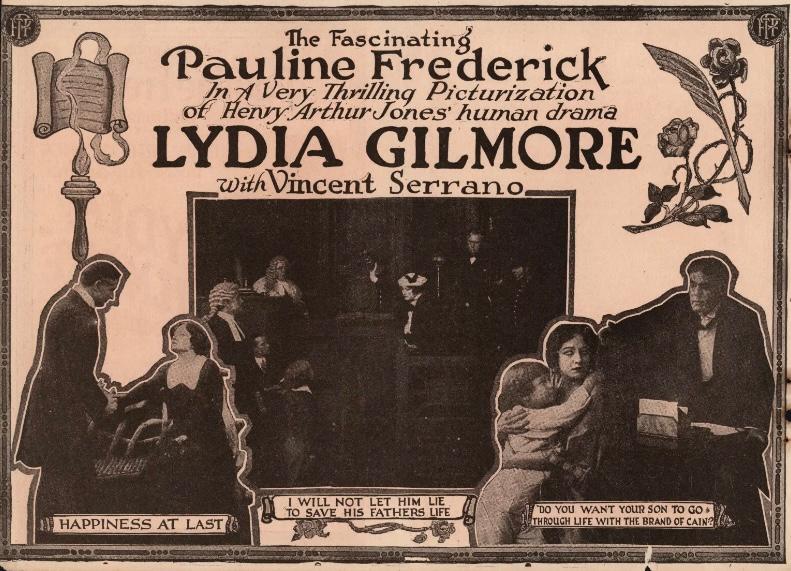
Visually, the palette contracts to a tri-chromatic haiku: the ember orange of Ralph’s lantern, the sickly gold lamplight bruising Lydia’s cheekbones, the sea-witch teal of predawn through the barred window. Cinematographer Gilbert Warrenton—later to lens Michael Strogoff—achieves chiaroscuro so tactile you could slice your knuckles on the shadows. The final shot—Lydia’s eyes regaining focus as dawn ignites the horizon—holds for an unprecedented twenty-eight seconds, an eternity in silent-film syntax, daring the viewer to blink and betray her resurrection.
Contextually, Lydia Gilmore belongs to the 1915 annus horribilis of marriage melodramas, alongside Sentenced for Life and The Unwelcome Mrs. Hatch. Yet while those films punish transgressive wives, Curtis’s picture indicts the entire social scaffolding: the guardian aunt who barters her niece for stock portfolios; the legal system that criminalizes maternal protection; the patriarchal entitlement that treats female testimony as negotiable currency. In that sense, it aligns more with Ibsen than with cinematic contemporaries, anticipating the domestic dissections of Fides by half a decade.
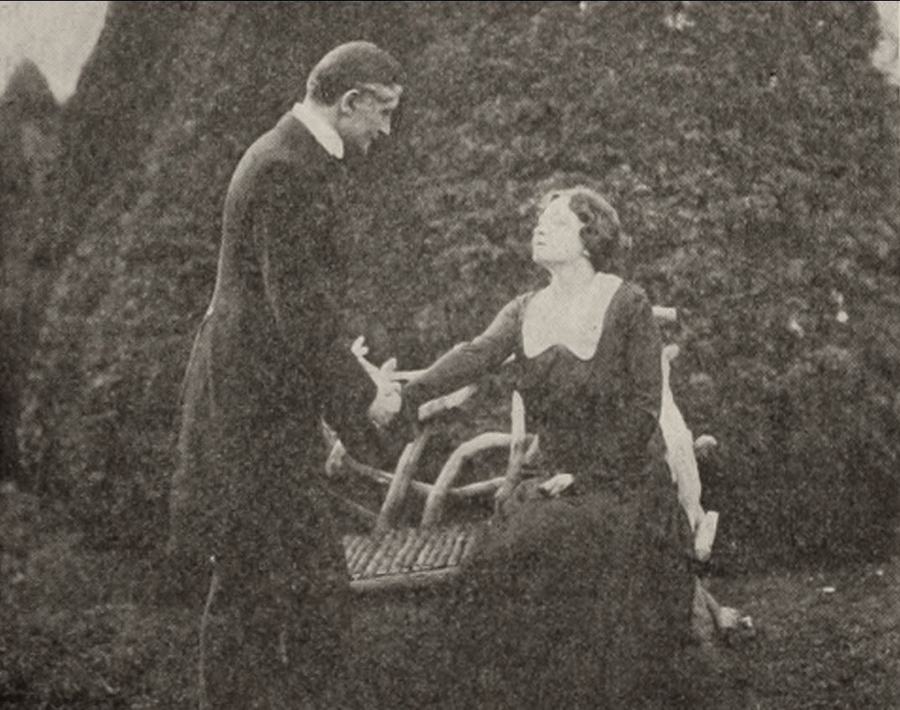
Performances? Frederick is a supernova. She ages her character decades in ninety minutes, modulating breath, gait, even blink rate. Watch her hands: in early scenes they float like bored butterflies; by the asylum coda they tremble with the staccato of a woman learning to reclaim her body. Serrana’s Ralph is no cardboard savior but a man corroded by self-loathing—note how he pockets Lydia’s confession letter, fingers smearing ink as though trying to absorb her guilt into his own bloodstream. Jack Curtis, doubling as both director and the cadaverous Dr. Gilmore, gifts himself no vanity: his character’s final moment—gun barrel kissing temple—is framed in a mirror that fractures his reflection, literally shattering the male gaze.
The screenplay, adapted from Henry Arthur Jones’s stage hit, hacks away Victorian verbiage, replacing it with elliptical title cards that function like haikus of dread: "Tonight the curtains breathe adultery," "A child’s oath is a dagger wrapped in silk," "The truth shall set none free." Editors Frank Wilson and Clara Sears weave flashbacks via match-cuts so sophisticated they make Drama v Kabare Futuristov No. 13 look like a slideshow. The result is a narrative Möbius strip where past and present copulate until linearity miscarries.
Reception-wise, critics in 1915 were flummoxed: the New York Dramatic Mirror lauded its "unflinching vivisection of marital contracts," while the Chicago Tribune condemned it as "a handbook for husband-killing suffragettes." Box office was modest—World War I headlines cannibalized cultural oxygen—yet the film minted cultists among the Greenwich Village intelligentsia. In subsequent decades, only a nitrate print at the Cinematheque Française survived, until a 2022 4K restoration by the Library of Congress and Kino Lorber resurrected it, complete with a tinting schema that follows the emotional barometer: amber for deceit, cyan for panic, viridian for the fragile equilibrium of the denouement.
Comparative modern lens? Picture Lydia Gilmore as the missing link between A Doll’s House and Revolutionary Road, yet filtered through the gendered claustrophobia of A Sister to Carmen. Its meditation on perjury anticipates the ethical landmines in The Crucible; its maternal self-immolation prefigures Mildred Pierce sans the noir glamour. Even the final image—Lydia silhouetted against sunrise—echoes in the closing shot of The Key to Yesterday, though Curtis arrives there not through metaphysical gimmickry but through sheer emotional attrition.
So, is it a masterpiece? Flaws abound: the comic-relief butler feels airlifted from a lost reel of The Brass Bottle, and the intertitles occasionally over-explain what Frederick’s eyebrows already telegraph. Yet these are quibbles. Lydia Gilmore endures because it refuses the anesthetic of moral clarity, insisting that love, guilt, and survival are not vertices of a tidy triangle but a Bermuda triangle where compasses spin madly. To watch it is to emerge winded, as though you’ve sprinted across a battlefield where every secret you ever buried has been disinterred and held to the light.
Stream the restoration, but dim the lamps, silence phones, and forgo popcorn—the film’s silence demands your breath as auxiliary soundtrack. Then, when the final iris closes, sit in the darkness until your pulse slows. Ask yourself: in a world still monetizing female silence, what price would you pay to keep your Ned from the stand? Lydia Gilmore offers no map, only a mirror—cracked, jagged, and shimmering with the afterimage of every viewer’s complicity.
IMDb 5.9
1928
Community
Log in to comment.