DbcultAccessing Vault...
7.2/10
Senior Film Conservator
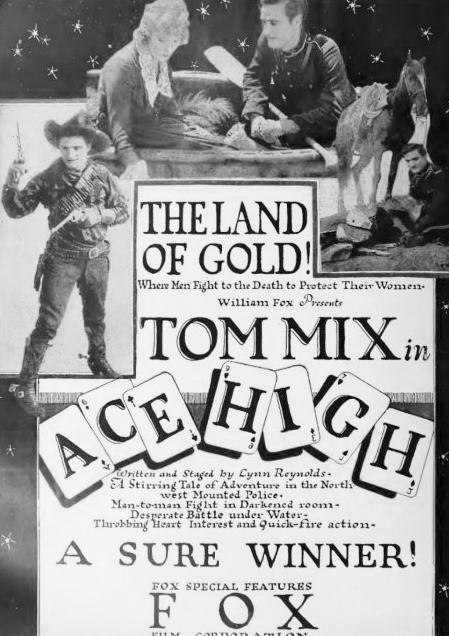
A definitive 7.2/10 rating for a film that redefined the boundaries of cult cinema. Ace High remains a cornerstone of transgressive art.
Ace High (1920) is a cinematic relic that marries the stark brutality of frontier life with the poetic fragility of orphaned innocence. Directed with a painterly eye for shadow and light, the film unfolds in a world where the snow isn’t merely a backdrop but a character—relentless, indifferent, and often as deadly as the human antagonists. At its core lies Annette’s discovery: a baby swaddled in a cradle of birch branches, found huddled against the frozen corpse of her mother. This image—a paradox of life and death—sets the tone for a narrative that oscillates between Gothic melodrama and hard-edged Western grit.
The film’s pacing is deliberate, almost glacial, mirroring the slow thaw of Annette’s isolation. Baptiste Dupre (played with grizzled stoicism by Lawrence Peyton) and his wife, a weaver whose hands are as calloused as her heart, become reluctant guardians to the child. Their cabin, perched on the edge of a pine forest, is a microcosm of survival—every splintered beam and chipped teacup a testament to years of scraping by. Yet the intrusion of the sheriff (Colin Chase) disrupts this fragile equilibrium. His obsession with Annette is not born of love but of power, a desire to possess what cannot be owned. Tom Mix’s entry as Jean Rivard, the Mountie, is a masterclass in understated heroism. He’s no swashbuckling figure but a man of quiet resolve, his red coat a flicker of humanity in a world drained of color.
The cinematography, though rooted in the aesthetics of early 1920s filmmaking, is striking in its minimalism. One scene lingers on a close-up of the baby’s breath frosting in the air, a silent reminder of mortality. Another frames the sheriff’s house as a jagged silhouette against a blood-red sunset, its windows like empty eyes watching the snowfall. These visual motifs echo the themes of the script: the impermanence of safety, the inevitability of confrontation. The script by Lynn Reynolds, while occasionally heavy-handed in its moralizing, excels in creating tension through subtext. The sheriff’s infatuation is never explicitly acknowledged as such; instead, it’s conveyed through a series of glances and gestures—a hand lingering on Annette’s arm, a chair overturned in a fit of pique. It’s a subtlety that modern audiences might underestimate, yet it’s precisely this restraint that gives the film its eerie authenticity.
Comparisons to 'The Foundling' (1938) are inevitable, given both films’ focus on children thrust into hostile environments. However, 'Ace High’ distinguishes itself through its colder, more austere tone. Where 'The Foundling' leans into sentimentalism, this film embraces a kind of stoic fatalism. Similarly, the harsh landscapes evoke memories of 'An Alpine Tragedy' (1923), but here the mountains are not a place of awe but a prison. The child’s presence is both a source of hope and a catalyst for tragedy—a duality that mirrors the film’s own structure, where every act of kindness is shadowed by a looming threat.
Tom Mix’s performance as Jean Rivard is the emotional anchor. Unlike the hypermasculine tropes that would later define Western heroes, Mix portrays Rivard as a man grappling with his own limitations. His rescue mission is not a grand gesture but a series of calculated risks, each one more desperate than the last. In one pivotal scene, he’s forced to choose between saving Annette and protecting the child, a decision that fractures his composed exterior. The film’s climax, set in a blizzard, is a masterstroke of visual storytelling. The sheriff’s house, besieged by wind and snow, becomes a symbol of his crumbling authority—a metaphor for the futility of his obsession.
The supporting cast, though often overshadowed by the film’s stark visuals, delivers performances that linger in the memory. Virginia Lee Corbin, as Annette, channels a quiet strength that contrasts with the sheriff’s volatility. Her scenes with the child are particularly moving, capturing a bond that defies the chaos around them. Even the peripheral characters—like Baptiste’s wife, whose loom becomes a symbol of domesticity under siege—add layers to the narrative. The film’s score, a sparse arrangement of piano and violin, underscores the tension without overpowering it. It’s a sound that haunts rather than hammers, much like the film itself.
What elevates 'Ace High' beyond a mere period piece is its exploration of moral ambiguity. Neither the sheriff nor Rivard is wholly evil or heroic; they’re products of their environment, shaped by the frontier’s harshness. The film’s most poignant moment comes when Annette, after escaping the sheriff’s clutches, returns to her cabin to find it burned to the ground. The ashes of her past are swept away by the wind, a visual metaphor for the impermanence of all things. This moment, devoid of dialogue, speaks volumes about the cost of survival.
In the pantheon of early Westerns, 'Ace High' occupies a unique space. It lacks the operatic scale of 'The Light of Western Stars' (1929) or the swashbuckling flair of 'Tosca' (1945), but it compensates with a raw, almost documentary-like realism. The film’s influence can be seen in later works like 'The Hunting of the Hawk' (1932), which similarly juxtaposes the rugged wilderness with human frailty. For modern viewers, it’s a window into a bygone era of cinema—where silence spoke louder than words, and every frame was a painting.
Ultimately, 'Ace High' is a film about the fragility of innocence in a world ruled by survival. The baby, the central symbol of hope, is both a blessing and a burden—a reminder that even in the darkest corners of the frontier, life persists. It’s a message that resonates beyond the film’s immediate context, echoing through the annals of cinema and into the hearts of those who dare to watch. To see it is to stand in the snow, feeling the cold seep into your bones, and wonder whether the fire you carry is enough to keep it at bay.
IMDb 5.7
1918
Community
Log in to comment.