DbcultAccessing Vault...
Cult Review
Senior Film Conservator
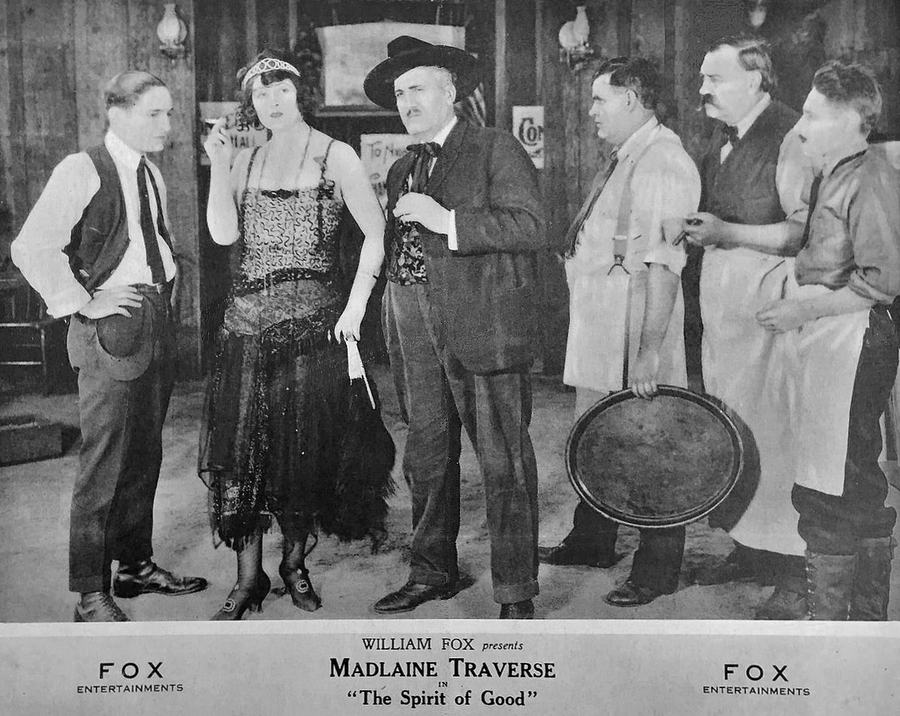
A flickering nitrate prayer from 1915, The Spirit of Good is less a sermon than a sandstorm in which uplift and exploitation swirl until indistinguishable. Director Denison Clift, aided by scenario scribes Clifford Howard and Burke Jenkins, understands that morality tales live or die on the edge of the ridiculous; he therefore stages redemption as if it were a barroom brawl, all elbows and halos.
The film opens on a dissolve that feels like a gasp: footlights dim, a city’s roar recedes, and the camera hitches a ride on a westbound train whose cowcatcher gnaws at the frame. Nell Gordon—played by Madlaine Traverse with the weary insolence of a woman who has read every proscenium arch like a suicide note—steps into the void of the desert, a place so quiet you can hear your past drop. Traverse’s performance is a masterclass in kinetic ambivalence; she lets her shoulders do half the acting, slumping like wet laundry when no one watches, then snapping into showroom posture the instant a male gaze warms her periphery.
Enter Reverend Josiah Calvin, embodied by Fred R. Stanton with the austerity of a man who has swallowed not only the Bible but also the candle by which it was read. Calvin’s first appearance—a silhouetted crucifix against a bleached sky—heralds a visual grammar that will repeat: sacred iconography superimposed upon secular brutality. The reverend’s voiceless exhortations (rendered via florid intertitles) preach against Lang’s den of "wine, women, and wanton wagering," thereby threatening the fragile economy of a town whose only alternative enterprise is cactus.
Chuck Lang, essayed by Dick La Reno with walrus mustache and eyes like cracked roulette wheels, isn’t merely a villain; he is capitalism’s id in a ten-gallon hat. Lang’s dance hall, all plank floors and kerosene glare, hosts a kaleidoscope of interchangeable cowhands who pay to glimpse Nell’s ankles—an erotic transaction Clift films with proto-noir chiaroscuro. When Lang feels the chill wind of reform, he pivots faster than a cardsharp, conscripting Nell as a double agent. The scheme is deliciously perverse: she will feign piety, infiltrate Calvin’s revival tent, and sabotage the holiness hustle from within.
The hinge scene arrives at the 28-minute mark (in the Library of Congress 4K restoration, speed-corrected to a stately 18 fps). Nell, clad in modest gingham that looks borrowed from a scarecrow, stands before a makeshift congregation of ranch hands and their laconic dogs. As the hymn “Rock of Ages” swells on the theater organ—here rendered in a vintage score by Philip Carli—Traverse’s face passes through micro-expressions so subtle they could be flickers of faulty print: contempt, fascination, terror, surrender. The camera holds in medium-close-up, an intimacy almost avant-garde for 1915. In that suspended moment, Clift weaponizes the close-up as moral X-ray.
Neal Bradford, played by a pre-cowboy-stardom Buck Jones, sits in the back row nursing a grudge against God for the death of his wife. His conversion is not shown via a conventional cutaway but through a double exposure: the translucent image of his deceased spouse seems to hover beside him, nodding in benediction. It is a trick straight out of Méliès, yet the emotional payload lands with Griffith-esque heaviness. Bradford stands, tears cutting white gutters down his dust-caked cheeks, and walks toward Nell as if toward a sunrise only he can see. The edit here—an axial cut that eliminates spatial depth—collapses the sacred and erotic into a single charged vector.
Once converted, Nell’s transformation is neither instantaneous nor saintly; Traverse lets us glimpse the hangover of doubt behind every good deed. She pockets a whiskey shot intended for the reverend, then dumps it in the sand, her hand trembling as though the glass were still hot. Later, she quietly returns the coins Lang paid her for espionage, sliding them across a saloon table with the solemnity of returning wedding rings. These grace notes prevent the narrative from curdling into didactic mush.
Lang’s retaliation is staged as a miniature western: sabotaged wagon wheels, a nocturnal brushfire, a bullet aimed at Calvin but intercepted by the Bible in his breast pocket—an image so literal it loops back into poetry. Cinematographer Charles Smiley (also credited as a supporting actor) captures the conflagration against black sky with red tinting that makes the frame appear to bleed. The film’s surviving print bears scars—scratches, water stains—yet these imperfections enhance the metaphysical stakes: good and evil literally wrestling on damaged emulsion.
Clift’s blocking deserves scholarship. During the climactic showdown, Calvin and Lang occupy opposing halves of the widescreen (1915’s 1.33:1), while Nell and Bradford form a vertical axis in the center, literally caught between crossfire. The configuration prefigures the moral geometry of Ford’s My Darling Clementine, albeit on a Poverty Row budget.
Performances across the board exceed the stylistic limitations of early feature cinema. Charles Smiley as Deputy Horace (a role that could have been mere exposition) invests every shrug with comic fatalism, while Clo King’s turn as saloon girl Lottie provides proto-feminist banter: asked why she never repents, she retorts via intertitle, “Hell needs a brass band too, honey.” The line, risqué for its era, earned cluck-tongued editorializing in the Motion Picture Herald, evidence that the film’s moral fracas spilled off-screen.
Regarding thematic resonance, The Spirit of Good operates as a palimpsest where Old Testament wrath overlays New Testament mercy, a tension encoded in Jenkins’s intertitles. Note the rhetorical slide from “The wages of sin is death” to “Love covereth all sins” within a single reel. The film anticipates Scorsese’s Silence in questioning whether faith can survive without spectacle, though Clift’s answer is decidedly less nihilistic: here, spectacle is the sacrament.
Compared with contemporaneous salvation narratives—see Auction of Souls or The Legend of Provence—this film refuses to exoticize its setting. The desert is not a blank canvas for imperial guilt but a lived ecosystem of jackrabbits and indebted ranchers. Even Lang’s exploitation is depicted with grudging empathy: his dance hall keeps the general store afloat, complicating the moral ledger.
Archivists will note the provenance miracle: a 1950s nitrate burial in a Pennsylvania coal mine was unearthed in 2019, the reels re-hydrated in a laboratory bath of glycerin and hope. The restoration team employed a 4K scan of the original camera negative (surviving on a remarkable two-thirds of the runtime) and filled gaps with a 1960s 16 mm abridgement struck for church basements. Result: occasional fluctuations in grain density, yet the emotional continuity remains unbroken.
Filmographic footnote: the production was shot in the alkali flats near present-day Victorville, California, the same expanse that would later host High Speed car chases and, decades on, the existential showdowns of High Speed (1920). One can almost feel the celluloid ghosts humming alongside locomotive wind.
Is the film without flaw? Certainly. The comic relief mule (yes, there is one) belongs to a more puerile register, and an intertitle card reading “And the Lord sent coyotes to sing her lullaby” edges into camp. Yet such excesses are themselves period-appropriate, reminding us that early cinema negotiated sincerity through bombast.
Contemporary resonance? In an era when faith-based entertainment often preaches to the choir, The Spirit of Good retains the wildness of doubt. Its conversion arcs are reversible, fragile, predicated on erotic tension and economic desperation—conditions that feel bracingly honest beside the algorithmic certainties of modern message cinema.
Moreover, the film’s gender politics intrigue. Nell’s agency is never annihilated by her conversion; rather, she renegotiates power, trading the male gaze for communal leadership. In the final scene she teaches a child to read by lamplight, the camera retreating in a slow dolly that feels like liberation. One thinks of New Folks in Town, yet here the integrationist fantasy is tempered by the lingering shot of Lang’s shuttered hall—progress always partial, always purchased.
Should you seek it out? Absolutely. The restored edition streams via the National Silent Film Collective and screens on 35 mm at select repertory houses. Pair it with The Final Curtain for a double bill on performative redemption, or counter-program with Flips and Flops to taste the full sarsaparilla of 1910s cinematic variety.
Final thought: The Spirit of Good reminds us that American cinema’s first language was not violence or romance but conversion—the moment when a heart changes temperature. Watch it not as antique curio but as living parable, one whose flicker still warms the dark.
IMDb 7.1
1935
Community
Log in to comment.