DbcultAccessing Vault...
Cult Review
Senior Film Conservator
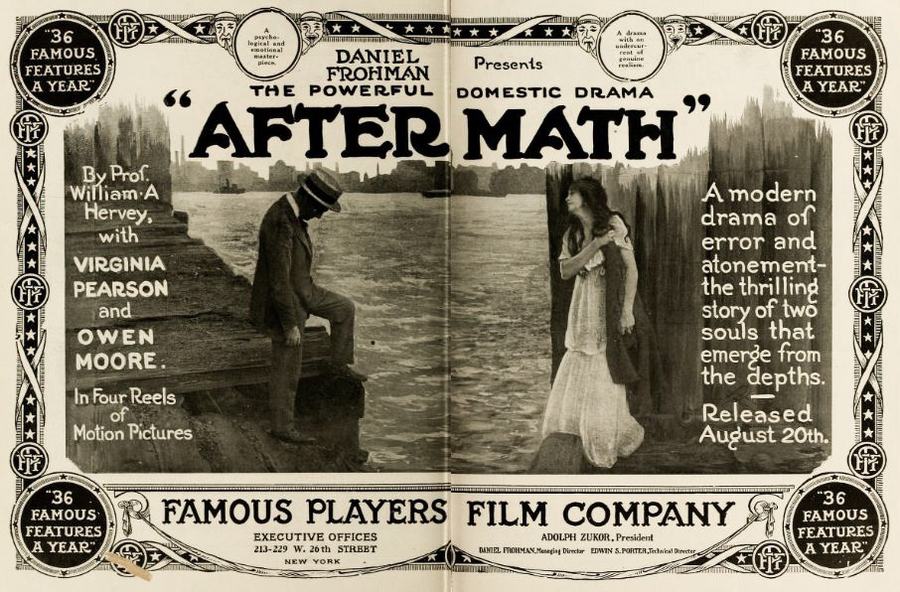
The first time I watched Aftermath, the print crackled like wet coal, and I felt the room tilt: two strangers teetering on a riverbank, their silhouettes swallowed by nitrate dusk. William Addison Hervey’s 1914 one-reel marvel—barely 12 minutes—contains more existential thorns than most prestige miniseries manage in twelve hours.
We open on a tableau that could be plucked from Millet’s The Gleaners: Ruth, angular and hawk-eyed, stands amid stubble fields, the orphanage’s last slap still echoing on her cheekbones. Virginia Pearson—better known for regal vamp roles—ditches the pearls and plays this wraith with a slumped shoulder, a gait that says she’s already apologizing for taking up space. Her departure is shot in irised vignette, the lens contracting until the locomotive’s scream becomes her lullaby.
Cut to Allan—Owen Moore, fresh off rom-com duties, here sporting a five-o’clock grief that ages him a decade. His practice is a single room above the apothecary; a child’s marble rolls across the floorboards, portending the lethal spoonful he will soon dispense. The intertitle card, all curlicue anxiety, reads: “A doctor’s hand may heal—or haunt.” It’s the kind of line that would play as camp in a sound picture, but in the cathedral silence it lands like a verdict.
Betrayal arrives wearing white spats. Ruth’s paramour, never named, materializes beneath a theatre awning; he twirls a cane whose silver head catches the marquee glow and throws it into her eyes. She thinks it’s starlight. We know it’s klieg-glitter concealing a shark. Their courtship is a whirl of taxi rides and drugstore champagne, shot mostly in extreme long shot so the city itself becomes a third lover—hungry, impatient, devouring.
Meanwhile, Allan’s catastrophe unspools in a single, merciless take: the mother’s face folding from worry to horror as the child’s breath hitches, the doctor’s own pulse visible in his throat. Hervey withholds the actual death; instead we get the aftermath—a coffin the size of a violin case being carried across a muddy street. The camera doesn’t follow the cortege; it stays on Allan’s shoes, now flecked with cemetery soil, a stain no rag can lift.
News of his sister’s train wreck reaches him via telegram, the paper trembling like a trapped moth. Moore lets his eyes go glassy, then shuts them too hard, as if darkness could be clenched out. He walks to the river through what feels like a city holding its breath—streetcars frozen, hats doffed, a cat on a windowsill following him with lantern pupils. The river is a black scrim; the suicide attempt is framed in wide shot so the horizon bisects his torso, turning him into half a man.
Enter Ruth, already waist-deep, hair unspooled like spilled ink. They see each other but do not speak—language would be sacrilege. Instead, the film cuts to superimposed waves lapping at their calves, then to a memory-flash of the dead child’s toy sailboat. The edit is so abrupt it feels like a door slammed on your fingers. She steps back; he steps forward; their shadows merge into a single bruise on the water.
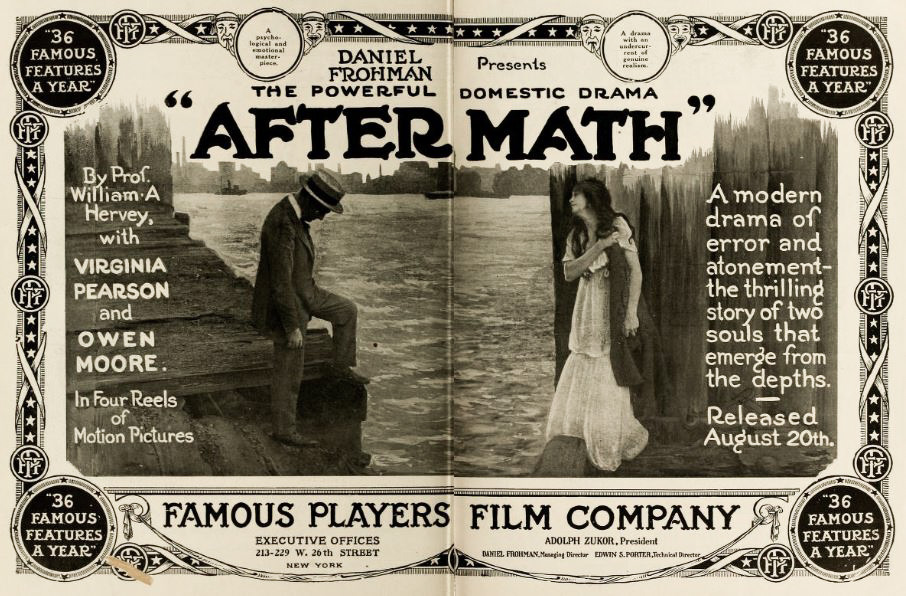
What follows is a resurrection stitched from small mercies: a shared cigarette (the flame cupped against an indifferent universe), a loaf of day-old bread purchased with her last nickel, the doctor’s coat draped around her shoulders like a flag of truce. Hervey refuses redemption arcs; the final intertitle simply states: “Tomorrow is another wound.” Fade-out on two figures trudging upriver, backs to camera, city skyline looming like a set of broken teeth.
Shot in December 1913 on the frostbitten backlot of Fort Lee, the celluloid carries actual breath-fog. Cinematographer William Marshall (later famous for Glacier National Park’s glacier-sheen) uses under-exposure to turn snow into slate, so every footstep scars the frame. Compare this to the pastoral fatalism of Germinal; or, The Toll of Labor; both films smear grime on utopian dreams, yet where the latter blames systemic gears, Aftermath indicts the mirror.
Pearson’s Ruth never succumbs to waif cliché; she spits out her backstory like bile, then clenches her jaw so tight you fear teeth will crack. Moore, often dismissed as Mary Pickford’s lesser husband, locates a tremor that anticipates James Mason’s later alcoholic doctors. When he pockets the fatal prescription, his thumb rubs the paper twice—an infinitesimal tell that speaks volumes.
Released the same month Ford unveiled the assembly line, Aftermath prefigures modernity’s casualties: opioid errors, predatory seducers, rail disasters. The film’s riverbank tableau recurs in everything from St. Elmo’s cliffside temptation to the nocturnal piers of The Man Who Came Back. Yet few contemporaries dared pair suicide ideation with cross-gender solidarity sans romance; their bond is soldered by nihilism, not hormones.
Unlike the ecclesiastical certainties of The Eternal Law or the carnivalesque grace in Chicot the Jester, Aftermath lands in an ethical twilight. No priest intervenes, no deus ex machina drops coins. The closing long shot withholds closure: sky and water share the same charcoal hue, so horizon dissolves. Viewers must decide whether the characters walk toward life or merely a slower death.
For decades the sole print sat in a Belgian convent archive, misfiled under “moral hygiene.” A 2018 4K photochemical rescue by EYE Filmmuseum unearthed tints—amber for interiors, viridian for the river—that restore Hervey’s chiaroscuro intent. The new restoration tours arthouses with a live trio performing a score of bowed saw and pump organ; when I caught it at Rotterdam the music keened like a weather front, audience members audibly swallowing sobs.
Aftermath is a splinter of obsidian lodged beneath the skin of early Hollywood mythmaking—too sharp for the era’s sentimental palate, too honest for comfort. It neither moralizes nor medicates; it simply holds the mirror to the abyss and dares you to blink first. A century on, its chill hasn’t warmed a degree.
Seek it out, but brace yourself: you’ll leave the theatre tasting river silt, and your own reflection will look suddenly suspect.
IMDb —
1917
Community
Log in to comment.