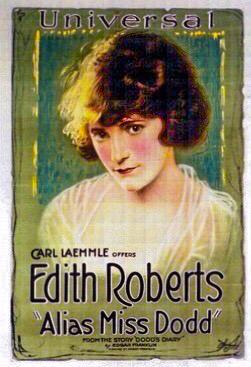
The first miracle of Alias Miss Dodd is that it makes a bookbindery look like a war room. Spines are slit, glue steams, and every folio seems to mutter possibilities. Into this gothic hush steps Jeanne—played by Edith Roberts with the kinetic poise of a woman who has already decided the world is insufficiently rearranged. She doesn’t walk; she deploys herself.
When the diary of self-declared rake Thomas Dodd lands on her bench, the film’s tone pivots from work-a-day naturalism to something bordering on fable. The journal’s pages, crabbed with imaginary debauchery, are shot in grainy inserts that feel like wounds. Rather than recoil, Jeanne stitches the book, then stitches herself into its narrative. It’s a dare: if fiction can wound, why can’t it also cauterise?
“She doesn’t walk; she deploys herself.”
Director Charles J. Wilson keeps the reveal of the “real” Thomas Dodd—Walter Richardson shuffling like a man wearing guilt as an ill-fitting coat—delayed just long enough for our expectations to calcify. When Jeanne strides into the parlour announcing filial devotion, the camera dollies in on Richardson’s watery blink; the moment is silent-era comedy gold, equal parts pathos and pratfall.
Meanwhile the mansion itself becomes a character: staircases yawn like unfriendly mouths, drapes swallow gaslight. Cinematographer Edgar Franklin uses high-contrast orthochromatic stock that turns skin lunar and shadows abyssal. You feel you could fall into the corridors and never strike bottom.
At plot centre stands the love triangle, though it is scalene at best. Kent (Harry von Meter) carries post-war fatigue in his cardigan pockets; Jeanne oscillates between puppet-master and patsy; Hazel Jenkins (Ruth King) drifts on the periphery, a moral barometer in a string of pearls. Jeanne’s insistence that Kent “repair” Hazel by marrying her smacks of self-immolation, yet Roberts plays it with such earnestness that self-righteousness becomes heartbreakingly human.
One could read the picture as a sly rejoinder to Beulah’s self-sacrificing martyrs or the street-gut grit of Trixie from Broadway. Both those films ask women to earn honour through pain. Jeanne already owns honour; what she seeks is agency, even if it means wearing a mask glued with false paternity.
“Truth ricochets like light in a broken mirror.”
The screenplay, attributed to Wilson & Franklin, is a Swiss watch of reversals. Each act ends on a hinge: the diary is real, the diary is fake; Jerry is victim, Jerry is viper; Jeanne is saviour, Jeanne is charlatan. These pivots are telegraphed with title cards that flirt with modernist fragmentation—single verbs (“Confesses.” “Denies.”) blazing in yellow on black.
Jerry Dodd, essayed by John Cook, is the film’s most modern creation. He embodies corporate avarice in a three-piece suit, but the script gifts him a soliloquy—delivered in silhouette against a ledger’s columns—that complicates rapacity into something approaching operatic need. You glimpse the hurt boy inside the ogre, a duality mainstream cinema wouldn’t attempt again until A Very Good Young Man flirted with redemption arcs.
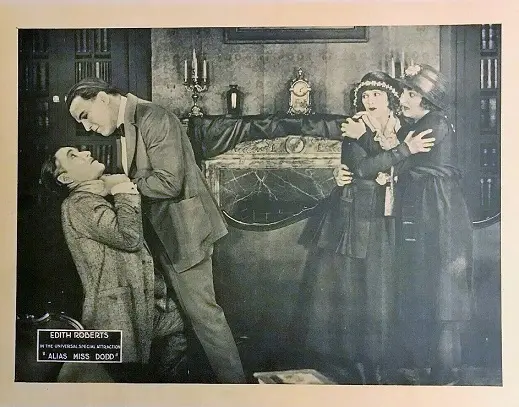
Mid-film, Jeanne foils Jerry’s forged-deed scheme in a sequence worthy of Hitchcock’s later “innocent wrong-woman” thrillers. A train whistle bleeds into the score, shadows rake across Persian rugs, and Roberts’ eyes become twin klieg lights. The bindery worker reclaims her vocation: she literally sews the forgery back into a legitimate codex, reversing entropy with needle and gut. It’s a metaphor so elegant it almost whistles.
Yet the emotional detonation arrives via Margaret McWade’s Sarah Ross. McWade strides into frame with the unhurried authority of a woman who has outlived her own mythology. Her denial of maternity is delivered not with indignation but a measured half-smile, as though she’s discarding last season’s hat. In that instant, Jeanne’s scaffolding collapses, and the audience realises the film has never been about parentage; it is about who gets to author their identity.
Kent’s eventual proposal—delivered on a terrace where moonlight pools like spilt cream—avoids melodrama because von Meter underplays. He lets the pause, the shuffle of shoe against flagstone, carry the weight. Jeanne’s acceptance is equally quiet: a nod that feels less like surrender than like signing a treaty with herself.
And then there is Thomas’ proposal to Sarah, a coda so gentle it could bruise. Richardson folds a gardenia into her hand, the same flower he once libelled in ink. The symbolism is unmistakable: stories, like flowers, can be re-planted. Forgiveness is just another form of grafting.
Viewed today, the film resonates in an age of curated online selves and deep-fake lineage. Jeanne’s impersonation prefigures influencer culture; Thomas’ diary predicts parasocial confessional vlogs. The picture asks: if you can be anyone, why choose to be honest? Its answer is neither trite nor absolute; it glows in ember-orange, like the final shot of the bindery lamps being snuffed at dawn.
Technically, the restoration available on streaming platforms derives from a 35 mm Dutch print. Scratches flicker like fireflies, and some intertitles were re-translated, yet the tinting—amber interiors, cerulean exteriors—survives. The Mont Alto Motion Picture score (piano, violin, and discreet clarinet) syncs beautifully with the emotional valence, swelling under Jeanne’s betrayals, then retreating into single-note pulses during revelations.
Comparative cinephiles will spot echoes in later works: the house-as-prison motif resurfaces in Der gestreifte Domino; the diary-as-MacGuffin trick reappears, gender-flipped, in A Branded Soul. Yet few silents marry screwball velocity with moral inquiry so seamlessly.
Weaknesses? A comic relief maid (Vida Johnson) feels air-dropped from another picture, all flutter and no function. And the rushed denouement—Jerry’s arrest happens off-screen—slightly blunts the catharsis. Still, these are paper cuts on an otherwise sumptuous canvas.
- Edith Roberts
- Margaret McWade
- Walter Richardson
- Harry von Meter
- Ruth King
- John Cook
- Vida Johnson
At barely 57 minutes, Alias Miss Dodd is a masterclass in compression. Every reel toggles between lampoon and lament, between the ache of wanting family and the terror of finding it. It offers no manifesto, only a proposition: identity is the one book we must all bind for ourselves, page by trembling page.
If you’re hunting for a silent that marries Lubitsch’s sparkle with Stroheim’s cynicism, stream this tonight. Let its dark-orange lies, yellow-tinged hopes, and sea-blue truths settle into your bones. Then ask yourself: which pages of your own story are fact, which are wish, and how willing are you to stitch them together until they hold?