DbcultAccessing Vault...
5.3/10
Senior Film Conservator
A definitive 5.3/10 rating for a film that redefined the boundaries of cult cinema. Alice at the Rodeo remains a cornerstone of transgressive art.
Is 'Alice at the Rodeo' worth watching today? Short answer: yes, but with significant caveats. This early Walt Disney short is an essential historical document for animation enthusiasts and film historians, offering a unique window into the formative years of a cinematic giant, but it is decidedly not for those seeking modern narrative complexity, sophisticated character development, or high-fidelity visuals.
As a critic, I approach films not just for their entertainment value, but for their place in the grand tapestry of cinema. 'Alice at the Rodeo,' like many of its contemporaries, serves less as a standalone piece of compelling storytelling for a modern audience and more as a crucial artifact. It’s a testament to innovation, a blueprint for future greatness, and a charming, if rudimentary, example of early animated storytelling.
This film works because it provides an invaluable historical snapshot of Walt Disney’s early creative endeavors, showcasing the groundbreaking blend of live-action and animation that defined the Alice Comedies. It’s a foundational text for understanding the evolution of character animation and narrative pacing in the silent era.
This film fails because its simplistic plot, rudimentary animation techniques by today's standards, and repetitive chase sequences can feel dated and unengaging for viewers accustomed to more sophisticated storytelling and visual dynamism. The humor, while charming for its time, often lacks the universal appeal of later Disney works.
You should watch it if you are a Disney historian, an animation student, or simply curious about the very beginnings of one of the most influential studios in cinematic history. It’s a pilgrimage, not a casual viewing.
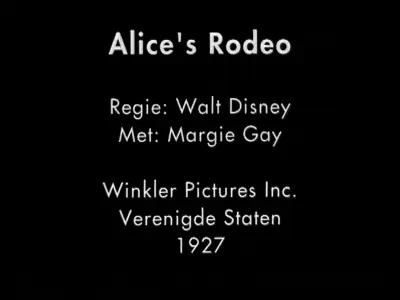
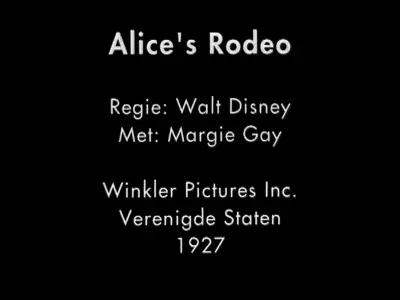
Released in 1927, 'Alice at the Rodeo' belongs to the 'Alice Comedies' series, a crucial chapter in Walt Disney's pre-Mickey Mouse career. These shorts, starring a live-action girl (Margie Gay in this instance) interacting with an animated world, were revolutionary. The very concept of seamlessly integrating a real person into a drawn environment was a marvel, pushing the boundaries of what audiences thought possible.
The direction, while uncredited beyond Walt Disney himself, demonstrates a nascent understanding of visual storytelling. The camera, though static for much of the action, effectively frames the interplay between Alice and her animated surroundings. There’s a clear intent to maximize the novelty of the live-action/animation hybrid, often placing Alice directly within the animated chaos, such as when she observes Julius’s bronc-riding feat.
The plot, a straightforward tale of Julius the Cat winning a rodeo prize and then having to retrieve it from the villainous Pete, is a template for countless cartoons to follow. It's simple. It's effective for its target audience. It establishes clear stakes, even if those stakes are merely a sack of money and a sense of justice.
In the realm of early animation, 'acting' translates to the expressiveness and movement of the drawn characters. Julius the Cat, a clear precursor to Oswald the Lucky Rabbit and Mickey Mouse, exhibits a remarkable range of emotions through his rubber-hose animation. His triumphant swagger after winning the bronc contest, his dismay at the theft, and his determined pursuit of Pete are all conveyed with a charming, if exaggerated, physicality.
Margie Gay, as Alice, provides the grounding force. Her performance is necessarily understated; her role is often to react to the animated antics around her. Yet, her presence is vital. She’s the audience's surrogate, her wide-eyed wonder and occasional interventions adding a layer of relatability to the fantastical world. Without her, the animated world might feel too abstract. She anchors the surreal.
The antagonist, Pete (often called Peg-Leg Pete in later iterations), is already a fully formed villain here – a bumbling yet persistent thief whose greed drives the conflict. His physical comedy and mischievous expressions are a highlight, laying the groundwork for his long career as a Disney foil, from his appearances in The Smilin' Kid to his later, more refined forms.
The cinematography, or rather, the visual composition of 'Alice at the Rodeo,' is functional. The animated backgrounds are sparse but effective in establishing the rodeo setting. The character designs are iconic of the era: simple, round, and highly elastic. The visual gags, while not always laugh-out-loud funny by modern standards, are inventive, relying on classic cartoon physics and exaggerated movements.
Pacing in a silent short is dictated by the rhythm of the animation and the intertitles. 'Alice at the Rodeo' maintains a brisk tempo, especially during the chase sequence. There's a constant sense of motion, a kinetic energy that keeps the narrative moving forward, preventing it from feeling stagnant despite its brevity. The sequence where Julius chases Pete across various rodeo obstacles is particularly well-executed, demonstrating a nascent understanding of comedic timing and visual momentum.
However, the limitations of the era are also apparent. The animation can be stiff in places, and the repetitive nature of the chase, while standard for cartoons of the time, might test the patience of a contemporary viewer. The visual gags, while foundational, lack the intricate layering and sophistication seen in later animated masterpieces.
The tone of 'Alice at the Rodeo' is lighthearted and adventurous. It’s designed for innocent fun, a brief escape into a world where problems are solved with a spirited chase and a bit of slapstick. There’s no deep emotional resonance, no complex moral dilemmas; it’s pure, unadulterated entertainment for a bygone era.
The central theme, if one can call it that, is the simple pursuit of justice and the triumph of good over mischief. Julius, as the underdog who earns his prize, represents the virtuous protagonist, while Pete embodies the petty thief who must be brought to heel. It’s a narrative framework as old as storytelling itself, here presented in a charmingly rudimentary animated form. One could argue that even in these early shorts, Disney was already instilling a sense of moral clarity, a black-and-white world where right and wrong were easily discernible, a characteristic that would define much of the studio's output for decades.
For the casual viewer seeking modern entertainment, 'Alice at the Rodeo' will likely feel slow, simplistic, and visually dated. It's not a film that will elicit gasps of wonder or profound introspection from a mainstream audience in 2024. Its humor is broad, its plot threadbare.
However, for anyone interested in the history of animation, the genesis of the Disney empire, or the evolution of cinematic storytelling, it is absolutely essential. It provides crucial context for understanding the groundbreaking techniques and character archetypes that would later become synonymous with Disney. Watching it is like examining the foundational sketches of a grand architectural marvel. It might not be the most beautiful part, but it's indispensable for understanding the whole.
It works. But it’s flawed. Its true value lies not in its immediate entertainment, but in its historical significance.
In the landscape of 1920s animation, the Alice Comedies carved out a unique niche. While studios like Fleischer were exploring surrealism and rubber hose animation in their own way, Disney's blend of live-action and animation was a distinct differentiator. The charm of Margie Gay's interactions with Julius set these shorts apart from purely animated offerings like Max Fleischer's 'Out of the Inkwell' series, which featured Koko the Clown interacting with live-action. Disney's approach felt more integrated, more magical.
The legacy of 'Alice at the Rodeo' and the Alice Comedies is profound. They honed Walt Disney's skills in storytelling, character development, and animation production. Julius the Cat, with his expressive personality and heroic antics, directly paved the way for Oswald the Lucky Rabbit and, ultimately, Mickey Mouse. The chase dynamics, the clear hero-villain dichotomy, and the emphasis on physical comedy are all elements that Disney would perfect in his later, more famous works, such as The Untamed.
It’s a surprising observation to realize just how much of Disney's later formula was already present in these early, relatively obscure shorts. The meticulous planning, the emphasis on personality animation, and the clear narrative arc were all being refined here. This wasn't just a studio throwing ideas at the wall; it was a visionary laying the groundwork for an empire.
'Alice at the Rodeo' is not a film you watch for pure, unadulterated entertainment in 2024. It is, however, an indispensable piece of cinematic history, a foundational text in the vast library of Walt Disney's creative output. Its charm lies in its pioneering spirit, its rudimentary yet effective animation, and its clear historical significance. While it may not thrill a modern audience, it offers invaluable insight into the origins of animated storytelling and the genius that would soon transform the entertainment world. For those with an appreciation for cinema's past, it's a worthwhile, albeit brief, journey back in time.
IMDb —
1926
Community
Log in to comment.