DbcultAccessing Vault...
Cult Review
Senior Film Conservator
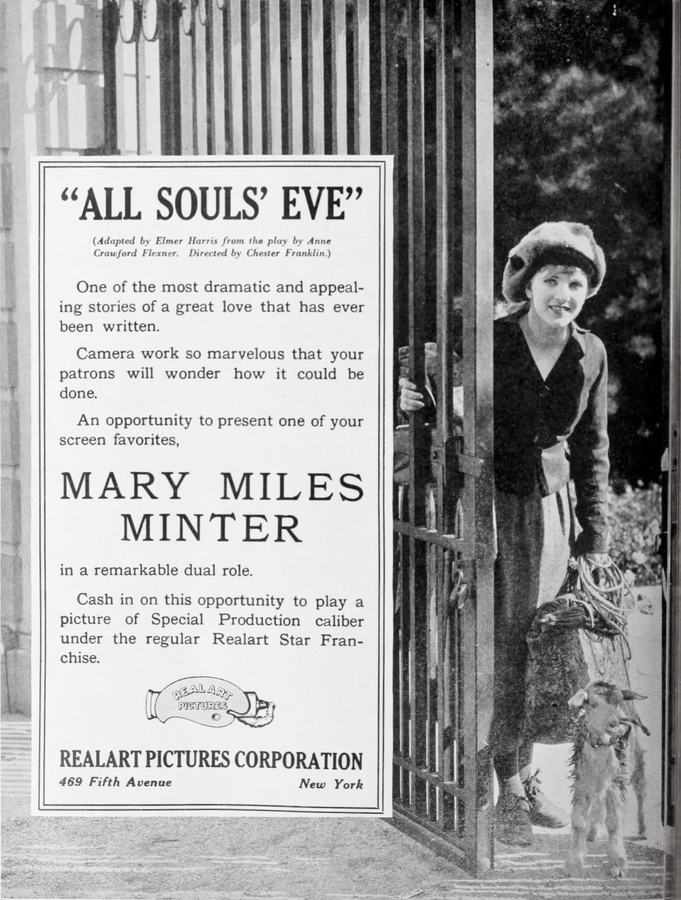
There are films you watch and films that watch you—All Souls’ Eve belongs to the latter coven. Released in the autumn of 1921, when the world still wore bandages from war and influenza, this spectral romance drapes its grief in lace so delicate you could mistake it for moonlight until it leaves burn marks on your wrists.
Jack Holt’s Roger Heath arrives like a man who has already been embalmed by sorrow: cheekbones sharp enough to cut the fog that perpetually loiters outside his studio, eyes two damp ash-pits where memory smolders. Holt, better known for rugged cowboys and trench-coat detectives, here unbuttons his machismo to expose a raw egg of mourning. Watch the way his shoulders collapse inward when he fingers the calico dress his wife wore the day she drowned—every crease in the fabric a paper cut on the soul.
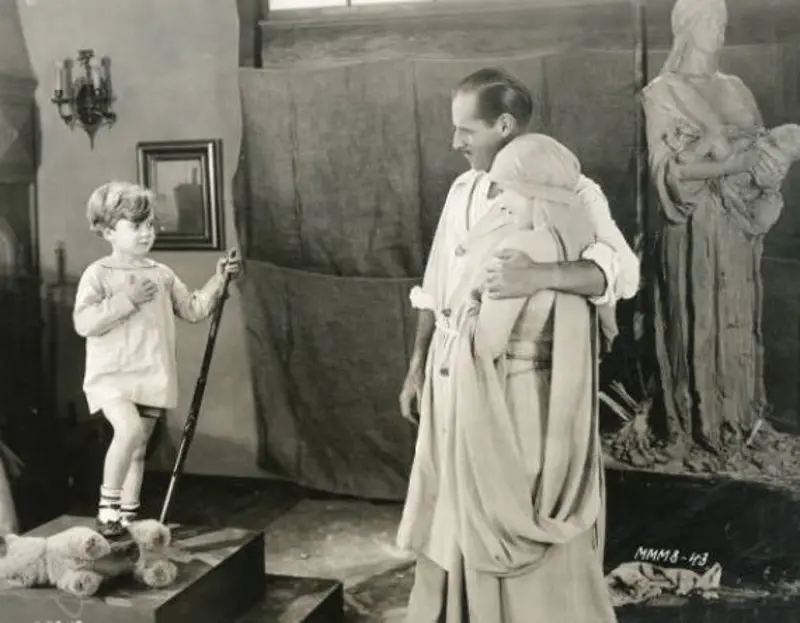
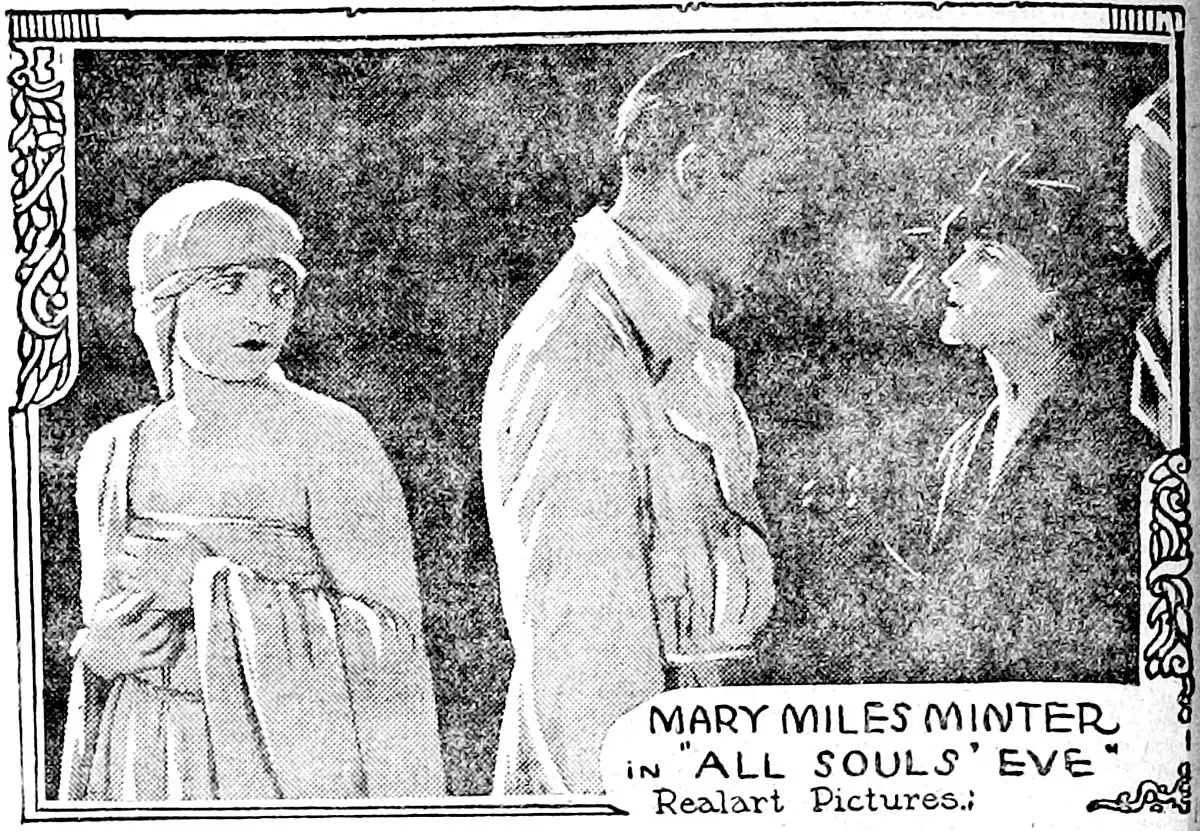
Enter Mary Miles Minter, the oft-maligned, forever-misunderstood star whose real-life tragedies—the unsolved murder of her lover, the subsequent ruin of her career—bleed into the celluloid like damp ink. As the maid, she is all downcast etiquette until the bell tolls eleven; then her vertebrae elongate, her chin lifts, and she becomes a woman who once danced barefoot on river stones. Minter’s acting is not transformation but revenance: she lets another woman’s pulse throb beneath her own pale skin. The moment she lifts the sculptor’s robe to her face, inhaling the clay-dust as though it were myrrh, cinema itself seems to inhale with her.
The screenplay, stitched by Elmer Harris and Anne Crawford Flexner from a Saturday Evening Post nouvelle, refuses the tidy séance logic you find in The Dead Alive or the Expressionist frenzy of Im Banne des Andern. Instead it opts for something more insidious: a slow accretion of domestic déjà-vu. A teacup placed on the left side of the saucer, a hummed aria off-key by exactly one quarter-tone, a hairpin discovered in the folds of a bedsheet like a silvery fishhook. Director Chester M. Franklin shoots these hauntings through windows and mirrors, so the living and the dead share the same pane of glass, neither quite solid, neither quite vapor.
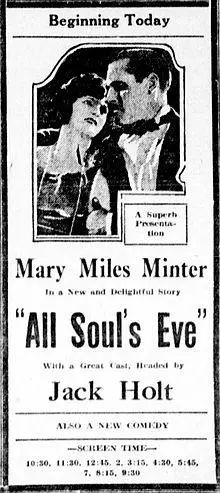
Visually, the film drinks from the same chalice as The Gulf Between—the rare early Technicolor that tinted flesh shades like bruised peaches—but here the palette has been bled to cobalt and umber. Candlelight quivers across wet clay, giving the statue-in-progress the glisten of something freshly exhumed. When Heath applies his chisel to the marble, sparks fly upward like souls leaving purgatory; the inverse shot reveals the maid’s pupils dilating, as if each spark is a memory she must swallow.
Lottie Williams, playing the busybody housekeeper, supplies brittle comic relief that curdles into dread. She rattles her keys like a jailer, warning that “the dead don’t knock.” Her warnings serve the same function as the Greek chorus in The Rebellious Bride, except the irony here is that the dead have already moved in, unpacked, and is wearing the maid’s apron.
Clarence Geldert’s physician, summoned to declare the maid hysterical, carries a black bag that might as well be a portable grave. His diagnosis—“female melancholia aggravated by moon cycles”—is the 1921 equivalent of calling a tsunami a minor plumbing issue. Watch the way he fingers the maid’s pulse, counting heartbeats like coins, while behind him the camera lingers on a baptismal font repurposed as a flower vase: water, again, the element that both drowns and baptizes.
The film’s中段 midpoint arrives wordlessly: a storm, a power outage, a single match struck to reveal the maid standing inches from the sculpture, her reflection grafted onto the stone so perfectly that when she lifts her hand the marble hand appears to lift too. In that flicker you grasp the central thesis: identity is not a fortress but a tent pitched nightly, easily colonized by any ghost with the right key of memory.
Carmen Phillips, as the sculptor’s dead wife seen in flashbacks, is filmed only through veils—lace, water, cigarette smoke—so her face arrives already half-erased, like a photograph soaked overnight. The intertitles describing her are written in past-perfect subjunctive: “Had she lived, she might have…”—a grammatical limbo that mirrors the film’s obsession with conditional afterlives.
Child actor Michael D. Moore appears briefly as the couple’s son, who exists only in memory and yet manages to upstage half the adult cast. His scene—blowing soap bubbles that drift into the graveyard—feels cribbed from a poem Rilke never wrote. Each bubble bursts against a headstone, leaving a wet kiss that evaporates before the next frame, a visual shorthand for innocence confronted by the porousness of worlds.
By the final act, the maid’s possession escalates from behavioral mimicry to full somatic takeover. She speaks in the wife’s voice, knows the combination to a locked drawer, and bears a scar that maps precisely to the dead woman’s old riding accident. The film never explains the mechanics—no ectoplasm, no Tibetan Book floated in via The Hidden Light—and that reticence is its genius. It trusts the viewer to accept grief as a solvent strong enough to dissolve the membrane between bodies.
The climax unfolds on Halloween night, when the veil is reputedly thinnest. Heath, drunk on absinthe and memory, attempts to chisel the maid/sculpture/wife into a single coherent form. The camera adopts a handheld tremor rare for 1921, foreshadowing the jittery subjectivity of The Night Rider. Marble dust swirls like poltergeist snow; the maid’s eyes roll white. Just as the hammer descends, the bell of a nearby cathedral tolls midnight, and the film cuts—to the sculpture, now finished: it is the maid’s face, but the eyes, those tide-pool irises, contain multitudes. A slow fade to black. No moral, no exorcism, no restoration of order. Only the implication that art, like possession, is a process of emptying oneself so that something other can settle in.
Viewers expecting the crowd-pleasing catharsis of Screen Follies No. 1 will exit bewildered. All Souls’ Eve offers no comic relief duo, no last-minute rescue. It ends the way a sigh ends: not with closure but with suspension.
Technically, the surviving print—housed at UCLA—bears water damage that streaks certain scenes with what looks like arterial spray. Archivists debate whether to restore or preserve these scars; I side with the scars. They rhyme with the maid’s scar, with the sculptor’s invisible wounds, with the film’s larger meditation on how damage is the truest portrait time ever paints of us.
Compared to its contemporaries, the picture lacks the opulence of The Oyster Princess or the revolutionary politics of The Life of General Villa. Yet its intimacy feels radical. It anticipates the domestic horror of Modern Husbands and the marital uncanny of The Thousand-Dollar Husband, while predating by a full decade the spiritualist chic of The Wrong Woman.
Reception in 1921 was politely puzzled. Variety called it “a poem written on a shroud,” while Photoplay dismissed it as “too morbid for the flapper set.” Modern critics, when they can locate a print, rank it alongside Az ösember as an example of primal cinema tapping into prehistoric fears: the fear that the person breathing beside you is not who she claims, that your memories are leasehold, not freehold, that love is just another word for willing possession.
So, is it horror? Romance? A Gothic tone-poem? Yes, and more. It is a meditation on the economics of grief: how the bereaved mortgage their future to the past, how a new body can be repossessed by an old debt. It is also a filmmaker’s treatise on the act of spectatorship itself—every viewer a potential ghost, every screen a sheet inviting possession.
Watch it alone, late, with the windows open so streetlamps can leak in and pool like mercury on your floor. When the maid lifts her eyes to camera in the final shot, you may feel your own pulse stutter, as if someone else’s finger has found your throat. That is the film’s true gift: it turns its audience into temporary real estate, a short-term rental for the dearly departed. And when the credits fade, you will find yourself humming a lullaby you never learned, wondering whose mouth taught yours the tune.
Seventy-seven minutes of celluloid séance, and not one second wasted. If you emerge un-haunted, congratulations: you were already empty.
IMDb —
1921
Community
Log in to comment.