DbcultAccessing Vault...
5/10
Senior Film Conservator
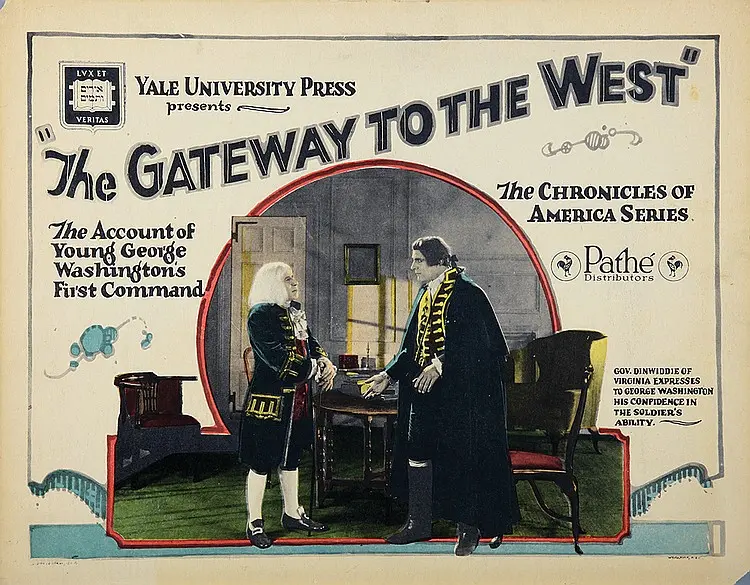
A definitive 5/10 rating for a film that redefined the boundaries of cult cinema. Gateway to the West remains a cornerstone of transgressive art.
Cinema, in its nascent decades, often grappled with the weight of history, seeking to distill the chaotic birth of nations into coherent celluloid narratives. Gateway to the West, directed with a discerning eye for period detail, stands as a monumental achievement in this endeavor. Unlike the melodramatic excesses found in contemporaneous works like The Birth of a Nation, this film opts for a more measured, almost documentary-like precision in its recreation of 1753. The script, penned by William B. Courtney, eschews the flamboyant romanticism of the era to focus on the grit and strategic anxiety of the Ohio Valley frontier. It is a world of mud, musket fire, and murky allegiances, where the survival of an empire hinges on the loyalty of a few scouts and the fickle nature of colonial politics.
The year 1753 remains a pivotal, if often overlooked, juncture in the American mythos. It was a time before the United States was a conceptual reality, a period defined by the collision of three distinct powers: the British colonists, the French expansionists, and the indigenous tribes who held the balance of power. The film captures this tripartite tension with a sophistication that belies its age. Jack Baston delivers a performance of stoic gravitas, portraying the rugged resilience required to navigate a landscape that was as diplomatically treacherous as it was physically demanding. His presence on screen provides a grounding force, anchoring the sprawling geopolitical stakes in the tangible reality of human endurance.
William B. Courtney’s screenplay is a marvel of structural economy. While some silent films of the period, such as The Misleading Lady, focused on lighthearted social dynamics, Courtney plunges the viewer into the visceral realities of territorial expansion. The dialogue—delivered through intertitles—is sharp, purposeful, and devoid of the flowery prose that often plagued silent epics. He treats the conflict between the American colonists and the French not as a simple battle of good versus evil, but as a clash of competing sovereignties. This nuance is particularly evident in the depiction of the Indian allies. Rather than relegated to the background as mere set dressing, the indigenous characters are portrayed as strategic actors with their own agendas and agency.
The cinematography utilizes the natural light of the outdoors to create a sense of immersion that was rare for the 1920s. The shadows of the dense forest are used to evoke a sense of constant, lurking danger, a technique that would later be perfected in the horror genre with films like The Wolf Man. In Gateway to the West, however, the horror is grounded in history. The threat of an ambush is not supernatural but political. The visual language of the film emphasizes the isolation of the frontier outposts, making the arrival of a messenger or a diplomatic party feel like a monumental event. This pacing allows the audience to feel the slow, agonizing build-up of tension that preceded the actual outbreak of hostilities.
The ensemble cast, featuring stalwarts like Charles E. Graham and Walter P. Lewis, brings a rugged authenticity to the proceedings. Graham, in particular, exudes an air of weary authority that perfectly encapsulates the colonial officer caught between the demands of the Crown and the realities of the American soil. There is a palpable sense of friction between the British regulars and the colonial militias, a foreshadowing of the revolutionary sentiments that would boil over decades later. This thematic depth elevates the film beyond a simple adventure story, transforming it into a prologue for the American identity.
Walter P. Lewis and Stanley Walpole provide excellent support, their faces etched with the harshness of the frontier. Unlike the polished, almost doll-like appearances in The Girl of My Dreams, the actors here look as though they have actually spent weeks in the wilderness. Their movements are deliberate and heavy, conveying the physical toll of 18th-century life. This commitment to realism extends to the costuming and prop design, which avoid the theatricality seen in Lombardi, Ltd.. The wool coats look heavy and damp; the muskets look like tools rather than toys. It is this tactile quality that makes the film's climax—a desperate struggle for control of the gateway—so impactful.
When comparing this film to other works of the era, such as The Border Legion, one notices a distinct shift in tone. While the latter leans into the lawlessness and rugged romance of the West, Gateway to the West is preoccupied with the birth of order and the establishment of borders. It is less about the individual outlaw and more about the collective struggle to define a nation's boundaries. This focus on the macro-political makes it a fascinating companion piece to The Volcano, which similarly explores the explosive nature of social and political upheaval.
Even in its quieter moments, the film remains intellectually stimulating. There is a sequence involving a parley between the French and the British that is a masterclass in silent tension. The actors rely on subtle shifts in posture and expression to convey a complex game of chess where the stakes are entire territories. This level of psychological depth is often missing from more action-oriented silents like Black and Tan Mix Up or the comedic fluff of A Studio Rube. Here, every gesture carries the weight of history.
The technical proficiency of Gateway to the West cannot be overstated. The editing, while following the linear conventions of the time, shows an early understanding of cross-cutting to build suspense. During the final skirmish, the intercutting between the advancing French troops and the desperate defense of the colonial fort creates a rhythmic intensity that rivals the best work of D.W. Griffith. Yet, it avoids the problematic moralizing found in The Evil Thereof, opting instead for a more objective, almost clinical observation of combat. This objectivity makes the violence feel more immediate and less choreographed.
Furthermore, the film’s exploration of justice and duty in an untamed land resonates with the themes of Life Story of John Lee, or The Man They Could Not Hang, albeit on a much larger, national scale. While John Lee deals with the fallibility of human law, Gateway deals with the forging of it. The film suggests that the 'gateway' is not just a geographical location, but a psychological threshold that the characters must cross to become something more than subjects of a distant king. They are becoming Americans, though they do not yet know the name for it.
In the broader context of the 1920s, a period often associated with the 'Jazz Age' and urban decadence, Gateway to the West served as a reminder of the nation's rugged foundations. It stands in stark contrast to the melodramatic domesticity of Her Reckoning or the urban crime focus of Chains of Evidence. It is a film that looks backward to understand the present, utilizing the medium of cinema to breathe life into the dry pages of history books. The result is a work that is as educational as it is entertaining, a rare feat in any era of filmmaking.
Ultimately, the film's enduring power lies in its refusal to simplify the past. It acknowledges the cost of expansion, the complexity of alliance, and the brutal reality of the 18th-century frontier. For the modern viewer, it offers a fascinating window into how the early 20th century viewed its own origins. It is a cinematic relic that, much like the history it depicts, remains vibrant, complex, and essential. Whether analyzed as a historical document or a piece of narrative art, Gateway to the West remains a towering achievement of the silent era, a bold exploration of the forces that shaped a continent.
IMDb 5.8
1933
Community
Log in to comment.