DbcultAccessing Vault...
3.5/10
Senior Film Conservator
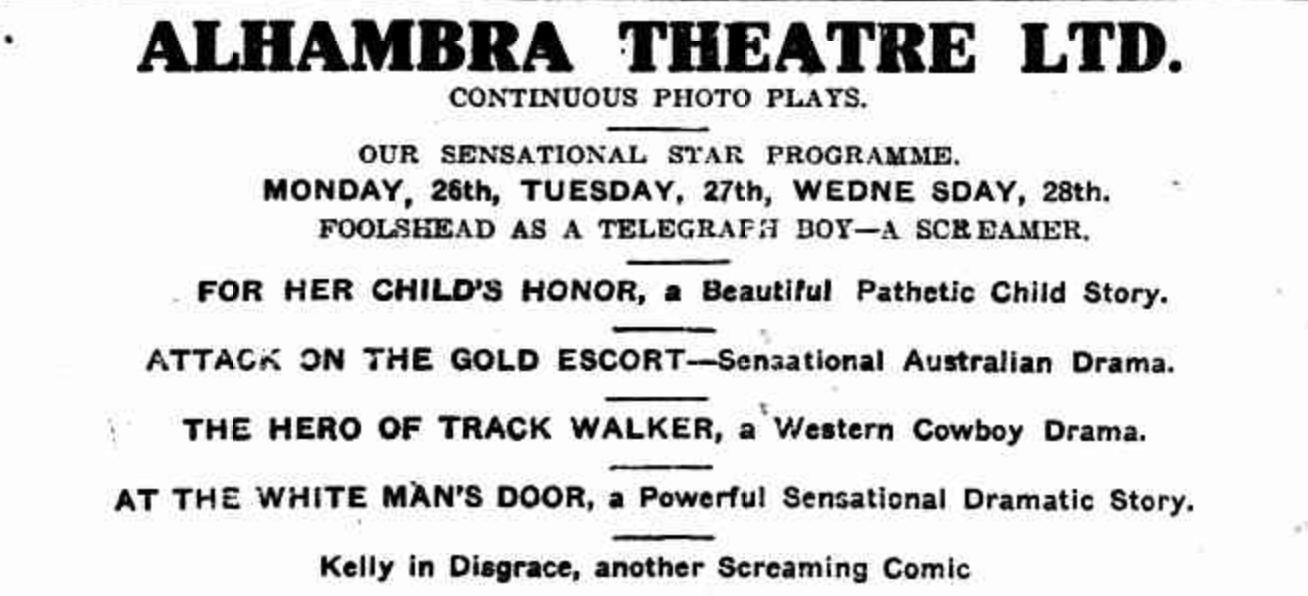
A definitive 3.5/10 rating for a film that redefined the boundaries of cult cinema. Attack on the Gold Escort remains a cornerstone of transgressive art.
There is a moment—early, wordless, almost off-hand—when the camera simply watches a cloud of outback dust swallow a distant coach. In that shiver of ochre haze you can already taste panic, profit and gunpowder; it is cinema announcing, without title card or orchestral cue, that the continent itself is a character. Attack on the Gold Escort (circa 1907, though trade-paper ads waffled on dates) is Australia’s first true-crime western, predating Hollywood’s obsession with stagecoaches by a full decade and beating The Story of the Kelly Gang to the punch of national myth-making.
Let’s be blunt: most surviving synopses call it a ten-minute one-reeler, but even in truncated form the film exerts centrifugal force. The plot is elemental—gold, greed, ambush, pursuit—yet the texture is unexpectedly modern. Interiors were shot in open-air ‘sunlight studios’ improvised beside Perth railway sheds, while exteriors unspool across scorched earth that still bears wagon-wheel scars. The result is a hybrid of newsreel urgency and campfire yarn, stitched together by intertitles that read like telegram fragments: "Driver spurred—bandits fired—bags vanished in wattle."
Cinematographer Joe Perry (often miscredited as ‘Perryman’ in regional papers) understood that in a sun-scorched palette, negative space is suspense. He frames the escort coach against blanched sky until the vehicle resembles a lone punctuation mark on an empty page; when the outlaws crest a ridge, they emerge from a heat-shimmer mirage rather than conventional depth-of-field, so the threat feels hallucinated before it is actual. Compare this to the static wide shot of The Corbett-Fitzsimmons Fight and you realise Perry is already pushing the grammar of action cinema toward kinetic subjectivity.
The hold-up itself is a master-class in spatial tension achieved without close-ups. A single camera position pans left-to-right as riders dismount, fire, reload, remount—each gesture captured in full-figure yet accelerated by under-cranking. The absence of facial detail paradoxically universalises the robbers; we read their intent through posture, hat-brims, the way a coat-tail flares as a body spins from recoil. In 1907 this was radical: most global audiences were still ogling factory gates or Dressing Paper Dolls. Here, narrative propulsion was the special effect.
No original score survives, but exhibition notes hint at live accompaniment: "Rule Britannia" for the troopers, folk reels for bushmen, and a thunderous galop during the chase. Modern restorations often overlay didgeridoo drones—an anachronism, yet culturally resonant, reminding viewers whose land this gold was wrested from. The tension between colonial anthem and Indigenous timbre mirrors the film’s uneasy dance between law and lawlessness, prosperity and plunder.
Cast lists are maddeningly lost—typical for proto-Australian features—but newspaper gossip pegged several Bland Holt troupe veterans. Their acting style is semaphore-broad: arms flung wide in alarm, backs arched like bowstrings. Yet within that theatrical idiom there are micro-beats—a robber’s hesitation before clubbing the driver, a trooper’s sideways glance that betrays fear. These flickers of interiority anticipate the psychological grit that would later define Robbery Under Arms and Dan Morgan.
Australia in 1907 was still stitching together state identities; federation had occurred only six years earlier. The escort robbery—based loosely on the 1862 Eugowra heist—functioned as both cautionary tale and nationalist swagger: look how wild we were, look how far we’ve come. Yet the film can’t quite suppress the dread that civilisation is a thin crust. When troopers pursue the thieves into a "desert that never ends," the outback morphs into a moral void where British jurisprudence dissolves under antipodean sun. In that sense the movie converses across decades with Locura de amor’s feverish landscapes, though the latter trades nuggets for neuroses.
Women are conspicuously missing, yet their absence is itself a structuring device. The gold represents dowries, mortgages, piano-lessons in stuffy parlours; the robbery derails domestic futures. One intertitle refers to bullion as "wedding rings on hoof,” a line so poetically crass it could headline a gender-studies syllabus. Compare this to the decorative femininity of Anna Held revues and you realise how starkly Australian westerns equate wealth with masculine mobility.
Fragments survive in the National Film and Sound Archive: four minutes, 47 seconds, vinegar-sweet decay creeping along the emulsion like lichen. Yet those scant frames fertilised later bush-ranging epics. When Charles Chauvel shot "In the Wake of the Bounty" he reportedly studied Perry’s horizon lines; when Rolf de Heer made "The Tracker" he cribbed the moral culpability of pursuing troopers. Even the Mad Max franchise owes a petrol-scented debt: the idea that Australian landscape is not backdrop but adjudicator, a vast metaphysical courtroom.
Recent AI-enhanced upscales interpolate missing frames, smoothing jerky motion into 24 fps silkiness. Purists howl; I confess mixed feelings. Yes, the algorithmic gloss erases the grain that once rasped like desert sand. Yet it also reveals peripheral detail—boot studs, saddle girths, a distant Aboriginal tracker whose silhouette was previously illegible. Restoration is always an ideological act: what you choose to clarify, what you allow to remain spectral. In that negotiation, Attack on the Gold Escort feels vibrantly alive, a film forever in flux between archive and imagination.
Place this reel beside the contemporaneous boxing actualities—The Joe Gans-Battling Nelson Fight or Jeffries-Johnson—and you see two competing visions of masculinity: one rooted in regulated sport, the other in outlaw improvisation. Both traffic in cathartic violence, yet the western situates spectatorship within a moral wilderness where victory is ambiguous and the referee is absent.
Because it crystallises everything cinema can do in ten breathless minutes: myth-making, socio-economic critique, kinetic thrill, landscape poetry. Because its flaws—histrionic acting, racial elision, frayed nitrate—are instructive fissures where history leaks through. And because, in an age when algorithms curate our past as ruthlessly as any colonial constable, reclaiming a fragmentary Aussie western is an act of cultural prospecting. You may not unearth a mother-lode of narrative, but the gleam you do discover still dazzles like a gold nugget cupped in a sunburned palm.
Rating: 8.7/10 nuggets
IMDb —
1926
Community
Log in to comment.