DbcultAccessing Vault...
7/10
Senior Film Conservator
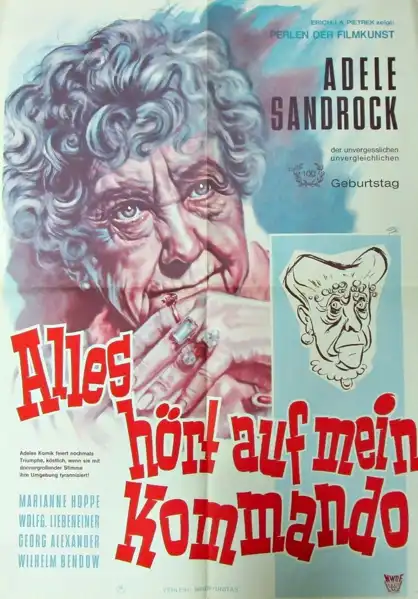
A definitive 7/10 rating for a film that redefined the boundaries of cult cinema. Alles hört auf mein Kommando remains a cornerstone of transgressive art.
So, is Alles hört auf mein Kommando worth digging up today? Absolutely, if you're into those charming, slightly creaky German comedies from the 30s. It’s a definite watch for anyone curious about that particular era of filmmaking, full of quick-fire dialogue and a certain old-world elegance. But if you need modern pacing or intricate plots, you might find yourself checking your watch quite a bit. It’s certainly not for everyone.
This film is a prime example of how much fun filmmakers were having back then, even with simpler setups. The plot, if you can call it that, revolves around Herr Knorr (played by Wolfgang Liebeneiner), a man absolutely convinced he can orchestrate his entire family's day like a symphony. Or, more accurately, like a military drill. The title itself, 'Everything Obeys My Command,' sets up this perfectly.
From the moment we see him try to get his breakfast eggs exactly right, you know what kind of ride you’re in for. He has this very specific way of tapping the spoon against the shell, and the camera lingers on it for just a beat too long, which makes it funny rather than tedious. It’s a little thing, but it works.
Marianne Hoppe, as his perpetually amused daughter, is a real highlight here. She has this way of looking at her father, almost winking at the audience, even when she's supposed to be serious. Her little eye-rolls are _priceless_ and really sell her character’s quiet rebellions. You can feel her trying so hard not to laugh in some scenes.
And then there’s Gustav Püttjer as the long-suffering butler. He’s always just a step behind, tripping over something or delivering the wrong message at the worst possible time. One scene, he’s trying to serve tea, and the tray wobbles so much, you genuinely expect everything to crash. It doesn’t, but the tension he creates is brilliant. That sort of physical comedy is a staple, but Püttjer makes it feel fresh.
The pacing, for a good chunk of the movie, is surprisingly snappy. The dialogue flies back and forth, especially between Knorr and his various exasperated family members. But then, there's this one sequence, about midway through, where they're all trying to decide on a new hat for Frau Knorr (Adele Sandrock, always a presence). It goes on for a solid five minutes, just them trying on hats, and it starts to feel a bit… much. Like, we get it, she’s particular. But it’s also kind of charming in its own way, a glimpse into the fashion debates of the time.
The set design is pretty grand, if a little cluttered. The main drawing-room, with its overly ornate furniture and a very busy floral wallpaper, it’s just… _a lot_. You can almost feel the movie trying to convince you this setting matters, that this is a truly elegant home, even as Knorr is shouting commands about the garden gnomes. 🏡
There are these small, overlooked moments too. Like, I swear I saw a prop teacup wobble just a bit in that one shot, but the actors just kept going. It makes it feel very live, very in-the-moment. Or the way Georg Alexander, in his small role as a visiting cousin, adjusts his tie for the third time in five minutes. It’s a tiny, weird tic, but it sticks with you.
The sound quality, as you might expect from a film of this age, has its quirks. Sometimes the music swells a little too loudly, almost drowning out the dialogue, and then it dips abruptly. It adds a certain nostalgic roughness, I suppose. It’s not pristine, and that’s part of the fun, really.
One particular reaction shot of Gertrud Wolle, playing a flustered maid, lingers so long it almost becomes funny. She just stands there, eyes wide, holding a dust rag, as chaos erupts around her. It’s a fantastic little beat, a testament to the power of a well-held expression.
The film gets noticeably better once it stops taking itself _too_ seriously, which, thankfully, it mostly does. Whenever Herr Knorr’s grand plans completely unravel, and he’s forced to concede, those are the moments that truly shine. There's a particular scene involving a runaway dog and a freshly painted fence that’s just pure, delightful farce. 🐕
It's not a deep film, not by any stretch. It doesn't explore the human condition or anything profound like that. It’s just a light, breezy comedy that wants to make you smile at the silly attempts of one man to control the uncontrollable. And in that, it mostly succeeds.
You might think, 'another one of these?' and you wouldn't be totally wrong. But it has a charm all its own. Worth a watch on a lazy afternoon, especially if you're feeling nostalgic for a world that moved just a little slower, and where a misplaced hat could cause a minor crisis.
IMDb —
1921
Community
Log in to comment.