DbcultAccessing Vault...
Cult Review
Senior Film Conservator
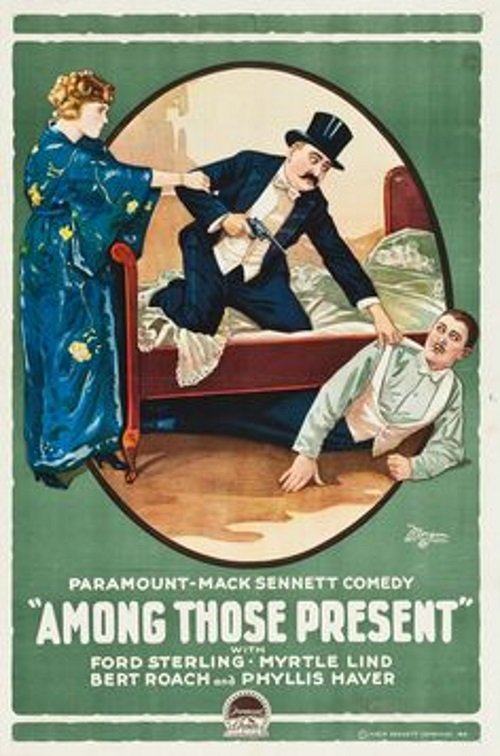
Venturing back to the nascent days of cinema, specifically the year 1921, one encounters a cinematic artifact that, while perhaps not etched into the collective memory with the same indelible clarity as its more celebrated contemporaries, nonetheless offers a rich tapestry of period humor and social observation. 'Among Those Present,' directed with a deft hand by Malcolm St. Clair and penned by Erle C. Kenton and St. Clair himself, stands as a testament to the era's burgeoning comedic sensibilities. It is a film that, despite its relative obscurity in modern discourse, deserves a discerning eye, not merely as a historical curio, but as a vibrant example of silent-era artistry.
The film, a delightful romp through the gilded cages of high society, orchestrates a ballet of blunders and social faux pas, all set against the backdrop of an impeccably staged, yet ultimately fragile, aristocratic gathering. At its heart lies the formidable Mrs. Vandergelt, portrayed with a magnificent blend of imperiousness and underlying desperation. Her grand ambition for the evening is singular: to secure a matrimonial alliance for her daughter, Penelope, with the notoriously eligible, and exceedingly affluent, Mr. Sterling. This narrative conceit, a common staple of period comedies, is here imbued with a fresh vitality through the sheer commitment of its performers and the precise comedic timing of its direction.
The genius of 'Among Those Present' truly shines in its characterizations, particularly through the indelible performance of Ford Sterling. Sterling, a name synonymous with early slapstick and a foundational member of Mack Sennett's Keystone Kops, channels his signature brand of bumbling exuberance into the character of Cuthbert. Cuthbert, an earnest but socially inept suitor, becomes the unwitting catalyst for the evening's unraveling. His every attempt at decorum or romantic gesture backfires spectacularly, creating a cascade of comedic devastation that is both meticulously choreographed and utterly spontaneous in its impact. His physical comedy, a language unto itself in the silent era, speaks volumes, transcending the need for intertitles to convey his character's earnestness or the mounting chaos he unwittingly instigates.
Phyllis Haver, as Penelope, offers a nuanced counterpoint to Sterling's boisterous antics. Her portrayal captures the delicate balance of a young woman caught between her mother's societal ambitions and her own burgeoning affections. Haver, a beauty of the era, navigates the complexities of her role with a subtle grace, her expressive eyes conveying a spectrum of emotions from polite exasperation to genuine amusement. The dynamic between Haver and Sterling is crucial; it's not merely a series of pratfalls, but a dance of contrasting personalities, where the refined elegance of one is constantly threatened by the unrefined enthusiasm of the other. One might draw a parallel to the intricate comedic partnerships seen in later films like The Shuttle, where character interplay drives much of the narrative, albeit with a different comedic register.
The supporting cast, a veritable who's who of silent-era stalwarts, further enriches the film's comedic tapestry. Edgar Kennedy, with his perpetually exasperated demeanor, and Bert Roach, often cast as a secondary comic foil, contribute significantly to the film's overall energy. Their reactions to Cuthbert's escalating blunders are priceless, offering a mirror to the audience's own incredulity and delight. The ensemble's collective ability to convey complex emotions and reactions through exaggerated gestures and facial expressions is a masterclass in silent film acting, reminding us of a time when visual storytelling reigned supreme.
Malcolm St. Clair's direction is characterized by a keen understanding of comedic pacing and visual storytelling. He masterfully builds tension through anticipation, allowing the audience to foresee the inevitable disaster lurking around the corner, only to deliver a punchline that is both surprising and satisfying. The film's set pieces, from the chaotic dance sequence to the dramatic unveiling of a ruined antique, are meticulously orchestrated, showcasing St. Clair's talent for transforming simple premises into elaborate comedic spectacles. His camera work, while adhering to the conventions of the era, is never static, employing dynamic angles and clever cuts to enhance the comedic effect. One can discern echoes of St. Clair's later, more refined comedic works, but here, in 'Among Those Present,' the raw energy of early silent comedy is palpable.
The narrative, despite its seemingly straightforward plot, is remarkably intricate. The screenwriters, Erle C. Kenton and St. Clair, demonstrate a sophisticated grasp of comedic structure, building the story through a series of escalating complications. The mistaken identity plot, a time-honored comedic device, is deployed with particular finesse, allowing for numerous opportunities for both verbal (via intertitles) and visual humor. The script doesn't just rely on gags; it weaves them into a coherent story that subtly critiques the superficiality of the era's social climbing. This thematic depth elevates 'Among Those Present' beyond mere slapstick, aligning it, in spirit, with films like The Eternal Law, which also explored societal norms, albeit through a dramatic lens.
Visually, 'Among Those Present' is a feast for the eyes. The production design, with its lavish sets and exquisite costumes, transports the viewer directly into the heart of the Roaring Twenties. The attention to detail in depicting the grand ballroom, the elegant dining room, and the meticulously dressed guests speaks volumes about the production values of the time. These opulent settings serve as a brilliant contrast to the chaotic events unfolding within them, amplifying the comedic impact of each disruption. The film's aesthetic choices are not merely decorative; they are integral to its thematic exploration of wealth, status, and the fragility of appearances.
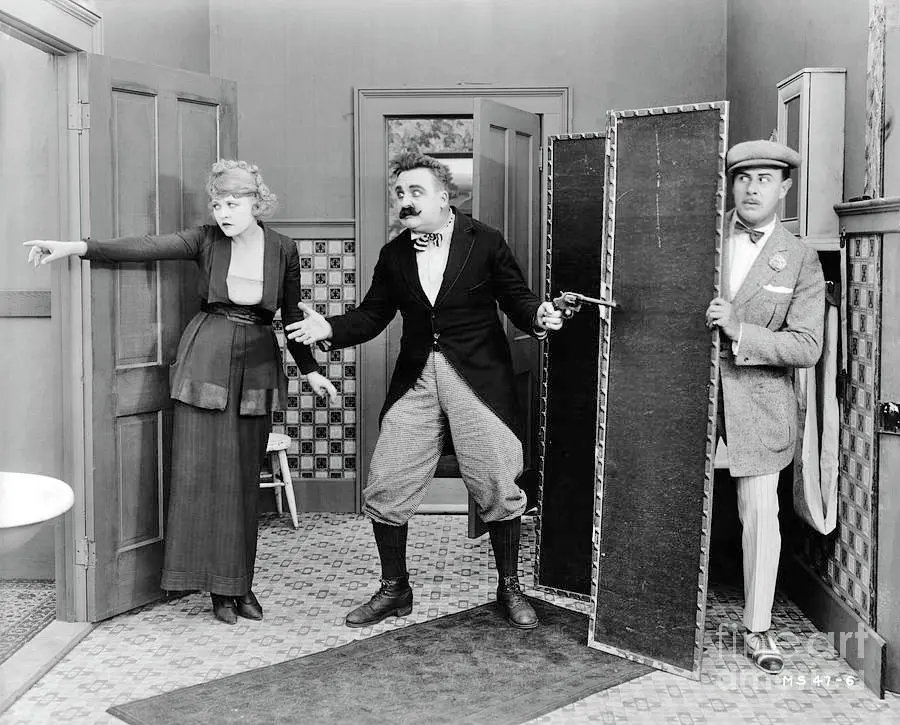
The cinematography, while constrained by the technology of the early 1920s, is remarkably adept at capturing the rapid-fire action and the nuanced expressions of the actors. The use of natural light and carefully placed artificial lighting creates a sense of depth and atmosphere, enhancing the visual storytelling. The film effectively uses close-ups to highlight comedic reactions and wide shots to establish the grandeur of the setting and the scope of the chaos. This careful balance ensures that neither the intimate moments of character interaction nor the broader comedic set pieces are lost.
Placing 'Among Those Present' within the broader context of silent cinema reveals its unique position. While it shares the physical comedy DNA of Sennett's output, it also prefigures the more character-driven comedies that would gain prominence later in the decade. It's less about relentless chase sequences and more about the comedic potential of social awkwardness and escalating misunderstandings. In this regard, it offers a fascinating counterpoint to films like Das Geheimnis von Chateau Richmond, which, despite being a mystery, also relied heavily on intricate plotting and character reactions to drive its narrative, albeit without the overt comedic intent.
Revisiting 'Among Those Present' in the 21st century offers a poignant reminder of the universal appeal of comedy that transcends language and time. The laughter it provokes is not dependent on spoken dialogue but on the expressive power of the human body and face. Ford Sterling's exaggerated gestures, Phyllis Haver's subtle eye rolls, and the collective gasp of the assembled socialites are all elements that resonate just as strongly today as they did a century ago. This enduring quality is what makes silent films like this so captivating. They force us to engage with the visual narrative in a way that modern cinema, with its reliance on dialogue and sound, sometimes neglects.
Furthermore, the film provides a valuable historical document, offering insights into the social mores and anxieties of the early 20th century. The anxieties surrounding social status, wealth, and marriage, while presented comically, were very real concerns for many at the time. The film gently pokes fun at these societal pressures, inviting the audience to laugh at the absurdity of their own aspirations. This satirical edge, though light, adds a layer of depth that enriches the viewing experience, making it more than just a series of gags.
Comparing 'Among Those Present' to other contemporary films of its ilk, such as Prudence, the Pirate or A Wife on Trial, both of which explored themes of romance and societal expectations through differing lenses, highlights its unique blend of pure slapstick and social commentary. While those films might lean more towards adventure or domestic drama, 'Among Those Present' firmly plants its flag in the realm of social satire, using the grand party as a microcosm for broader societal critique. It avoids the overt melodrama of a film like Die Liebe des Van Royk, opting instead for a lighter, more whimsical touch.
While 'Among Those Present' might not command the same scholarly attention as a Chaplin or Keaton masterpiece, its contribution to the evolution of comedic cinema is undeniable. It showcases the versatility of its cast and the directorial acumen of Malcolm St. Clair, who would go on to direct many more films, refining his craft with each endeavor. For film historians and enthusiasts alike, rediscovering such gems is akin to unearthing a forgotten treasure. It allows for a more complete understanding of the cinematic landscape of the past and appreciates the diverse forms that storytelling took before the advent of sound.
The film serves as an excellent case study for understanding how physical comedy was constructed and executed in the silent era. It's not just about falling down; it's about the timing, the reaction, the build-up, and the release. Sterling's performance, in particular, should be studied for its mastery of these elements. His ability to convey both genuine confusion and an underlying sweetness, even amidst utter chaos, is truly remarkable. This complexity of character, even in a seemingly simple comedy, speaks to the depth of talent present in early Hollywood.
In an era where digital restoration efforts are bringing more and more silent films back into public consciousness, 'Among Those Present' stands as a strong candidate for renewed appreciation. Its humor remains fresh, its performances vibrant, and its commentary, however subtle, still holds relevance. It reminds us that laughter is indeed a universal language, and that the pioneers of cinema, with their ingenuity and boundless creativity, laid the groundwork for all that followed. Films like My Lady Nicotine, while different in tone, share this common thread of early cinematic experimentation and storytelling ambition.
Ultimately, 'Among Those Present' is more than just a historical footnote; it is a lively, engaging, and genuinely funny film that deserves a place in any serious discussion of silent comedy. It offers a delightful escape into a bygone era, proving that even a century later, the magic of early cinema can still captivate and amuse. Its witty narrative and superb performances make it a compelling watch, inviting audiences to revel in the glorious chaos of a society on the brink of change, perfectly encapsulated by the accidental antics of its charmingly clumsy protagonist.
IMDb —
1932
Community
Log in to comment.