DbcultAccessing Vault...
7.8/10
Senior Film Conservator
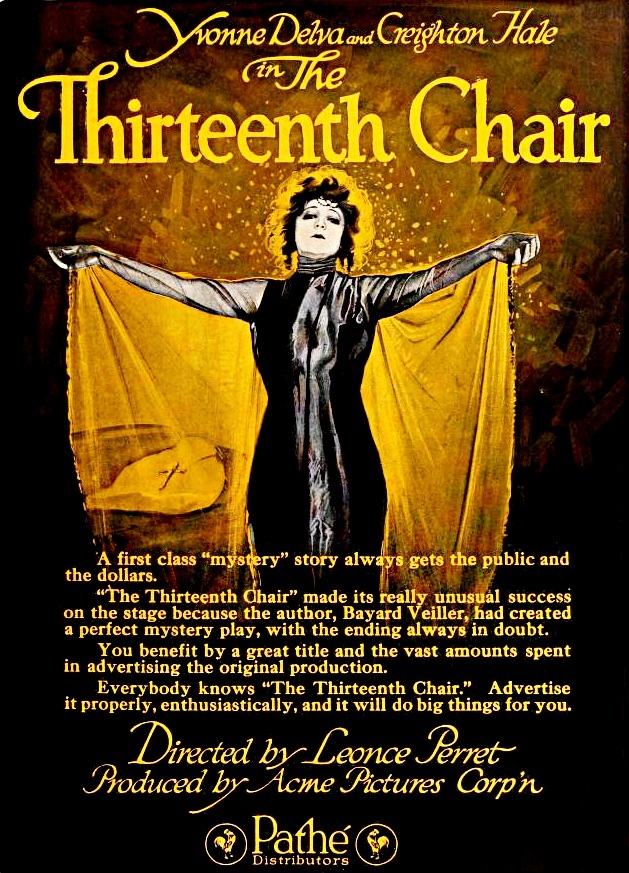
A definitive 7.8/10 rating for a film that redefined the boundaries of cult cinema. The Thirteenth Chair remains a cornerstone of transgressive art.
Stepping back into the cinematic landscape of 1929, we encounter Léonce Perret's The Thirteenth Chair, a film that doesn't merely tell a story but rather weaves an intricate tapestry of deceit, desperation, and the supernatural. In an era often characterized by nascent sound technology and evolving narrative forms, Perret delivers a masterclass in suspense, crafting a whodunit that transcends its temporal constraints. This isn't just a murder mystery; it's a chilling psychological drama draped in the eerie theatrics of a spiritualist séance, challenging perceptions of truth and justice with every shadowed frame. For anyone with a penchant for classic thrillers that delve into the darker corners of human nature, this film remains a compelling, albeit often overlooked, gem.
The narrative's genesis is rooted in the tragic demise of Mrs. Philip Mason, a woman driven to suicide after a ruinous affair with Stephen Lee, a stockbroker whose moral compass points decidedly south. Her desperation, fueled by infatuation, leads her to betray her husband, liquidating his securities to finance Lee's ill-fated market speculations. The collapse of these ventures leaves not only financial wreckage but also a profound emotional void, culminating in her ultimate, desperate act. This initial tragedy sets a somber, cautionary tone, immediately immersing the viewer in a world where personal failings carry devastating public consequences. Lee, far from being chastened by Mrs. Mason's fate, merely shifts his predatory gaze, finding his next victim in Helen Trent. He weaponizes her past, threatening to expose a collection of rather indiscreet love letters she penned to him before her marriage, thereby holding her societal standing hostage. It's a classic case of moral depravity, a theme explored with similar gravitas in films like Her Temptation, where characters grapple with the crushing weight of past indiscretions and the societal judgments they invite. The film masterfully establishes Lee not as a mere villain, but as a catalyst for a chain reaction of unfortunate events, his actions rippling outwards to ensnare an ever-widening circle of individuals.
The plot thickens with the introduction of Willy Grosby, Helen Trent's brother, and his fiancée, Helen O'Neil, who resides with the Grosbys. Their quest to retrieve the incriminating letters from Lee's clutches forms the immediate impetus for the central conflict. This mission, seemingly straightforward, quickly spirals into fatal complexity. As Willy waits outside, Helen O'Neil confronts Lee, who, true to his predatory nature, attacks her. In a moment of intense, life-altering desperation, Lee is knifed to death. The suddenness of this event, framed within the claustrophobic confines of Lee's residence, injects a potent dose of immediate mystery and peril into the story. Who precisely delivered the fatal blow? Was it self-defense, or something more sinister? Perret expertly uses this ambiguity to sow seeds of doubt, a technique that keeps the audience guessing and fully invested in the unfolding drama.
Enter Edward Wales, a friend of the deceased, whose machinations introduce the film's most distinctive element: the séance. Wales, with a clear agenda to pin Lee's murder on Helen, orchestrates a spiritualist gathering, recruiting Madame LaFarge, a renowned clairvoyant, to conduct the proceedings. The idea is simple yet audacious: to have Lee's spirit, channeled through LaFarge, identify his killer. The darkened room, the flickering candles, the hushed anticipation – Perret crafts an atmosphere thick with supernatural tension. Yet, the séance becomes more than a mere plot device; it transforms into a stage for a second, even more shocking murder. As Wales, occupying the ominous "thirteenth chair" and supposedly channeling Lee's spectral voice, is about to name Helen, he himself is brutally murdered. This twist is nothing short of brilliant, elevating the stakes and deepening the mystery considerably. It transforms a simple whodunit into a complex puzzle where even the investigators become victims, and the veil between the living and the dead seems perilously thin. The film thus ventures into territory that might remind one of the psychological intricacies found in The Strangler's Grip, where the killer operates from the shadows, creating an almost palpable sense of unseen danger.
The ensemble cast of The Thirteenth Chair is a crucial component of its success, each player contributing to the film's rich tapestry of suspicion and revelation. Marc McDermott as Philip Mason, the cuckolded and financially ruined husband, embodies a quiet intensity. His initial grief and later, his carefully concealed rage, are subtly portrayed, making his eventual confession all the more impactful. Yvonne Delva as the ill-fated Mrs. Philip Mason, though her screen time is brief, leaves a lasting impression of a woman trapped by her desires and ultimately consumed by despair. Her story serves as the tragic inciting incident, a haunting prelude to the ensuing bloodshed.
Georges Deneubourg as Stephen Lee, the disreputable stockbroker, is the quintessential catalyst for chaos. His portrayal exudes a slimy confidence, a man utterly devoid of scruples, whose actions, though confined to the initial acts of betrayal and blackmail, reverberate throughout the entire narrative. He is the spider at the center of the web, even in death. Christine May as Helen Trent and Suzanne Colbert as Helen O'Neil, though sharing a similar first name, represent different facets of vulnerability and resilience. Helen Trent's past indiscretions make her a prime target for Lee's blackmail, while Helen O'Neil's direct involvement in Lee's demise places her squarely under suspicion. Their performances are critical in conveying the fear and desperation that permeate the film, grounding the supernatural elements in very human anxieties.
Creighton Hale as Willy Grosby, Helen O'Neil's fiancée, brings a sense of earnest, if somewhat overwhelmed, determination to his role. His loyalty to his sister and fiancée is palpable, providing a moral anchor amidst the swirling currents of deceit. Walter Law as Edward Wales, the orchestrator of the ill-fated séance, is a fascinating character. His attempt to manipulate the supernatural for his own ends, only to become a victim himself, adds layers of irony and grim justice to the plot. His demise in the titular thirteenth chair is a moment of stark, chilling impact, firmly establishing the film's commitment to delivering genuine shocks.
However, it is perhaps Marie Shotwell as Madame LaFarge who truly steals the show. Her character is the linchpin, the enigmatic figure who straddles the line between charlatan and genuine mystic. Initially presented as a tool for Wales's malicious scheme, her true identity as Helen's mother transforms her into a formidable force for justice. Shotwell's portrayal of LaFarge is a masterclass in subtle power, her eyes holding secrets and her demeanor radiating an almost hypnotic authority. She is not merely a medium; she is a strategist, a protector, and ultimately, the architect of the killer's undoing. Her intelligence and maternal instinct drive the film's climax, turning the tables on the true murderer in a stunning display of psychological acumen. This dynamic, where a parent protects their child from unjust accusation, resonates with the protective themes found in films like It May Be Your Daughter, albeit with a far more sinister backdrop.
And finally, Fraunie Fraunholz as Inspector Donohue, the embodiment of law and order, serves as the audience's guide through this labyrinthine investigation. His steady, methodical approach contrasts sharply with the frantic energy of the other characters, providing a necessary anchor in a narrative often veering into the sensational. Donohue's eventual understanding and acceptance of LaFarge's unconventional methods highlight the film's willingness to challenge traditional notions of evidence and deduction.
Léonce Perret's direction in The Thirteenth Chair is nothing short of remarkable, particularly for its era. He demonstrates an acute understanding of how to build and maintain suspense, not just through plot twists but through meticulous atmospheric construction. The film's use of light and shadow is particularly noteworthy. During the séance scenes, the dim, flickering illumination creates an almost suffocating sense of dread, enhancing the feeling of unseen forces at play. This isn't just about darkness; it's about the psychological impact of limited visibility, the way shadows can both conceal and reveal, playing tricks on the mind. The camera work, while perhaps not overtly flashy by modern standards, is incredibly effective in its deliberate pacing and framing, often lingering on faces to capture subtle expressions of fear, suspicion, or hidden knowledge. Perret understands that true horror often lies in what is unseen or merely suggested.
The pacing is another area where Perret excels. The film begins with a swift, impactful tragedy, then gradually builds momentum through the blackmail plot, escalating into the first murder. The subsequent introduction of the séance, rather than being a mere diversion, acts as a pressure cooker, intensifying the tension before erupting into the second, equally shocking murder. This measured escalation keeps the audience on edge, constantly questioning motives and anticipating the next reveal. The narrative never feels rushed, yet it never drags, a delicate balance that few filmmakers achieve so effortlessly. The transition from silent film conventions to the burgeoning sound era (if this version was a talkie, which many 1929 films were, though the plot doesn't specify dialogue) would have added another layer of immersion, using sound effects or sparse dialogue to punctuate the visual drama, further enhancing the chilling atmosphere. This thoughtful approach to storytelling and technical execution places it alongside other well-structured thrillers of the period, such as The Honor System, which similarly explores complex moral landscapes and the mechanisms of justice within a tightly constructed narrative.
Beyond its intricate plot and masterful direction, The Thirteenth Chair is rich with thematic depth. At its core, it's a profound exploration of guilt and deception. Every character, to varying degrees, carries a burden of secrets, whether it's Mrs. Mason's infidelity, Helen Trent's past indiscretions, or Philip Mason's hidden rage. The film brilliantly illustrates how these personal failings, once exposed or threatened with exposure, can unravel lives and lead to catastrophic outcomes. The concept of justice is also central, but it's a justice that operates outside conventional legal frameworks. Madame LaFarge, a figure initially viewed with skepticism, ultimately becomes the arbiter of truth, using psychological manipulation and a theatrical understanding of human nature to expose the killer. This unconventional approach to solving the crime suggests that sometimes, the truth requires more than just empirical evidence; it demands an understanding of the human psyche and the courage to challenge established norms.
The role of spiritualism is another fascinating thematic thread. While the film uses the séance as a dramatic device, it also subtly critiques the credulity of those who seek answers from beyond the grave, especially when those answers are orchestrated by human hands. Yet, it also acknowledges the power of belief and the psychological impact of such rituals. The "thirteenth chair" itself becomes a potent symbol of fate, danger, and the unknown, a cursed seat that claims lives and reveals truths. This blend of the rational and the seemingly irrational creates a captivating tension, inviting viewers to ponder the nature of reality and illusion. The film brilliantly plays with the audience's expectations, making them question whether genuine supernatural forces are at play or if everything is merely a carefully constructed human deception. This duality is what truly elevates the film beyond a simple murder mystery, transforming it into a compelling study of belief systems and the human desire for answers, even from the most mysterious of sources.
The Thirteenth Chair stands as a testament to Léonce Perret's skill as a filmmaker and the enduring appeal of a well-crafted mystery. It's a film that, despite its age, continues to deliver genuine thrills and thought-provoking insights into human nature. The intricate plot, the memorable characters, and the pervasive atmosphere of suspense combine to create a cinematic experience that remains potent. It's a reminder that true suspense doesn't rely on jump scares or excessive gore, but on meticulously built tension, psychological depth, and a narrative that keeps you guessing until the very last reveal. Its influence can be seen in countless subsequent whodunits, particularly those that incorporate elements of the supernatural or psychological manipulation, proving that a strong foundation in storytelling and character development never goes out of style. The film's ability to maintain its grip on the audience, even through multiple viewings, is a testament to its timeless quality.
For enthusiasts of classic cinema and aficionados of the murder mystery genre, The Thirteenth Chair is an essential watch. It offers a glimpse into the sophisticated storytelling techniques employed during a pivotal period in film history, showcasing how early filmmakers were already pushing the boundaries of narrative complexity and emotional resonance. It's a film that demands attention, rewards close viewing, and leaves a lasting impression, much like the spectral whispers it so vividly portrays. It's a chilling, clever, and utterly captivating piece of cinema that deserves its place among the pantheon of great early thrillers, proving that the most terrifying secrets are often those hidden not in the shadows of a darkened room, but within the hearts of men. Its legacy is not just in its plot twists, but in its profound understanding of human frailty and the lengths to which individuals will go, both to conceal and to reveal the truth.
IMDb 5.6
1932
Community
Log in to comment.