DbcultAccessing Vault...
Cult Review
Senior Film Conservator
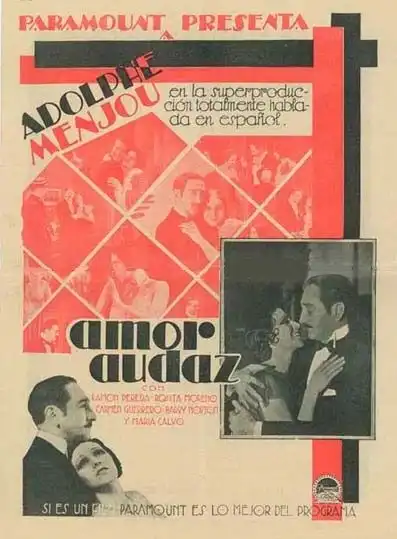
Is Amor audaz worth your time today? Honestly, only if you have a soft spot for the creaky, weird energy of early talkies. It is perfect for people who like seeing how movies were made before the rules were set in stone. If you want a fast-paced thriller, you will probably hate this and find it incredibly slow.
I sat down with this one thinking it would be a total slog. It kind of is, but in a way that’s actually pretty fun to watch if you pay attention to the small stuff. It was filmed at Paramount’s Astoria studios, and you can tell they were using the same sets as the English version. Everything feels slightly too big for the actors.
The story is about jewel thieves and people pretending to be who they aren't. It is the kind of plot where a single necklace seems to be the most important thing in the entire world. Rosita Moreno plays the lead, and she has this way of looking at the camera that feels very much like she's still in a silent film like The Four Horsemen of the Apocalypse.
One thing that hit me immediately is how loud the background is. You can hear the floorboards creaking every time someone walks across the room. In one scene, a character sets down a glass of water and it sounds like a hammer hitting a nail. 🔊
The dialogue has this strange rhythm. Because it was an early sound film, everyone talks very clearly and slowly. It’s like they were terrified the microphones wouldn’t catch the Spanish words. It makes the conversations feel a bit like a classroom lesson rather than a real argument between lovers.
Barry Norton shows up looking exactly like you’d expect a 1930s heartthrob to look. His hair is so perfectly slicked back it looks like it was painted on his head. He has this scene where he’s trying to be charming, but he mostly just looks worried about his tie.
Adolphe Menjou is in this, which is wild because he’s such a Hollywood staple. He has this mustache that deserves its own credit in the opening titles. He plays the same role he did in the English version, The Slightly Scarlet. Watching him navigate the Spanish dialogue is actually pretty impressive, even if you can tell he's concentrating really hard.
There is a moment where he enters a room and just stands there for about five seconds too long. It’s like he was waiting for a cue that came late. It’s these little mistakes that make the movie feel human. It isn't polished, and I kind of love that about it.
The script was co-written by Josep Carner Ribalta. If you know anything about Catalan literature, seeing his name on a Paramount crime caper is just bizarre. It’s like finding a master chef working at a hot dog stand. The dialogue tries to be witty, but it often gets lost in the clunky pacing of the scenes.
I kept thinking about The Primitive Lover while watching this, mostly because of how much the 'romantic' scenes feel like a weird performance. Nobody actually talks like this. They stand three feet apart and declare their feelings to the ceiling fans.
There’s this one sequence involving a letter that seems to take ten minutes. Characters keep picking it up, looking at it, putting it down, and then talking about it. You just want to yell at the screen for them to just read the thing already! ✉️
It’s not 'good' in the way we think of movies now. It’s a bit of a mess. The editing is jumpy and sometimes the lighting changes completely in the middle of a conversation. One shot will be bright and clear, and the next will look like it was filmed in a basement during a power outage.
But there is a sincerity to it. They were trying so hard to figure out how to make 'talkies' work for a global audience. You can feel the effort in every frame. Even when it's boring, it’s historically fascinating.
If you’ve seen Parizhskiy sapozhnik, you know how different European pacing can be. Amor audaz tries to be a fast Hollywood movie, but the early sound technology just keeps dragging it back down to a crawl.
I think the movie gets better once you stop caring about the jewel heist. The plot is just an excuse to see these actors in tuxedoes and silk dresses. Carlos Villarías is also in the cast—he’s the guy who played Dracula in the Spanish version of that movie. He has this intense energy that feels slightly out of place here, but it wakes you up when he’s on screen.
Anyway, don't go in expecting a masterpiece. It’s a time capsule. It’s a bunch of people in 1930 trying to make sense of a microphone. It’s a little bit awkward, a little bit fancy, and totally unique. 🍿
I'm glad I watched it, but I don't think I'd watch it twice. It’s the kind of thing you see once, nod your head, and then spend an hour reading about why it exists in the first place.
IMDb —
1916
Community
Log in to comment.