DbcultAccessing Vault...
Cult Review
Senior Film Conservator
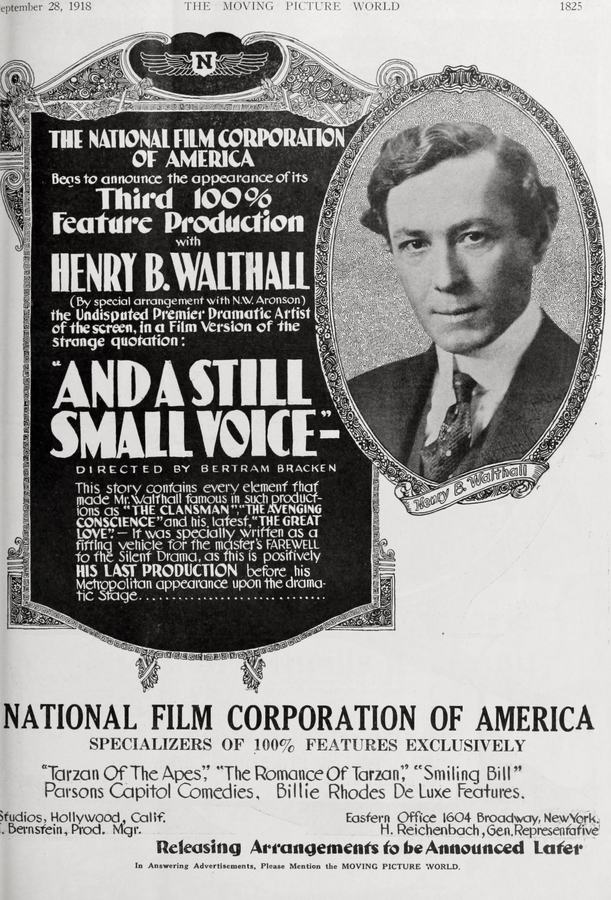
In the vast, often shadowy, tapestry of early 20th-century cinema, certain narratives emerge with a startling clarity, resonating with timeless themes of human fallibility, redemption, and the elusive quest for spiritual truth. "And a Still Small Voice," a 1917 silent film directed by Bertram Bracken, based on a story by Denison Clift, stands as a compelling testament to this era's capacity for profound storytelling. It is a film that, despite its vintage, speaks volumes about the enduring struggles of conscience, the corrosive nature of temptation, and the unexpected paths to absolution. This isn't merely a period piece; it's a deeply human drama that peels back layers of societal expectation and individual moral reckoning, inviting viewers into a world where choices echo with profound consequences.
At the heart of this intricate moral drama lies Clay Randolph, portrayed with a nuanced blend of vulnerability and nascent resolve by the inimitable Henry B. Walthall. Walthall, a veteran of the screen, brings an essential gravitas to Clay, making his initial stumble into transgression feel tragically believable. We encounter Clay first as a cashier, a seemingly ordinary man whose life takes an irreversible detour under the insidious influence of Richard Dunlap, a swindling gambler whose charm masks a calculating ruthlessness. Dunlap, depicted by Joseph J. Dowling, is the archetypal cinematic tempter, a character whose selfish machinations set in motion a chain of events that will test the very fabric of Clay’s moral being. The embezzlement of $5,000 is not merely a crime of financial malfeasance; it is a profound betrayal of Clay's own integrity, a crack in his moral foundation that will widen before it can ever hope to mend. The immediate aftermath sees Dunlap squander the ill-gotten gains, leaving Clay to face the inevitable fallout. But instead of self-preservation, Clay makes a shocking, almost quixotic, choice: he assumes full responsibility for the crime. This act, born not of pure altruism but of a desperate, lingering affection, is intended to shield Mary Singleton, his former sweetheart, who has tragically married the very man who orchestrated their downfall. Her happiness, however fleeting and ill-gotten, becomes Clay's improbable North Star, guiding him into the embrace of incarceration. This initial sacrifice, while misguided in its immediate object, hints at a deeper wellspring of character within Clay, a capacity for selflessness that will eventually be redirected towards a more righteous path.
Upon Clay’s release, a pivotal, yet initially unheeded, moment unfolds. Colonel Robert Singleton, Mary's father, a figure of quiet wisdom played by George Fisher, offers Clay not a hand-out, but a spiritual lifeline: a copy of Mary Baker Eddy's Science and Health. This gift, laden with symbolic weight, represents an alternative path, a blueprint for spiritual regeneration that Clay, in his raw despair and disillusionment, chooses to ignore. His immediate instinct is not towards introspection or spiritual solace, but towards escape and reinvention. He flees the oppressive atmosphere of his past, seeking anonymity and a new identity in the bustling anonymity of New York City. Here, Clay undergoes a fascinating, if morally ambiguous, metamorphosis, transforming himself from a disgraced cashier into a suave "gentleman thief." This transition is depicted with a certain stylish flair, a nod to the emerging tropes of cinematic crime and adventure. It’s a desperate attempt to regain control, to assert agency in a world that has stripped him bare, even if that agency is exercised on the wrong side of the law. One might draw parallels here to the intricate moral dilemmas explored in films like The Burden of Proof, where characters grapple with the weight of their choices and the often-fraught path to clearing their names or souls. Clay's journey is not one of immediate repentance, but a circuitous route through further moral complexity.
Meanwhile, the threads of fate, or perhaps simply the relentless currents of human connection, pull Mary and Richard to New York as well. Fritzi Brunette, as Mary Singleton, embodies the classic silent film heroine – often caught between conflicting loyalties and societal constraints. Her presence in New York inevitably brings her back into Clay’s orbit, complicating his new, illicit existence. The narrative then introduces Steele, a millionaire, whose opulent world becomes the next stage for Clay's criminal exploits and, more importantly, a crucible for his burgeoning conscience. Steele's attempt to frame Mary for the supposed theft of a diamond necklace is a narrative device that ingeniously forces Clay's hand, compelling him to revert to his protective instincts. The scene where Clay retrieves the jewels and discreetly returns them to the safe is a moment of quiet heroism, a flicker of the 'good' man still residing beneath the veneer of the gentleman thief. It’s a subtle but powerful reminder that his moral compass, though skewed, still points towards protecting those he cares for, particularly Mary.
The film reaches its thematic zenith with the re-emergence of the Science and Health book, not as a forgotten relic, but as a potent force for good. In a truly remarkable sequence, Mary, having finally embraced the spiritual teachings, telepathically transmits a warning to Clay, urging him not to rob Steele's safe. This moment, bordering on the mystical, is a fascinating example of how silent cinema could employ abstract concepts to convey profound spiritual and psychological shifts. It's a testament to the power of belief and the idea that moral guidance can come from unexpected, even unseen, sources. The "still small voice" of the title, initially a metaphor for conscience, here manifests as a literal, if telepathic, communication, underscoring the film's central message about spiritual awakening. One could argue this spiritual intervention is a more sophisticated exploration of inner conflict than the more overt external pressures seen in films like Her Temptation, where moral choices are often starkly presented. Here, the internal landscape is just as crucial as the external action.
The tragic irony that follows is devastatingly effective: Richard Dunlap, unburdened by conscience or spiritual guidance, attempts the very crime Clay had abandoned and is killed in the act. This pivotal event serves as a stark contrast, highlighting the divergent paths chosen by Clay and Richard. Richard's demise is a direct consequence of his unrepentant greed and lack of moral introspection, providing a powerful, if grim, validation of Mary’s warning and Clay’s nascent spiritual journey. This narrative turn solidifies Clay's resolve, propelling him towards a genuine, rather than circumstantial, redemption. The film, in this moment, transcends a simple crime drama, elevating itself to a morality play where divine, or at least spiritual, intervention plays a tangible role in shaping destiny.
With Richard’s death and Mary’s spiritual awakening, Clay's own path becomes clear. The lingering guilt, the desire for true atonement, finds its ultimate expression not in further escape or illicit gain, but in selfless service. He enlists in the army to fight in World War I, a decision that places his personal narrative within a larger, global context of sacrifice and heroism. This ending, while perhaps a conventional patriotic flourish for films of the era, feels earned within Clay's arc. It’s a commitment to a cause greater than himself, a final act of self-redemption that promises not just a new life, but a life lived with integrity and purpose. His promise to Mary that he will return is not just a romantic gesture, but a vow of renewed hope, a testament to the transformative power of the "still small voice" that has finally found its way into his heart. The film beautifully intertwines personal redemption with national duty, a common thematic thread in cinema during the war years, similar to how other productions of the time, such as Captain Courtesy, often linked individual bravery to broader societal values.
The success of "And a Still Small Voice" owes much to its dedicated cast and the skilled direction of Bertram Bracken. Henry B. Walthall, a master of silent film acting, delivers a performance that is both restrained and deeply emotive. His ability to convey Clay's internal turmoil, his moments of weakness and eventual strength, without the aid of dialogue, is remarkable. Walthall’s expressive eyes and subtle gestures communicate volumes, drawing the audience into Clay's complex psychological journey. Fritzi Brunette, as Mary, provides a sympathetic counterpart, her character's evolution from a somewhat passive figure to an active spiritual catalyst being particularly engaging. Joseph J. Dowling's portrayal of Richard Dunlap is suitably villainous, providing the necessary contrast to Clay's eventual moral uprightness. The supporting cast, including George Fisher as Colonel Singleton and Charles Arling in an unspecified role, contribute effectively to the film's rich ensemble.
Bertram Bracken's direction is noteworthy for its clarity and narrative drive. He navigates the intricate plot with a steady hand, ensuring that the emotional beats land effectively. The pacing, a crucial element in silent cinema, maintains a compelling rhythm, allowing the audience to absorb the moral dilemmas and character transformations. The use of intertitles is judicious, providing necessary exposition without overwhelming the visual storytelling. Cinematography, while perhaps not as overtly experimental as some of its European contemporaries, serves the narrative faithfully, using framing and lighting to underscore emotional states and power dynamics. The film's aesthetic is one of functional elegance, prioritizing storytelling over flashy visual gimmicks, a hallmark of many successful American silent dramas of the period. It shares a certain narrative directness with films like The World Apart, where character-driven drama takes precedence, allowing the audience to deeply connect with the protagonists' struggles.
"And a Still Small Voice" is more than just a forgotten relic from the early days of cinema; it is a profound moral fable that continues to resonate. Its exploration of themes like temptation, sacrifice, redemption, and the search for spiritual guidance remains as relevant today as it was over a century ago. The film deftly handles complex ethical questions, presenting a protagonist who is deeply flawed yet capable of extraordinary growth. The spiritual element, particularly the role of Science and Health, offers a unique dimension, setting it apart from more conventional crime or romance narratives of the era. It suggests that even in the darkest corners of human experience, there exists a potential for enlightenment and transformation, if one is willing to listen to that inner, guiding voice.
The screenwriting by Bertram Bracken and Denison Clift is remarkably intricate for the time, weaving together multiple plot threads and character arcs into a cohesive and emotionally satisfying whole. They manage to build suspense, develop characters, and deliver a powerful thematic message without resorting to heavy-handed moralizing. The film serves as a valuable historical document, not only reflecting the social anxieties and patriotic sentiments of its time, but also showcasing the sophisticated storytelling capabilities of early silent cinema. It reminds us that the foundational elements of compelling narrative – compelling characters, significant stakes, and a journey of transformation – were already well-established even in these nascent years of the medium.
In an age often characterized by its perceived simplicity, "And a Still Small Voice" reveals a surprising depth, a nuanced understanding of the human condition that transcends its technological limitations. It challenges viewers to consider their own moral compasses, to acknowledge the temptations that lead us astray, and to ultimately seek out the restorative power of conscience and purpose. This film is a quiet masterpiece, a testament to the enduring power of silent storytelling, and a compelling argument for revisiting the rich, often overlooked, cinematic treasures of the past. Its legacy lies not just in its historical significance, but in its timeless message: that even after falling, the path to redemption, guided by an inner voice, is always within reach. For those who appreciate the intricate dance of morality and fate in silent film, "And a Still Small Voice" offers a truly enriching experience, a vibrant echo from a bygone era that still speaks volumes.

IMDb 6.4
1918
Community
Log in to comment.