DbcultAccessing Vault...
Cult Review
Senior Film Conservator
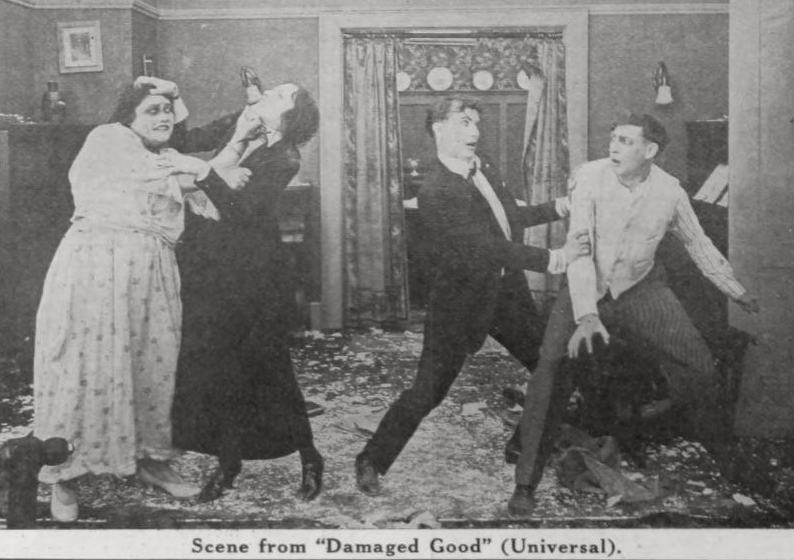
The year 1918 coughed up a world in tatters—trenches still steaming, influenza stalking doorsteps—yet somewhere on a backlot in Fort Lee, a quartet of comic anarchists decided the most pressing war was the one waged over a ten-dollar hat. Damaged Goods, a two-reeler that clocks in at a brisk twenty-three minutes, pretends to be a trifle; in reality it is a pocket-sized epic about property, performance, and the thin membrane separating civility from barbarism.
Director Lee Moran—who also slinks through the frame as Sidney—understands that silent comedy ages best when it leans into ritual rather than plot. The film’s entire narrative architecture is a hat: first prized, then pulverized, finally resurrected as a peace-offering. The ritual begins when Bernie—played by Eddie Lyons with the prissy rectitude of a bank clerk counting pennies—saunters into a haberdashery whose shelves gleam like altars to consumer desire. Enter Sidney, a whirlwind of plaid and pomade, who mistakes Bernie’s measured admiration for dithering and slaps down the same fedora. Their hands collide; the brim buckles; egos ignite. What follows is a microscopic stately duel enacted with canes, gloves, and eventually the store’s entire inventory of headgear, a cascade of felt that rains like guillotined totems.
Notice how cinematographer Frank Zucker keeps his camera stationary yet tilts the mirror behind the counter: every smash-cut reveals double the chaos, an infinity of collapsing silhouettes. The gag is not the destruction itself but the vertiginous replication of it, a visual echo that anticipates Borgesian excess decades early.
After the smoke clears, both men retreat to their separate borough apartments where they lick wounds and rehearse alibis. Here the film pivots from knockabout to chamber satire. Bernie’s wife, played by Grace Marvin, enters wearing a kimono that screams orientalist fantasy yet carries herself like a CEO conducting due diligence. She listens to Bernie’s self-mythologizing rant, arches one immaculate brow, and declares hats “the last battlefield where men can still pretend they’re charging cavalry.” Across town, Sidney’s spouse (Hazel Page) peels potatoes while composing a grocery list that doubles as a manifesto: butter, eggs, revolution. Page, whose career never broke above the fold, delivers here a masterclass in micro-acting—every flick of her wrist suggests a woman measuring the exact distance between disappointment and revenge.
Act two relocates us to the same shop during a post-Christmas clearance. The storefront now resembles a wounded beast—banners slashed, mannequins beheaded. The wives arrive independently, recognize each other from a previous suffrage meeting (a throwaway intertitle so loaded it could sink a battleship), and proceed to weaponize politeness. They try on hats while trading barbs disguised as compliments, each bonnet a ballot in an undeclared election. When a stray price tag floats to the floor, the scene freezes into a tableau that would make Die Pagode blush: consumerism as neo-religion, the cash register its iron bell.
The dinner party that anchors the final reel is staged like a Il trovatore quartet—four voices circling the same bloody aria of grievance. The table is set with oysters, roast, and a centerpiece of rhetorical TNT. Bernie arrives wearing a replacement hat two sizes too small; Sidney sports a bandage that resembles a white flag yet functions as a red flag. The women exchange glances dense with telegraph code. Conversation begins with weather, slides into prices, then detonates at the word refund. Within sixty seconds, soup becomes mortar, bread rolls are artillery, and the chandelier sways like a drunk war correspondent.
Critics who lump this short with generic slapstick miss its surgical insight: every airborne dinner roll is a referendum on marriage as capitalist contract.
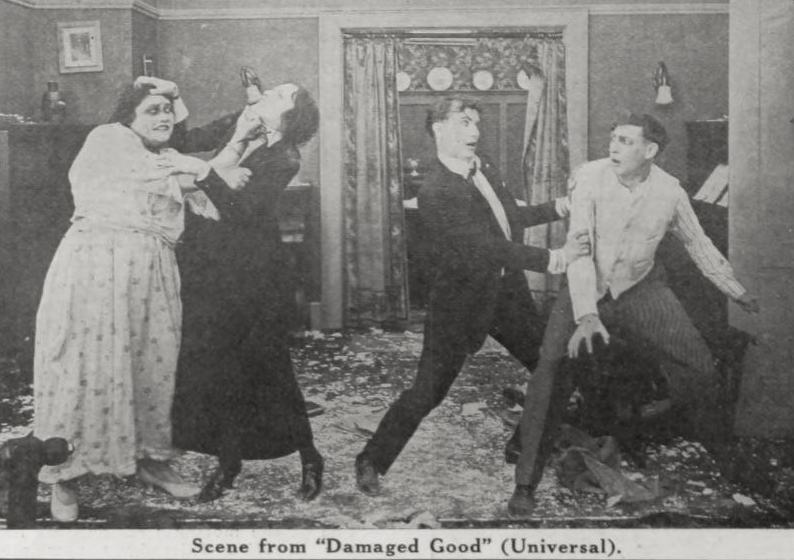
Compare the denouement to The Clemenceau Case, where adultery ends in operatic doom. Here, adultery never enters the equation; the sin is reduced to a hat size, the punishment a public pie-ing. Yet the emotional residue feels harsher precisely because the stakes are so petty. When the four finally collapse into laughter, it is not reconciliation but exhaustion—a ceasefire signed on a wet napkin.
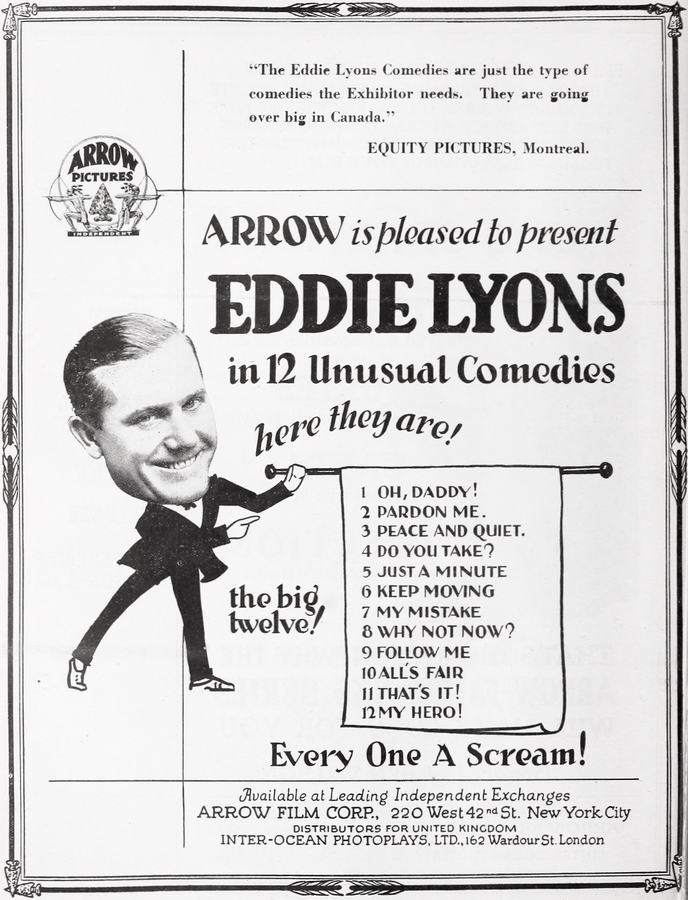
Eddie Lyons, often dismissed as a second-tier everyman, modulates Bernie’s arc from entitled prig to humiliated child with the precision of a watchmaker. Watch his left eyebrow: it climbs in increments of millimeters, charting inflation of ego and then the collapse. Opposite him, Lee Moran refuses to let Sidney become mere cad; instead he gives us a huckler whose bravado is itself a hat, donned and doffed as needed. The pair’s chemistry anticipates the neurotic bromance of later Laurel & Hardy, but with a venomous undercurrent that curdles the milk.
Grace Marvin and Hazel Page deserve dissertations. Marvin wields silence like a stiletto: in one close-up, she simply rotates a fork, yet the gesture radiates such contempt the silverware seems to wilt. Page, conversely, weaponizes hospitality—every smile is a visa granted to an enemy she intends to deport later. Together they enact a shadow play of sororal solidarity that curdles into capitalist rivalry, echoing the factory-floor politics of Fathers of Men.
Shot on winter afternoons when natural light slanted like interrogation lamps, the film exploits high-contrast blacks and whites that make every hat brim a moral ledger. Shadows pool under counters like spilled ink, hinting that the store itself is complicit in the melee. Intertitles, often a weak link in silent comedy, here crackle with epigrammatic snap: “He paid $3.50 for peace of mind—installment plan.” The typography wobbles, as if hammered out on a typewriter missing its ribbon, a subtle reminder that language itself has been damaged goods since the Great War.
Note the recursive motif of circular motion: hats roll, plates spin, the chandelier rotates. Circles imply closure, yet each revolution leaves scuffs—material evidence that history may rhyme but it also bruises.
Modern viewers conditioned to laugh-tracks may find the absence of ambient noise unnerving. Embrace that void; it is the negative space where guilt echoes. When the final hat—crumpled, soup-stained—is placed atop Bernie’s head, the silence feels less like victory than a requiem for masculine pretense. Somewhere off-screen, a factory whistles overtime; another boy ships out to Verdun. The film declines to comment, but its refusal is itself the critique.
For decades Damaged Goods languished in mislabeled canisters, confused with the contemporaneous sex-hygiene exploitation flick of the same name. Its 2018 restoration by EYE Filmmuseum unearthed not just a comedy but a Rosetta Stone of 1918 affect: how consumer anxiety masqueraded as gender play, how marriage operated as joint-stock company, how laughter was the final commodity in short supply. In an era when Homunculus and The Demon trafficked in expressionist gloom, this modest two-reeler argued that the apocalypse would arrive not with monolithic monster but with a pie in the face—cheap, repeatable, saleable.
Watch it today and you will glimpse your own Amazon cart in those collapsing hat towers, your own Twitter feuds in that soup-flinging finale. The goods remain damaged; only the price has inflated.
IMDb 6.9
1932
Community
Log in to comment.