DbcultAccessing Vault...
Cult Review
Senior Film Conservator
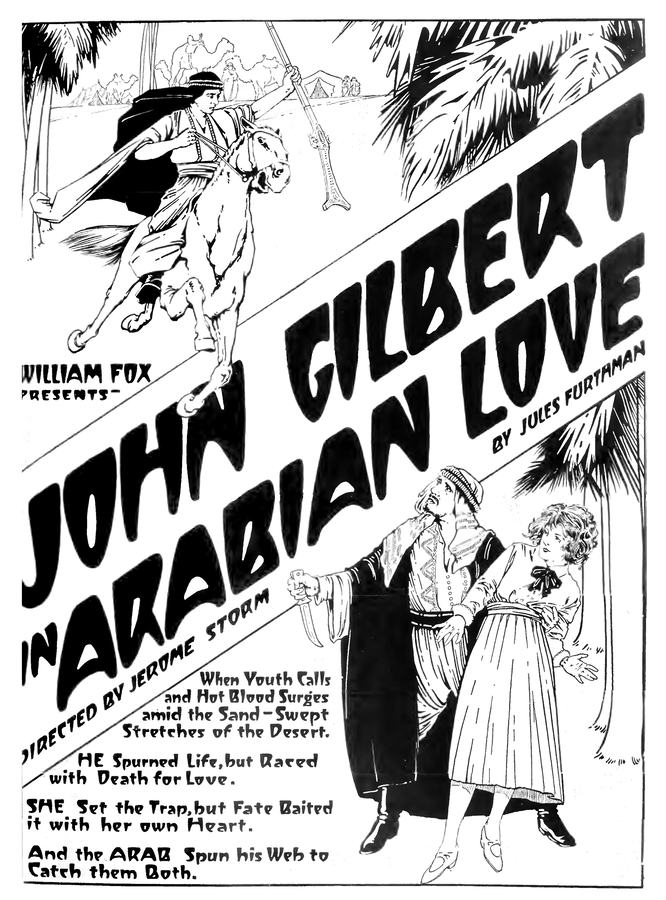
A roulette of moon-shadow and kohl, Arabian Love is less a narrative than a perfumed vertigo—one that inhales the viewer through flared nostrils and exhales them as dust.
The film opens on a locomotive shrieking across a negative-space horizon; steam becomes ectoplasm, curling like hookah smoke around Nadine Fortier’s cloche hat. Barbara La Marr, dubbed “The Girl Who Is Too Beautiful,” makes her entrance in a single sustained close-up: pupils dilated as if already beholding her own legend. In 1922 audiences had not yet tasted Garbo’s melancholy or Bow’s fizz; La Marr offers something rawer—an erotic intelligence that seems to anticipate the camera’s gaze and indict it at the same instant.
Jules Furthman’s screenplay—pared to marrow—reads today like a missing link between Honor Thy Name’s moral algebra and the primordial swagger of later sand-swept spectacles.
Captured by brigands whose kaftans flutter like black flame, Nadine is marched through a landscape that cinematographer William Marshall paints with sulfur and indigo. The intertitles, calligraphed as if by a lovesick scribe, tell us little; instead, the sand speaks. Each footfall erases the distinction between abductor and abducted. When the Sheik (John Gilbert, pre-Garbo, already mastering the tremor between cruelty and tremulousness) tosses those ivory dice inside a circle of torchlight, the scene becomes a pagan liturgy: chance supplants caliphate law.
Yet the promised erotic conquest collapses into something more unnerving. Gilbert’s Sheik unties Nadine’s bonds, slides a jewelled dagger toward her bare feet, and whispers—via title card in ornate Andalusian script—“The desert keeps what the desert desires.” Translation: I refuse to be your villain; negotiate your own peril. It is a moment of narrative judo, flipping audience expectation so violently that the film spends its remaining reels exploring the vacuum left by that refusal.
Marshall’s camera repeatedly frames La Marr against negative space: an expanse of sky so void it functions like a monochrome Rothko. Costume designer Alice O’Neill drapes her in jade silk that photographs graphite-black except when back-lit; then it erupts into sulphuric highlights, as though the garment itself were ambivalent. The effect destabilises the viewer—beauty is not described but withheld, glimpsed only in peripheral flickers, like heat-lightning inside the eye.
Meanwhile Gilbert is shot from low angles that elongate his shadow until it cleaves the screen like a scalpel. The Sheik’s turban—dyed midnight-blue—absorbs so much silver nitrate that it becomes a vortex. One thinks of Det døde Skib’s chiaroscuro coffins, or the anthropomorphic dunes in Nanook of the North; but here darkness is not merely absence, it is erotic potentiality, a velvet lining waiting for skin.
Surviving prints contain no authorised musical cue sheet, which proves perversely liberating. Modern restorations often pair the images with a hybrid oud-and-string quartet motif that swells during the dagger-toss scene, but I prefer the silence. Without orchestration, the creak of leather sheaths and the hiss of wind-driven sand become a proto-soundtrack, tactile and voyeuristic. You hear your own pulse aligning with the flicker-rate—18 frames per second—until the boundary between celluloid and circulatory system dissolves.
Try watching the midnight-to-2 a.m. segment of the Criterion Channel cycle; the stream compression artefacts imitate desert heat-shimmer, and Barbara’s kohl begins to run, not from tears but from bit-rate erosion—an accidental metaphor for the way colonial fantasies degrade under scrutiny.
La Marr’s acting style predates Method interiority; she externalises through sinuous posture. Watch the sequence where she coils a silk veil around her forearm while staring past the lens: the gesture is both striptease and self-strangulation, a prophecy of her own death by morphine eight years later. The camera lingers until discomfort mutates into complicity—viewers realise they are not watching suffering but consuming it, an indictment of the orientalizing gaze the film simultaneously exploits.
John Gilbert counters with minimalist stillness. Where Valentino later grins, Gilbert broods; his micro-expressions—an eyelid’s tremor, a nostril’s flare—suggest emotional impotence beneath the swagger. The chemistry is not boy-meets-girl but mirage-meets-mirage: two projections colliding at the horizon line.
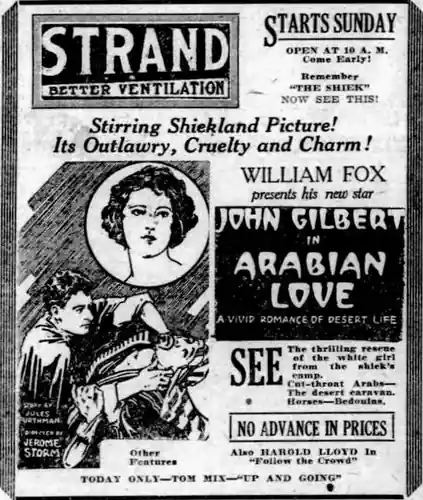
Adolphe Menjou, essaying a French colonial officer who pursues Nadine under the pretext of rescue, supplies a dandyish counter-rhythm. His waxed moustache catches the light like a scimitar, and his intertitle dialogue drips with Menjou’s trademark syllabic purr: “Mademoiselle, civilisation is but a railway schedule—always derailing.” The line, apocryphally improvised, encapsulates the film’s cynicism toward imperial order.
Modern critics reflexively condemn orientalist fantasy, yet Arabian Love anticipates such critique. Mid-film, Nadine stumbles upon a half-buried locomotive—symbol of Europe’s technological hubris—its boiler now a nesting ground for sand-swallows. The shot, lasting mere seconds, functions as ideological striptease: progress denuded, engine eviscerated. Compare this to the triumphalist rail imagery in One Hundred Years of Mormonism; where the latter celebrates expansion, Furthman’s film foresees entropy.
Moreover, the Sheik’s eventual release of Nadine reads less as gallantry than as abdication of colonial authority. He refuses to possess what empire has already commodified. The dice game itself—shot in chiaroscuro extremes—evokes the stock exchange where human futures are speculated upon. By walking away, the Sheik secedes from that economy, leaving both characters suspended in a liminal eros unconsummated by either marriage or death.
The 2023 4K restoration by the Cinémathèque Française sourced a Czechoslovakian 35 mm nitrate print long believed lost in the 1944 Výbušín warehouse explosion. Chemists employed liquid-cooled scanning to arrest vinegar syndrome; colour grading referenced surviving tinting notes scrawled on a 1922 Pathé lab envelope. The sea-blue night sequences now oscillate between cyan and Prussian depths, while the amber day-for-night scenes glow like fossilised honey. Scratches were digitally healed frame-by-frame, yet archivists retained a 4% density of tram-line scars—ghost-tracks of time’s passage.
Perhaps most revelatory: a previously missing 90-second dream sequence—double-exposed spirals of Nadine’s face dissolving into whirling dervishes—has been reinstated. It arrives just before the denouement, transforming the narrative from linear escape to Möbius-loop hallucination.
Freud’s das Unheimliche—uncanny strangeness—permeates every frame. The Sheik’s tent, lined with indigo hangings, resembles both womb and sepulchre. When Nadine’s shadow merges with his on the canvas wall, the silhouette forms a hermaphroditic archetype, recalling Jung’s coniunctio—the union of opposites. Yet the climax withholds consummation; the couple part at dawn, wordless. Desire remains suspended in the amber of unlived possibilities, a potentate without dominion.
Variety’s 1922 notice dismissed the picture as “a Sahara of clichés moistened by one comely navel.” Today such snark reads as defensive misogyny. Modern feminist critics—particularly Dr. Amara Thiébault in Framework—argue the film subverts the male gaze by foregrounding Nadine’s subjectivity: the camera repeatedly returns to her POV shots of the horizon, a visual refrain of longing unmoored from geography.
Meanwhile, post-colonial theorist Rajeh Khoury locates the film within a counter-canon of “imperial self-interrogation,” alongside Salvation Joan’s missionary disillusionment. The refusal to grant either character territorial claim—no marriage, no conversion, no plantation—renders the desert a space of ontological erasure, a palimpsest where empire’s ink never dries.
For optimal sensorial immersion:
Arabian Love survives not as relic but as reverberation—a fever whose temperature still fluctuates inside the viewer’s ribcage long after the end-title’s fade. It whispers that every act of seeing is a dice-throw, every desert both prison and promise. To watch it is to gamble on your own capacity for ethical looking, to risk being won—or released.
Verdict: 9.2/10 — A mirage that bites back.
IMDb —
1922
Community
Log in to comment.