DbcultAccessing Vault...
5.2/10
Senior Film Conservator
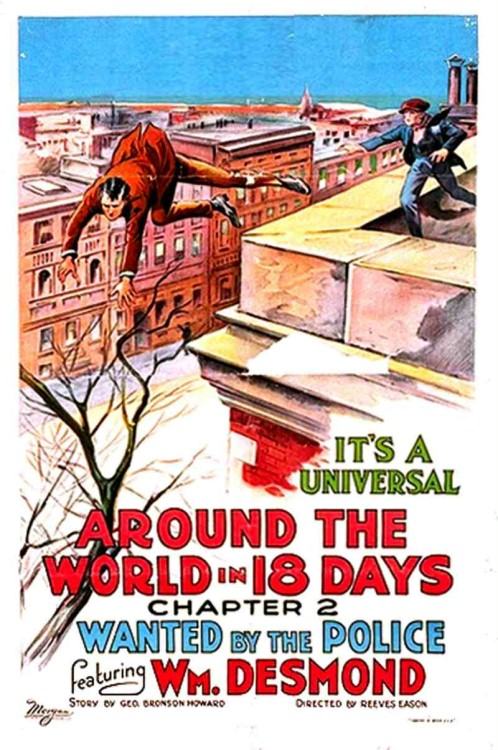
A definitive 5.2/10 rating for a film that redefined the boundaries of cult cinema. Around the World in Eighteen Days remains a cornerstone of transgressive art.
In the pantheon of silent cinema, few formats captured the restless energy of the 1920s quite like the adventure serial. Around the World in Eighteen Days (1923) stands as a monument to this freneticism, recalibrating Jules Verne’s quintessential travelogue for an era defined by industrial expansion and corporate ruthlessness. While the original Phineas Fogg sought to prove a point of mathematical possibility, his grandson, Phineas Fogg III—portrayed with a rugged, square-jawed determination by William Desmond—is motivated by the cold, hard realities of late-stage capitalism. The stakes are no longer merely social prestige; they are the literal control of a global energy empire.
The film’s premise is a masterclass in narrative compression. By reducing the timeframe from eighty days to eighteen, directors B. Reeves Eason and Robert F. Hill reflect the burgeoning technological optimism of the post-WWI world. This is a world where the distance between London, Yokohama, and New York has been decimated by the internal combustion engine and the telegraph. Much like the thematic undercurrents found in The Son of His Father, the weight of the ancestral name acts as both a catalyst and a burden for our protagonist.
Every great serial requires a villain whose persistence borders on the supernatural, and Wade Boteler’s Brenton does not disappoint. Brenton is the quintessential boardroom predator, a man who views the world not as a place of wonder, but as a ledger to be manipulated. His $100,000 wager with Fogg is a cynical ploy, a distraction designed to mask his real-time sabotage of Fogg’s travel arrangements. The conflict here is a fascinating precursor to modern corporate thrillers, blending the physical hazards of the road with the bureaucratic treachery of the office.
The dynamic between Fogg and Brenton mirrors the tension found in The V That Vanished, where an elusive prize drives men to the brink of moral collapse. In Eighteen Days, the prize is the proxy votes of scattered stockholders, a MacGuffin that forces the narrative to pivot through various exotic locales with a speed that leaves the audience breathless. The film utilizes its twelve chapters to maintain a rhythmic pulse of crisis and resolution, a structural necessity that keeps the viewer tethered to Fogg’s escalating desperation.
While the serial is ostensibly an action-adventure, the presence of Laura La Plante provides the necessary emotional ballast. As the daughter of the beleaguered company president, her character serves as the moral compass for Fogg’s odyssey. La Plante, who would later become one of Universal’s biggest stars, brings a luminous presence to the screen, even within the constraints of the genre. Her chemistry with Desmond is palpable, providing a soft contrast to the hard-edged machinery and constant movement that dominate the plot.
The romantic subplots in these early serials often felt perfunctory, but here, the stakes feel personal. Fogg isn't just saving a company; he is preserving a future for the woman he loves. This blend of domestic stakes and global adventure is reminiscent of the emotional architecture in The Echo of Youth, where the past and future collide in a struggle for personal autonomy.
From a technical standpoint, the production of Around the World in Eighteen Days was a logistical feat. While much of the "global" travel was achieved through clever use of California locations and Universal’s expansive backlot, the film successfully creates a sense of scale. The cinematography captures the visceral thrill of the chase—steamships billowing smoke, early biplanes cutting through the clouds, and the rhythmic clatter of locomotives. The editing is particularly noteworthy for the period, utilizing cross-cutting to heighten the tension between Fogg’s progress and Brenton’s machinations back home.
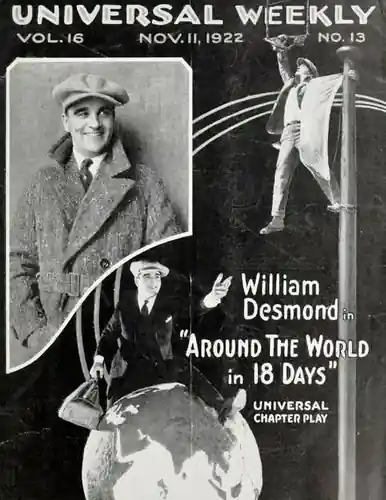
The film’s depiction of foreign lands, while undoubtedly filtered through the colonial lens of the early 20th century, offers a fascinating look at the era’s appetite for the exotic. For audiences of 1923, these glimpses of the "Orient" or the "South Seas" were as much a draw as the plot itself. This penchant for the distant and the dangerous can also be seen in The Island of Desire, a film that similarly trades on the allure of the unknown.
Adapting a literary classic is always a perilous endeavor, especially when the source material is as beloved as Verne’s. Around the World in Eighteen Days takes significant liberties, effectively creating a sequel rather than a direct adaptation. This approach allows the writers—George Bronson Howard, Robert Dillon, and Frank Howard Clark—to modernize the stakes. In contrast to the more faithful, albeit darker, adaptation of Mary Shelley’s work in Life Without Soul, this film chooses to embrace the optimism of the machine age, even as it warns of the greed it can foster.
Furthermore, the film’s focus on social standing and the pressures of the elite class invites a comparison to Dabbling in Society. Phineas Fogg III is a man of the world, but he is also a man of a specific class, and his ability to navigate the globe is as much a result of his social capital as it is his physical stamina. The serial format allows for a deeper exploration of these nuances than a standard feature would permit, giving each "proxy" hunt the weight of a standalone drama.
One cannot discuss this film without acknowledging the sheer brilliance of its cliffhangers. Each chapter concludes with Fogg in a seemingly inescapable predicament—dangling from heights, trapped in burning buildings, or facing the barrel of a conspirator’s gun. This episodic tension was the lifeblood of the silent era, ensuring that audiences returned week after week. The pacing is relentless, a stark contrast to the more contemplative nature of The Professor or the melodrama of The Divine Sacrifice.
The writing team understands the economy of the silent screen. Dialogue titles are kept to a minimum, allowing the physical performance and the geography of the chase to tell the story. This is visual storytelling in its purest form, where the movement of a train across a landscape conveys more information than a page of script. The sequence involving the proxies in the final chapters is particularly effective, as the temporal window closes and the geography narrows back toward the boardroom.
Around the World in Eighteen Days serves as a bridge between the Victorian adventure novel and the modern action blockbuster. It captures a moment in time when the world felt both vast and reachable, when the airplane was a miracle and the corporation was the new frontier of conquest. Its influence can be felt in everything from the Indiana Jones series to the high-stakes races of the Fast & Furious franchise. It is a testament to the enduring power of the chase, the fundamental cinematic thrill of seeing a man move through space against the relentless ticking of a clock.
In the broader context of 1920s cinema, this serial represents Universal’s ability to merge high production values with popular sensibilities. It avoids the static theatricality of early silent films, opting instead for a fluid, kinetic style that feels remarkably modern. For those interested in the evolution of the action genre, it is an essential text, standing alongside works like The Tidal Wave in its ambition to depict the scale of human conflict against the backdrop of a changing world.
While some may find the serial format’s repetitive nature taxing, Around the World in Eighteen Days overcomes these hurdles through sheer charisma and technical ingenuity. William Desmond is a compelling lead, and the stakes—both corporate and romantic—provide a narrative engine that never stalls. It is a vibrant, pulse-pounding relic of an era that believed anything was possible if you just moved fast enough. It remains a fascinating study in the intersection of literature, technology, and early cinematic spectacle.
IMDb 5.3
1928
Community
Log in to comment.