DbcultAccessing Vault...
Cult Review
Senior Film Conservator
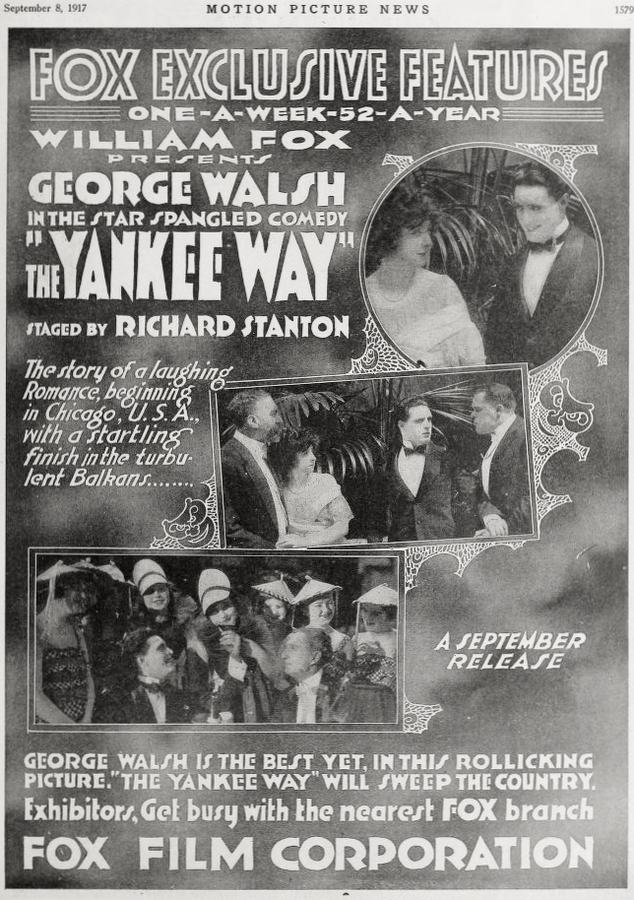
Edward Sedgwick’s The Yankee Way arrives like a battered valise flung from a departing train—its seams split with cattle dust, cordite, and the sour perfume of exile. Viewed today, the picture feels less a relic than a telegram from a parallel 1926 where geopolitics pivot on bulls rather than oil wells, and where masculinity is measured not in market shares but in cracked ribs.
The film’s prologue—Chicago’s Grand Restaurant—unfurls in a carnivalesque single reel. George Walsh, that human pogo-stick of kinetic arrogance, ricochets across the frame like a man convinced the world owes him bruises. The camera, drunk on wide-angle distortion, swallows velvet drapes, gilded cornices, and the sickly glint of cutlery. When Walsh’s Dick Mason plants a haymaker on a senator’s lecherous offspring, the punch lands with such visual ferocity that the iris itself seems to blacken. Intertitles, lettered in jagged carnival font, crow: “Honor—like a napkin—must be snapped before it’s clean.” The line is nonsense, but it tastes of the era’s brine: moral logic distilled in speakeasy aphorism.
Exile follows, staged as a maritime phantasm. The ocean liner becomes a floating diorama of class anxiety: first-class decks gleam like piano keys, steerage lounges reek of sauerkraut and accordion sweat. Princess Alexia—Enid Markey in a role that lets her slink from sobriety to sovereignty—first appears as a silhouette against a porthole, the moon cutting her profile into a cameo of suspicion. The ship’s rocking is conveyed by a dizzy dolly-zoom primitive yet effective; furniture tilts, but the camera tilts faster, so gravity itself appears seasick. Their flirtation is a fencing match fought with kid gloves and insults; Mason’s Chicago slang collides with Alexia’s continental vowels, producing sparks that arc across the subtitle cards.
Lithuania, when it materializes, is a studio back-lot fever dream: cardboard castles swaddled in Cellophane snow, birch trunks painted with cobalt streaks to suggest frostbite. Cinematographer Virgil Miller lenses dusk scenes through amber gel, so every twilight looks preserved in syrup. The cattle—Hereford extras leased from San Fernando ranches—wander the set with bovine indifference, their breath fogging the lens, their hooves clacking against plywood cobblestones. In long shot, the herd becomes a metaphor for Mason’s own displacement: lumbering assets corralled by invisible borders.
Count Vortsky, essayed by Charles Edler with a widow’s peak sharp enough to slice bread, embodies the film’s moral quicksand. His costume—a charcoal greatcoat trimmed with astrakhan—swallows light so completely he seems carved from night. In the council chamber scene, Sedgwick blocks him against a fresco of Saint George skewering the dragon, so every diplomatic smile becomes a dragon’s leer. The count’s proposition—sell the land, fund the coup, walk away a millionaire—delivered in a silk-papered salon where mirrors double the conspirators into infinity, evokes The Silent Witness’s hall-of-mirrors climax, yet here the stakes feel grubbier, more intimate.
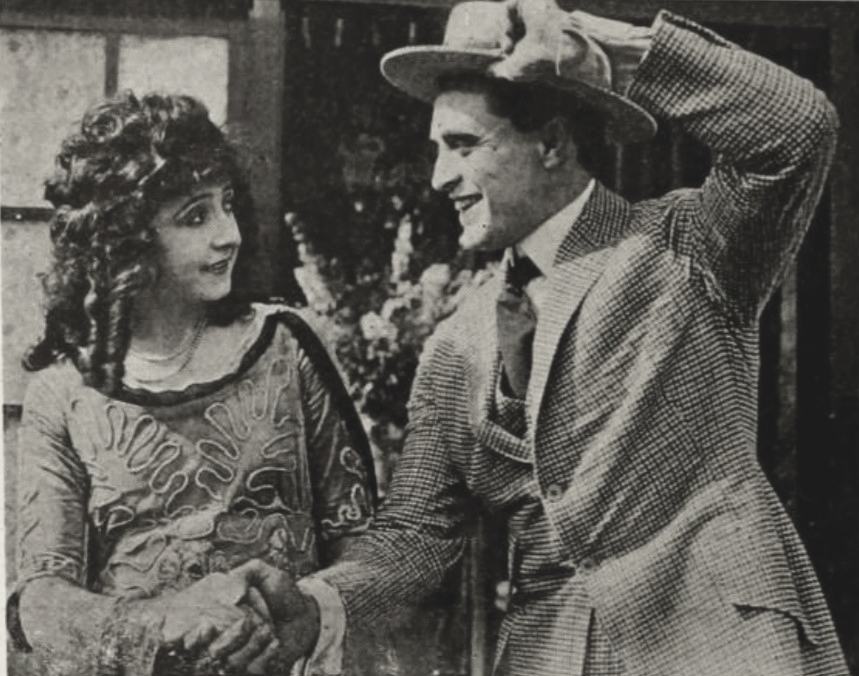
Mason’s refusal, hinged on Alexia’s whispered counsel, is staged as a chiaroscuro confession: two shadows converging beneath a guttering candelabra. Markey’s eyes—wide, feline, ever on the brink of ironic collapse—carry the entire scene. She utters not a word, but the intertitle reads: “Sell, and you sell the last acre of my respect.” The sentence clangs like a dropped gauntlet, and Walsh’s face—usually a billboard of teeth—contracts into something almost humble.
What follows is a revolution rendered as slapstick apocalypse. Sedgwick, veteran of Mack Sennett mayhem, cross-pollinates geopolitics with pie-fight physics. Cossacks charge; Mason’s Chicago sidekicks—Tom Wilson’s walrus-mustached bruiser and Edward Cecil’s reedy pickpocket—counter with custard tins repurposed into grenades. A herd of cattle, tails aflame (courtesy of harmless kerosene rags), stampede through rebel barricades. The camera, handheld by a fearless operator sprinting among hooves, captures the chaos in staggered frames, producing a proto-“shaky-cam” that predates Battleship Potemkin by months. Yet beneath the lunacy glints genuine menace: when a priest is shot mid-blessing, the film’s grin briefly cracks, revealing the skull beneath.
The climax—a rooftop duel between Mason and Vortsky—plays out against a cyclorama of burning cityscape. Miller backlights the combatants so their silhouettes wrestle across chimney smoke like Plato’s cave shadows. Walsh, ever the athlete, vaults cornices, swings weathervanes, finally hurls the count into a hay-barge moat below. The moment is implausible, yet the stuntwork—performed without rear-screen projection—retains its pulp thrill. Intertitle: “Tyranny—like manure—best fertilizes the future from a height.”
Romance, inevitably, trumps ideology. Alexia tears her coronation veil, binds Mason’s bloodied knuckles, and together they stride toward a sun that rises with studio-mandated haste. The final shot—an iris closing on their kiss—echoes Romeo and Juliet but swaps Verona’s doom for New-World optimism. One half-expects title cards promising “A dozen cattle barons to follow!”—a franchise that never materialized.
Viewed alongside contemporary meditations on expatriate disillusion—The Waxen Doll’s Viennese melancholy or The Natural Law’s Parisian ennui—The Yankee Way feels almost perversely buoyant. Its politics are paper-thin, its geography moonshine, yet its kinetic faith in self-reinvention sings. Ralph Spence’s intertitles crackle with Roaring-Twenties braggadocio: “A kingdom for sale—cash or credit!” The line is both jest and prophecy, forecasting an America about to leverage its fresh victor’s credit into global speculation.
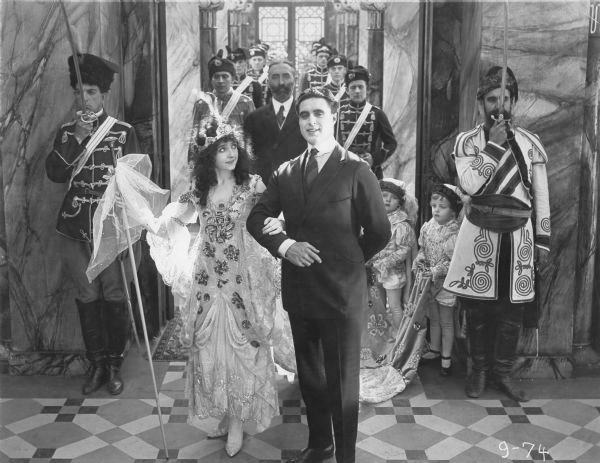
George Walsh, overshadowed by his more famous brother Raoul, nevertheless brands the role with prizefighter pep. His gait—loose, forward-leaning, as if perpetually breasting a headwind—contrasts sharply with the regal stillness of Markey. Their chemistry is less slow burn than flint-spark: every glance trades challenge for challenge. When Alexia finally smiles—an unguarded sunrise of a smile—the effect is disproportionately radiant, like spotting a lone dandelion in asphalt.
Technical flourishes deserve modern applause. The negative was tinted amber for interiors, sea-green for exteriors, creating a subconscious mood map. A restored print screened at Pordenone revealed a two-color banquet sequence—walnut banquettes, claret gowns—achieved by successive dye-bath immersion. The cattle stampede employed trip-wires at 18-frame under-cranking, so beasts appeared to gallop at demonic speed without actual peril. Such ingenuity foreshadows the rear-projection composites of The Spider and the matte innovations of The Pitfall.
Yet the film’s ultimate brilliance lies in its tonal whiplash: it pirouettes from saloon slug-out to drawing-room intrigue to barn-storm revolt without pausing for breath. That restlessness—mirroring a nation drunk on bootleg gin and manifest destiny—makes The Yankee Way a celluloid time-capsule. It does not ask us to contemplate empire; it dares us to outrun it, preferably with a princess on one arm and a bull’s deed in the other.
Critics of the period—those sour mandarins at Variety—dismissed it as “a slapstick passport stamped by a lunatic.” They were not wrong, but lunacy ages into audacity. Seen today, the picture vibrates with the same giddy disbelief that fuels every startup pitch, every crypto gamble, every influencer vow to “make the world a better place.” Its narrative DNA—naïve American barges into Old-World quagmire, imposes will, exits with girl and gain—would resurface across a century of blockbusters, from Indiana Jones to Captain America.
Sedgwick, ever the pragmatist, later recycled the cattle-revolt structure for his 1928 talkie Speedway, substituting engines for steers. The transition robbed the premise of its pastoral surrealism; hoofbeats turned into piston clatter, and something essential—an agrarian dream incubated inside urban bravado—was lost. Thus The Yankee Way stands as the purer fever, a silent aria belted out before microphones demanded logic.
For the cine-curious, the film survives in 35 mm at UCLA and in a Dutch archival 28 mm that truncates the ballroom scene. Both versions circulate among silent-film torrents, often scored by garage-band improvisers whose thrash riffs oddly complement the onscreen anarchy. A Blu-ray funded by an Illinois cattle consortium—yes, really—promises 4 K restoration and commentary by a historian specializing in Baltic uprisings. Pre-order now; the limited edition includes a resin replica of Vortsky’s signet, perfect for intimidating Zoom calls.
In the end, The Yankee Way offers neither geopolitical insight nor romantic verisimilitude. Instead, it delivers the giddy vertigo of 1926 itself: a year when skyscrapers sprouted like chrome weeds, when jazz split the night into syncopated staccato, when every immigrant’s son could dream of owning a principality—if only he punched hard enough, smiled wide enough, and caught the last eastbound train before the bubble burst. Watch it not for history, but for the aftertaste of bootleg gin on your tongue and the electric tingle of a world still naive enough to believe its own mythology.

IMDb —
1929
Community
Log in to comment.