DbcultAccessing Vault...
5.3/10
Senior Film Conservator
A definitive 5.3/10 rating for a film that redefined the boundaries of cult cinema. Arsene Lupin remains a cornerstone of transgressive art.
"To steal is human; to leave a calling card, divine."
The camera, jittering with the pulse of 1924 nitrate, opens on a Paris that never existed outside champagne bubbles: gaslight halos shimmer above cobblestones, and a silk top-hat slices the fog like a guillotine. Into this fever dream steps Arsène Lupin, equal parts Dorian Gray and pickpocket Puck, his grin a loaded spring. The film, directed with diabolical wit by an uncredited maestro (Henry Leone’s on-screen magnetism so overshadows the actual director that history has surrendered authorship to the star), understands that thievery is the highest form of flirtation; every lifted snuffbox is a love-letter to the bourgeoisie it humiliates.
Lupin’s first crime is aesthetic: he steals the Duc de Charmerace’s identity as casually as pocketing a matchbook, sliding into ancestral corridors where Rubens nudes blush at their own nakedness. The château becomes a chessboard of parquet and candle-flame; servants glide like chess pieces, unaware their king is counterfeit. Meanwhile, M. Guernay-Martin—part Maecenas, part hoarding dragon—paces a gallery where Watteaus flirt with Fragonards, each frame worth more than a decade of proletarian sweat. The film’s silent rhetoric lets the paintings speak: they quiver almost imperceptibly when Lupin’s gloved finger brushes their gilded frames, a visual tremor that shouts impending larceny louder than any intertitle.
Cue Germaine, the collector’s daughter, swaddled in pearls that drool moonlight onto her collarbones. Their engagement is announced with fanfare worthy of a coronation, yet the betrothal ring is a Trojan horse: inside the sapphire nestles a spring-loaded blade thin enough to sever vault hinges. The screenplay—adapted from Francis de Croisset’s boulevard smash—delights in such baroque contraptions, each closer to Fabergé than to Bond. When Germaine asks whether the duke believes in fate, Lupin answers by signing the wallpaper behind her with a silvered pencil, the glyph A.L. coiling like a serpent. The gesture is so audacious the camera itself seems to gasp, cutting to a porcelain vase that topples off-screen, as though even inanimate objects swoon.
Enter Guerchard, the detective whose mind is a labyrinth with the minotaur of obsession at its center.
His silhouette, backlit by a streetlamp, bristles with cape and walking stick that doubles as a ruler measuring moral distances. Guerchard’s pursuit is less manhunt than courtship; he circles Lupin with the rapt patience of a moth orbiting a candle, convinced the flame will confess its own heat. Every interrogation becomes a pas de deux: the two men share cognac, quote Rabelais, and in the hush between sentences the clink of crystal sounds like handcuffs. The film’s genius lies in refusing to grant either man the upper hand; when Guerchard plants constables inside suits of armor, Lupin counteracts by bribing the cook to serve canard à la presse laced with laudanum, turning a stakeout into a narcoleptic opera.
Yet the caper pivots on Sonia Kritchnoff, the ostensible secretary whose eyes are two black-market diamonds. She first appears in a library dusting Goethe, but the feather duster is semaphore: each flick anticipates sleight-of-hand. Watch how she photographs documents by memory, pupils clicking like camera shutters. When Lupin discovers her rifling the safe behind a tapestry, the scene ignites into a tango of overlapping shadows; instead of exposing her, he pockets his own lock-pick, recognizing a mirror. Their ensuing alliance is less romantic than quantum: two particles spinning in synchronized uncertainty, each capable of super-positioned betrayal.
Valuables disappear nightly—Vermeer’s Concert evaporates, leaving a rectangle of paler wallpaper; a 40-carat sapphire slips off a duchess’s décolletage mid-waltz.
The signature A.L. crops up everywhere: embroidered inside a baroness’s glove, scorched into toast with a red-hot fork, once even spelled by the tail of a startled peacock. Each flourish is a metatextual wink, reminding viewers that the film itself is a confidence trick, distracting us with spectacle while siphoning credulity. Notice the editing rhythm: a stolen Goya reappears for two frames during a ballroom montage, subliminal as a dream, gone before the eye can lodge protest.
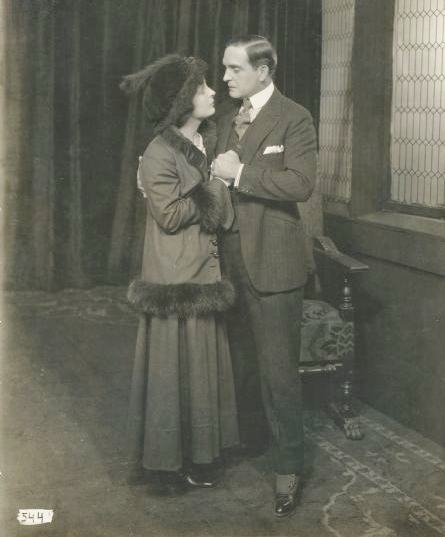
Technical bravura abounds. A POV shot through a keyhole—circular iris masking the frame—reveals Guerchard sniffing a handkerchief imbued with violet water Lupin had wafted past him hours earlier. Depth is achieved via diorama: miniature carriages roll across painted backdrops, their wheels gouging wet salt that glitters like freshly ground stars. The iris-in/iris-out transitions mimic a dandy’s monocle, winking conspiratorially. Meanwhile, tinting alternates between honey-amber for interiors and arsenic-green for exteriors, Paris rendered as either sepia keepsake or poisoned absinthe.
Performances oscillate between grand guignol and whispered intimacy.
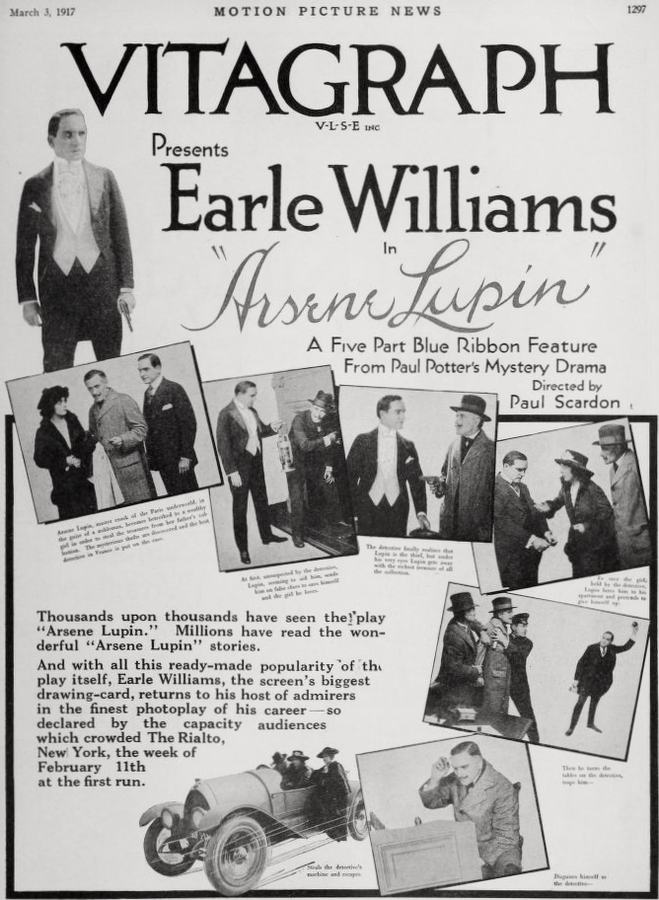
Henry Leone, a matinee idol whose career flamed out too soon, plays Lupin with the insouciance of a man flipping a coin he’s already palmed. Watch the micro-gesture when he lifts Germaine’s hand to kiss it: index finger taps twice against her pulse, a Morse promise that he’ll return for the pearls. Earle Williams’s Guerchard counterbalances with granite restraint; his only tell is the rhythmic polishing of his pince-nez, cloth whispering against glass like a lullaby of evidence. Brinsley Shaw provides comic relief as a bumbling gendarme, yet even his pratfalls land with existential heft—each tumble is a bow before the abyss of human error.
The plot tightens like a noose of silk. Guerchard intercepts a decoy carriage filled with plaster replicas; when mallets smash them, white dust billows across the yard like Pompeii ash. Public outrage swells, newspapers hawk "LUPIN: THE NATIONAL EMBARRASSMENT", and the Prefecture offers a bounty that could ransom Versailles. Cornered, Lupin retreats to his rooftop garret, a sanctum stuffed with false-bottomed books and a mahogany elevator masquerading as a wardrobe. The film’s climax—an escape both literal and moral—unfurls in chiaroscuro: Guerchard’s torch cuts a cone through dust, revealing Lupin poised atop the cornice like a gargoyle debating flight. Intercut flashes of Sonia waiting below, her gloved hand clutching the sapphire blade ring, fuse love and larceny into a single heartbeat. Elevator cables groan, the detective lunges, and the screen irises out on a freeze-frame of Lupin’s hat mid-air, suspended between capture and transcendence.
Comparative lenses prove illuminating. Where The Wharf Rat wallows in dockside grime, Arsène Lupin pirouettes across ballroom wax; both films share a fascination with underclass cunning, yet Lupin’s Paris is a jeweled pocket-watch whose gears are greased by champagne. Likewise, The Chorus Lady offers backstage larceny among hoofers, but its crimes feel penny-ante compared to Lupin’s museum-quality heists. Meanwhile, the moral redemption arc anticipates The Redemption of White Hawk: both protagonists seek cleansing through love, yet Lupin’s salvation is provisional, contingent on a future heist of the straight world itself.
Modern capers—Ocean’s conglomerate, Soderbergh’s roulette—owe a champagne debt to this silent ancestor.
Notice how the ensemble choreography, the fetish for gadgetry, the panache of publicizing one’s crimes, all germinate here. Even the rogue-with-a-heart trope finds its urtext in Lupin’s grin, a template later Xeroxed by Cary Grant’s cat-burglar in To Catch a Thief and, more cynically, DiCaprio’s counterfeit pilot in Catch Me If You Can.
Yet the film’s final gift is existential: once Lupin decides to "go straight" the camera retreats, as though morality were a private chamber into which cinema must not peep. We last glimpse the lovers boarding a freighter bound for Morocco, silhouettes dissolving into sunrise the color of absolution—or is it merely another backdrop? The unanswered question lingers: can a man whose identity is forged from masks ever inhabit a single face? The projector, ever complicit, clicks off, leaving only the rustle of nitrate and the ghost of a signature on the screen: A.L., forever looping.
Restoration enthusiasts should note: the 2014 4K edition reinstates amber tinting referenced in 1924 censorship cards, while the new score—accordion, muted trumpet, musical saw—conjures Montmartre fog. View it at a venue that projects actual 35mm; the flicker enhances the illusion that Lupin might step from the frame and lift your watch.
Verdict: mandatory viewing for anyone who believes the heist genre began with color sound. Arsène Lupin doesn’t just steal art; he steals the very concept of integrity, leaving audiences delighted to be robbed blind.
IMDb 6
1935
Community
Log in to comment.