DbcultAccessing Vault...
Cult Review
Senior Film Conservator
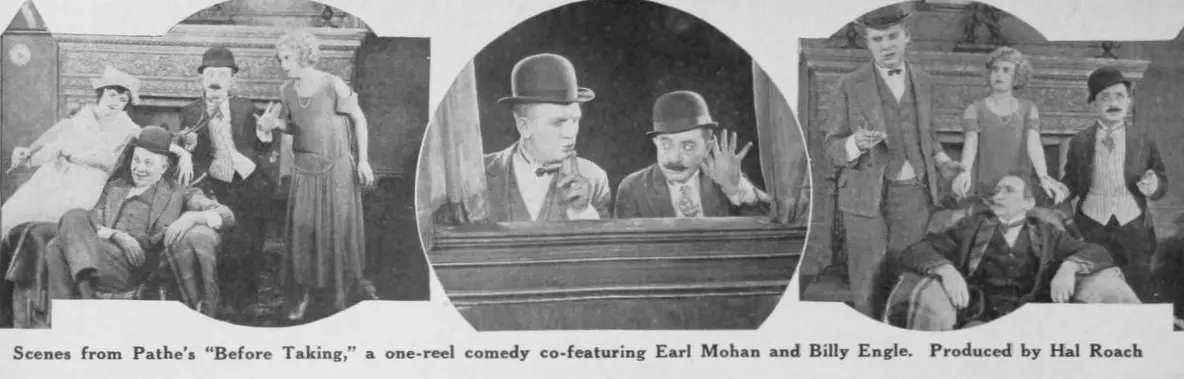
In the annals of early cinematic comedy, few premises possess the audacious, almost macabre, brilliance of Hal Roach’s 1918 short, Before Taking. This film, a testament to the era’s boundless creativity and a precursor to countless mistaken-identity farces, plunges its audience into a domestic crisis where the lines between professional and charlatan, savior and thief, are hilariously blurred. It’s a narrative that, even today, retains a potent, darkly comedic edge, inviting us to ponder the absurdities of human trust and the often-fragile veneer of authority.
The film opens on a scene of profound despair: a gravely ill man, whose condition has apparently confounded every reputable physician in town, lies prone, his family hovering in a state of anticipatory grief. The medical profession, in this narrative, has capitulated, leaving the family in a desperate limbo. Enter, not a new wave of medical specialists, but two bumbling burglars, portrayed with masterful ineptitude by George Rowe and Billy Engle. Their initial objective is prosaic: to relieve the household of its material wealth. Yet, fate, in its most mischievous guise, intervenes. Through a series of contrivances and misunderstandings, these two ne’er-do-wells are mistaken for the much-hoped-for, highly specialized doctors. The ensuing chaos is a symphony of physical comedy and situational irony, where the sanctity of life and the pursuit of petty larceny become inextricably, ludicrously intertwined.
Hal Roach, a name synonymous with silent comedy's golden age, particularly through his later collaborations with Laurel and Hardy, demonstrates his nascent genius as a writer in Before Taking. The premise is simple, yet its execution is a sophisticated exercise in escalating absurdity. Roach understands that true comedy often springs from the subversion of expectations and the juxtaposition of the mundane with the outrageous. Here, the gravitas of a life-or-death situation is systematically undermined by the utterly unqualified 'specialists' whose primary concern is not the patient’s pulse, but the gleam of a silver spoon. This kind of audacious storytelling sets Before Taking apart from many of its contemporaries, imbuing it with a timeless appeal that transcends its century-old vintage.
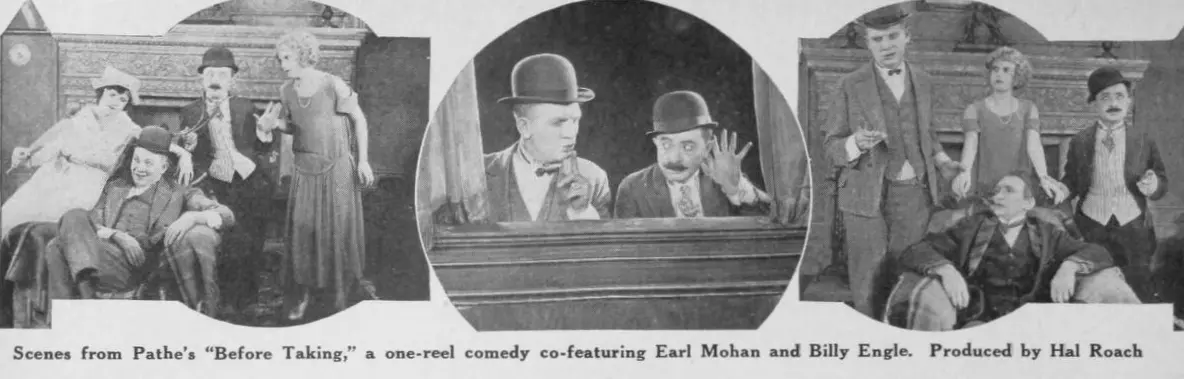
The film thrives on its physical comedy, a hallmark of the era. Rowe and Engle, as the accidental 'surgeons,' are a study in comical incompetence. Their handling of surgical instruments, designed for precision and delicate intervention, becomes a spectacle of fumbling, clumsy, and utterly unorthodox maneuvers. A scalpel, in their hands, might be used to pry open a locked drawer or to test the weight of a watch, never for its intended purpose. The humor is derived not just from their ineptitude, but from the unwavering belief of the family in their expertise, a testament to the power of desperate hope and the superficiality of appearances. The film cleverly exploits the audience's knowledge of the true identities of the 'doctors,' creating a constant, delightful tension between what is seen and what is known. This dramatic irony is the engine of the film's comedic momentum, propelling it through a series of increasingly ludicrous scenarios.
The success of Before Taking rests heavily on the shoulders of its ensemble cast, each member contributing to the film's vibrant comedic tapestry. George Rowe and Billy Engle, as the central figures of deception, embody the archetypal bumbling rogues. Rowe, with his expressive face and nimble physical comedy, often serves as the more outwardly bewildered of the duo, his internal conflict between larceny and the unexpected demands of his 'profession' subtly conveyed. Engle, on the other hand, frequently plays the more cynical or pragmatic half, always with an eye on the next valuable trinket. Their chemistry is palpable, a well-oiled machine of comedic timing that makes their interactions both believable and uproariously funny. Their performances are a masterclass in silent film acting, relying on exaggerated gestures, facial contortions, and precise physical movements to convey character and intent without a single spoken word.
IMDb —
1919
Community
Log in to comment.