DbcultAccessing Vault...
Cult Review
Senior Film Conservator
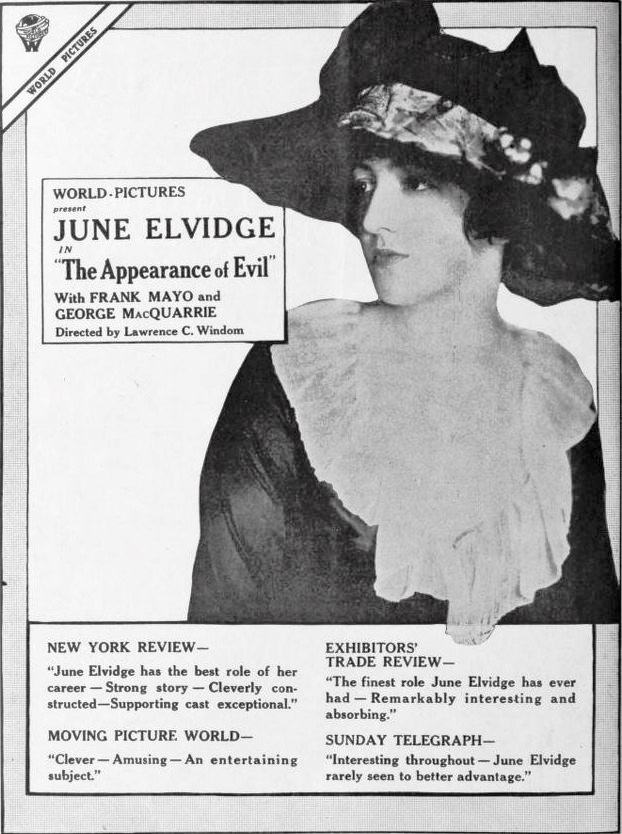
Bayport, 1918: a town whose morals are varnished to a mirror shine—reflecting only the faces already in power.
When Appearance of Evil premiered, exhibitors billed it as a "tempest of whispered desire," but the film is less tempest than scalpel: a cool incision into the carcass of social hypocrisy. The plot—deceptively laconic on paper—unspools like a poisoned valentine. Clara Beranger’s scenario, laced with Horace Hazeltine’s caustic intertitles, refuses to grant the audience the moral catharsis it craves. Instead we linger inside the parlor’s velvet choke-hold, forced to watch the machinery of reputational death at work.
Maida Brown, incarnated by June Elvidge with the porcelain composure of a woman who already hears the slam of the exile’s gate, is no swooning victim. Notice the micro-shift in her shoulders when the maid barges in—Elvidge lets the left scapula lift a millimeter, a semaphore of recrimination that silent-era cameras devour. The performance is built on negatives: the refusal to beg, the refusal to weep on cue, the refusal to confess a sin she does not recognize. That negative space is where the audience must pour its own complicity.
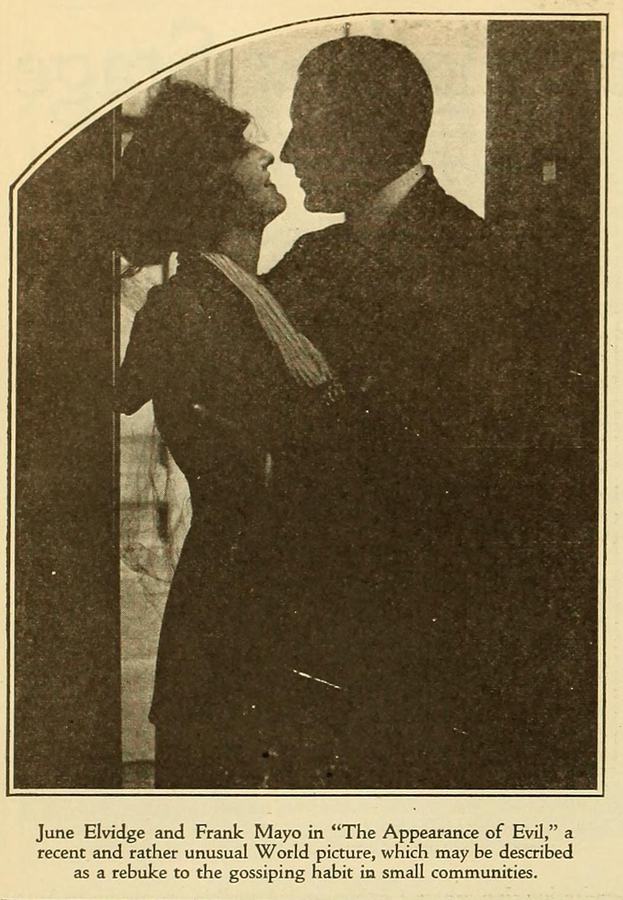
Louis Letchworth, played by Douglas Redmond, arrives as both catalyst and red herring. He is introduced in a dissolve that superimposes the whirring propeller of his factory over his close-up—an omen that desire and industry share blades. Redmond’s body language is all executive leisure, but watch the way his fingers drum against jodhpur seams whenever Maida utters her late husband’s name; the film quietly suggests that courtship is simply another vertical trust, drilling for whatever affection still bubbles beneath bereavement.
The Purity League sequences are staged like ecclesiastical tribunal crossed with stock-exchange floor: men waving ledgers of virtue, voices raised in speculative disgust. Director George MacQuarrie (pulling double duty as the League’s president onscreen) blocks the scene in depth: foreground clergyman, mid-ground banker, background stenographer whose pencil scratches out the official record of shame. The deeper the focus, the shallower the mercy.
Harold Brown—Frank Mayo in perhaps his most thankless role—skulks through these tableaux with the elastic grin of a man who has monetized schadenfreude. Mayo, usually the genial leading man, weaponizes that familiarity; every smile detonates a frame later when we realize it is simply the reflection of the estate’s iron gates closing on Maida. His surveillance is rendered via a repeated visual motif: a window within a window, iris shots that shrink Maida and Louis to doll-size conspirators while Harold’s eye fills the matte like a malign moon.
Inez Ranous, as the maid Electa, embodies the petit-bourgeois panic that lubricates the entire moral machine. Ranous has the fluted cheekbones of a Gibson Girl gone sour; her gossip is delivered not with malice but with the terror that proximity to impropriety equals eviction from the tribal circle. The film’s most chilling cut jumps from Electa’s whispered tattle to a church bell tolling—an Eisensteinian collision that fuses private slander with public execution.
Cinematographer Louis R. Grisel shoots Bayport at twilight whenever possible, letting sodium streetlights bruise the sky lavender. Night-for-night photography was still a rarity in 1918; the choice turns the town into a photographic negative of propriety—white picket fences glow like scar tissue. A later sequence shows Maida packing her trunk beneath a kerosene lamp whose flame flickers in such perfect sync with the film’s 18-frame-per-second chatter that the very light seems to gulp for oxygen.
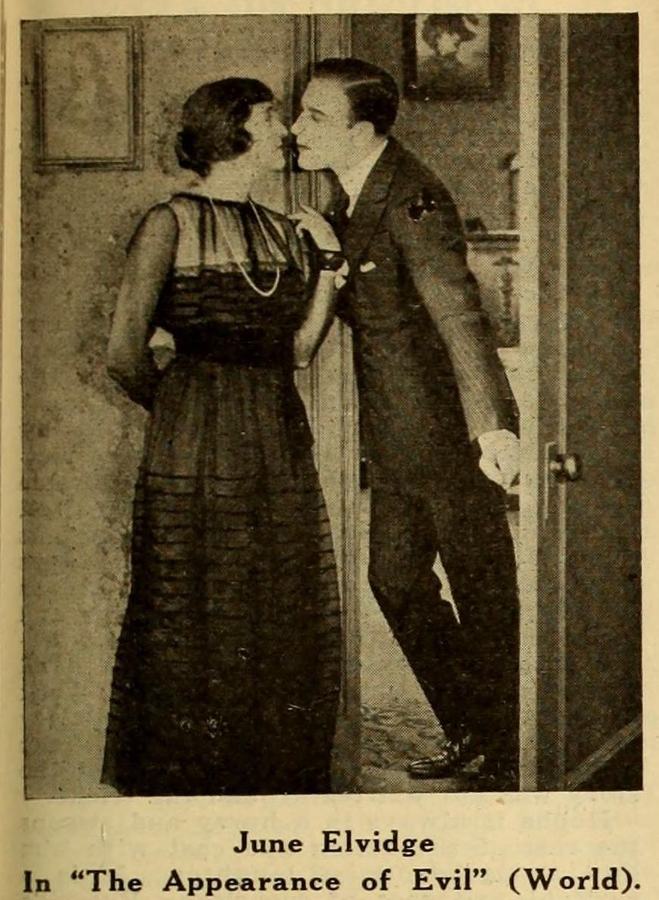
Clara Beranger’s intertitles deserve a monograph. She favors synecdoche: “A kiss—then the scaffold.” “A widow’s weeds—then the weeds of exile.” Each card lands like a haiku written on a death warrant. The sparse wording leaves sonic space for the theater’s orchestral embellishment, yet the rhythm is so precise that even a solo piano cannot drown out the moral dissonance.
Compare this to the more baroque redemption arcs of The Divine Sacrifice or the Alpine fatalism of Das Geheimnis der Lüfte: Appearance of Evil offers no transcendence, only entropy. The film’s final reel withholds even the satisfaction of Harold’s exposure; a title card informs us the estate transferred to him via a loophole unearthed “in the chiselled margins of the will.” Maida and Louis, now presumably married, are last seen booking passage to Argentina—a destination that, in 1918 parlance, equals the moon. Their silhouettes dissolve into a stock-footage steamer, the frame freezing before faces become legible. The viewer is stranded on the pier with the same townsfolk who wielded torches of purity, denied both absolution and apocalypse.
Historically, the picture premiered one month after the Sedition Act amendments, and its parable of sanctioned surveillance felt eerily coterminous with headlines about government censors reading private mail. Contemporary reviewers at Variety called it “a shaky sermon on too-obvious vice,” but that misreads the film’s refusal to sermonize at all. MacQuarrie’s direction is clinical, not didactic. The camera doesn’t leer at Maida’s alleged fall; it watches the watchers, panning across knitting circles and barbershop quartets who trade rumor like currency.
Musically, surviving cue sheets suggest a leitmotif structure: a strangled waltz for Maida’s lost marriage, a syncopated airplane-factory rag for Louis, and an inverted hymn for the League. Restored screenings that honor these cues reveal how dissonance was built into the era’s DNA—every melodic resolution feels like a trap snapping shut.
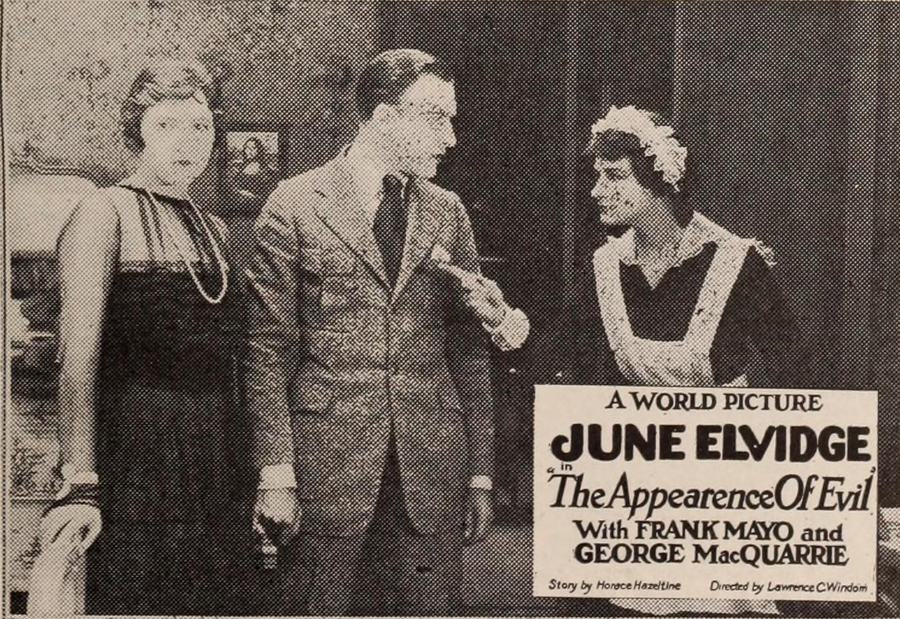
Performances aside, the film’s production design sneaks in social critique. The Brown estate’s parlor is overstuffed with taxidermied game—stags frozen mid-leap—an unsubtle reminder that the rich decorate with death. When Harold finally inherits, he lounges beneath a boar’s head whose glass eye stares directly at camera, a totem of triumphant predation.
Modern viewers will clock an uncanny prefiguration of #MeisterGate dynamics: the speed with which a woman’s autonomy is transmuted into communal threat, the legal scaffolding that rewards male opportunism. Yet Beranger’s script is too icy to congratulate itself on prescience; instead it leaves us in the uncomfortable position of rooting for a couple whose motives the film never fully sanctifies. We never learn whether Louis courts Maida for love, for lucre, or for the sheer dare of it. That ambiguity is the film’s most radical device, far more subversive than the scandal that launches the plot.
Archival status: the last known print perished in the 1931 Henderson vault fire, leaving only a 200-foot fragment—Maida’s farewell close-up, tears arrested mid-cheek like suspended mercury. The image has the ghostly vibrancy of a daguerreotype exposed too soon after death. Digital reconstructions interpolate surrounding frames, but the gap where narrative should flow becomes a stutter of mortality itself, reminding us that censorship can be chemical as well as moral.
Should a print surface, the color palette would reward 4K scanning; Grisel’s bi-pack tinting alternates between amber interiors (suggesting kerosene’s nicotine haze) and steel-blue exteriors where the Atlantic gnaws at pilings. The contrast encodes the film’s emotional chiaroscuro: safety equals suffocation, freedom equals exposure.
In the final analysis, Appearance of Evil lingers because it denies the viewer the cathartic bloodletting that melodrama promises. The evil referenced in the title is not desire but surveillance rationalized as virtue. The picture’s true horror lies in the townsfolk’s refusal to recognize themselves in the very passion they condemn—a hall of mirrors that reflects outward, never inward. That impenetrable self-righteousness feels, in 2024, less like period curio than prophecy.
Verdict: essential viewing for anyone convinced that moral panic is a 21st-century invention. Bring a coat; even in nitrate flames, Bayport’s wind cuts straight to the bone.
IMDb —
1926
Community
Log in to comment.