DbcultAccessing Vault...
Cult Review
Senior Film Conservator
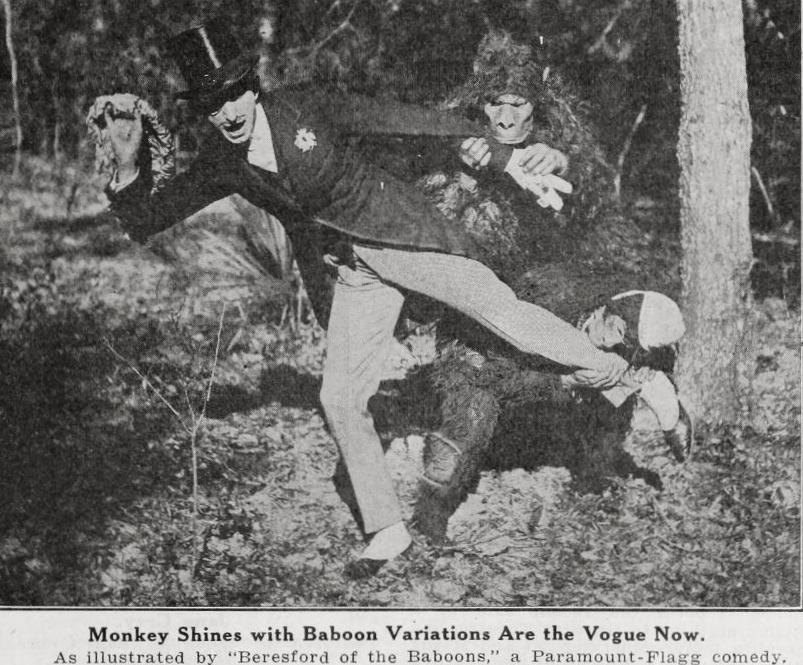
There are films that gently nudge the boundaries of convention, and then there is Beresford and the Baboons, a cinematic marvel that not only shatters them but then meticulously reassembles the fragments into a mosaic of delightful absurdity and profound human insight. From its audacious premise to its surprisingly tender denouement, this picture, penned by the inimitable James Montgomery Flagg, stands as a testament to the boundless imagination of early cinema. It’s a narrative so uniquely eccentric, so utterly committed to its outlandish conceit, that it transcends mere genre classification, sprawling across the landscapes of adventure, romance, and a particularly droll form of social satire. To simply call it a ‘wild child’ story would be to undersell its intricate tapestry of themes and its audacious exploration of what truly constitutes 'civilization' versus 'savagery.'
Our protagonist, the titular Beresford, is introduced to us not as a rugged frontiersman, but as the scion of the esteemed Earl of Swank. This initial aristocratic grounding is crucial, for it provides the starkest possible contrast to the life that fate so cruelly, yet comically, carves out for him. Lost in the most dramatic fashion on a desolate, sun-baked island as a mere boy, Beresford’s survival hinges not on innate human ingenuity alone, but on an intervention so peculiar it could only spring from the fertile mind of Flagg. He is discovered, not by benevolent explorers or a native tribe, but by a community of baboons. And here, dear reader, is where the film truly begins its magnificent divergence from any predictable path.
The baboons of Beresford’s island are no ordinary primates. They are, in Flagg’s whimsical vision, custodians of a most peculiar, almost anachronistic curriculum. Imagine, if you will, a young human boy, eyes wide with curiosity, being initiated into the mysterious rites of the jungle. One might expect lessons in foraging, predator evasion, or perhaps the nuanced art of cracking nuts with a well-aimed rock. Instead, Beresford’s simian mentors impart wisdom that feels plucked directly from a drawing-room comedy. Their syllabus includes, with an earnestness that defies belief, the principles of mining engineering, the intricate strategies of stud poker, and the delicate dexterity required for hem-stitching. This triumvirate of skills is not merely a throwaway gag; it forms the very bedrock of Beresford’s identity, a delightful and persistent question mark against our preconceived notions of education and utility.
Consider the sheer audacity of this premise. Mining engineering, a discipline born of industrial ambition and geological understanding, taught by baboons? The strategic cunning of stud poker, a game of bluff and probability, mastered in the heart of a primal jungle? And hem-stitching, a domestic art of meticulous precision, learned from creatures more accustomed to grooming than garment repair? It’s a stroke of genius, a satirical jab at the arbitrary nature of human knowledge systems. What does it say about civilization that these seemingly sophisticated skills can be acquired, or at least interpreted, through the lens of pure, unadulterated instinct? Joseph Burke, in a performance that oscillates between the feral and the refined, embodies this paradox with remarkable conviction. His Beresford is not a caricature but a deeply empathetic figure, whose very being questions the boundaries we erect between the 'natural' and the 'learned.'
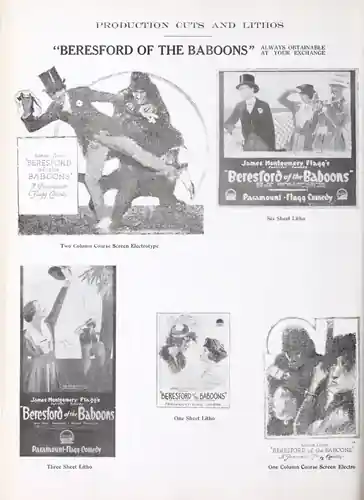
Burke’s portrayal of Beresford is nothing short of a revelation. He manages to convey the raw physicality of a man raised among primates – the agile movements, the keen senses – while simultaneously hinting at the latent intelligence and inherent gentility of his noble birthright. He’s a wild man, yes, but one capable of a contemplative gaze, a subtle gesture that betrays a mind constantly processing the world through a dual lens. This isn't merely a Tarzan archetype; it's a more nuanced exploration of identity forged in the crucible of an unconventional upbringing. The challenge for Burke was immense: to make us believe in the believability of a man who can not only swing through trees but also, presumably, calculate geological strata or bluff an opponent out of a pot. His success lies in making Beresford's inherent sincerity the anchor of this wild narrative.
The supporting cast, though perhaps less central to the film’s fantastical core, provides essential grounding. Olin Howland, whose career often saw him in character roles, brings a necessary gravitas or perhaps an exasperated disbelief to his part in the expedition. He acts as a foil, representing the conventional world’s bewilderment at Beresford’s existence. Beatrice Tremaine, as the young lady who captures Beresford’s heart, is crucial. Her role is not simply that of a damsel in distress or a romantic ideal; she is the catalyst for Beresford’s confrontation with his human heritage and the complex emotional landscape of love. Tremaine imbues her character with a blend of curiosity, compassion, and a touch of societal propriety, making her an intriguing bridge between Beresford’s two worlds. The chemistry between Burke and Tremaine, though often unspoken and expressed through longing glances and tentative gestures, is palpable, lending a genuine emotional weight to the film’s latter half.
Thematic resonance pulses throughout Beresford and the Baboons. At its heart, it’s a profound meditation on the age-old debate of nature versus nurture. Is Beresford, despite his aristocratic blood, fundamentally a product of his baboon upbringing? Or do the echoes of his human lineage, particularly his capacity for complex emotion and, dare we say, a certain inherent 'nobility,' assert themselves regardless? The film playfully suggests that perhaps the distinction is not as clear-cut as we imagine. The baboons, by teaching him skills that are quintessentially human, blur these lines even further. It’s a satirical commentary on the arbitrary value we place on certain forms of knowledge and the often-farcical rituals of human society. The very notion of an Earl learning poker from primates is a brilliant subversion of class and education, challenging the viewer to consider what truly prepares one for life, whether in the jungle or the drawing-room.
James Montgomery Flagg, primarily celebrated for his iconic 'Uncle Sam Wants You' poster, reveals a vastly different facet of his artistic genius as the film’s writer. His screenplay for Beresford and the Baboons is a masterclass in whimsical storytelling, blending adventure with an undercurrent of philosophical inquiry. Flagg doesn’t shy away from the inherent ridiculousness of his premise; rather, he embraces it, using it as a vehicle for gentle satire. His dialogue, though sparse in the early, wilder sections, comes alive with wit and charm once Beresford encounters human society. The narrative pacing is expertly handled, allowing Beresford’s transformation to feel earned, and the eventual collision of his two worlds to resonate with both humor and pathos.
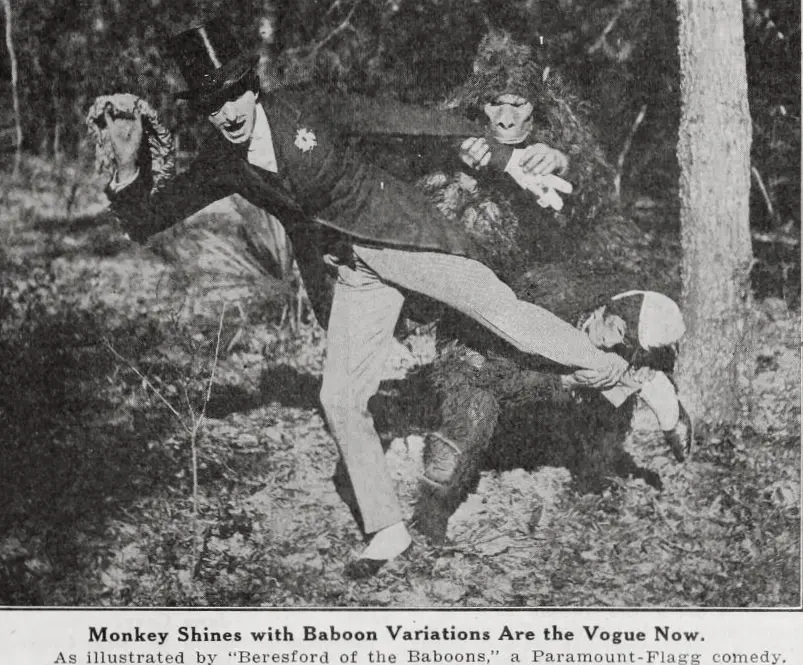
The arrival of the expedition marks a pivotal shift in the film’s tone and direction. Beresford’s secluded, baboon-taught existence is abruptly shattered by the encroachment of human civilization. This isn’t just a physical discovery; it’s an existential crisis. How does a man who understands the intricate geology of a mine, the subtle tells of a poker face, and the precise stitching of a hem, all through the lens of baboon wisdom, reintegrate into a society that values these skills in entirely different contexts? The initial interactions are fraught with a charming awkwardness, a 'fish out of water' scenario played for both laughs and genuine emotional depth. Beresford’s attempts to communicate, to understand the bewildering customs of 'his own kind,' are handled with sensitivity, avoiding broad caricature in favor of a more nuanced portrayal of cultural clash.
And then, there is love. The burgeoning romance between Beresford and the young lady from the expedition is the emotional anchor that pulls him, however reluctantly, towards a future in the human world. It’s a classic tale of attraction between opposites, but with a uniquely Beresfordian twist. How does one court a woman when one’s primary social conditioning comes from a troop of baboons? The film explores this with a delicate touch, highlighting the universal language of emotion that transcends even the most unconventional upbringing. This romantic thread is handled with a sweetness that prevents the film from descending into mere farce, giving Beresford’s journey a powerful, relatable motivation.
In the broader tapestry of early cinema, Beresford and the Baboons occupies a singular space. While other films of the era might have explored themes of societal integration or the allure of the wild, few did so with such an imaginative, almost surreal, twist. One might draw a tangential comparison to A Misfit Earl, which similarly explores the disjunction between aristocratic lineage and unconventional circumstances, albeit through a more conventional narrative lens. The romantic awakening, while perhaps less overtly dramatic than in A Modern Cinderella, carries a profound weight, symbolizing Beresford's bridge back to humanity. In an era that also gave us the visual tapestry of The Painted World, illustrating the burgeoning artistry of film, Beresford and the Baboons distinguishes itself not just through its visual storytelling, but through its sheer narrative inventiveness, proving that compelling cinema could arise from the most improbable of premises. It stands apart from the more straightforward adventure narratives like Rough and Ready, offering a more whimsical, thought-provoking journey.
The film’s lasting legacy lies not just in its memorable premise but in its gentle exploration of what it means to belong. Beresford is an outsider in both worlds, yet finds a way to synthesize his unique experiences into a coherent identity. It's a reminder that wisdom can come from unexpected sources, and that the most profound lessons are often learned outside the confines of traditional institutions. The film doesn't preach; it entertains, provokes, and ultimately charms, leaving the audience with a smile and perhaps a renewed appreciation for the eccentricities of life.
In conclusion, Beresford and the Baboons is more than just a quirky adventure film; it’s a delightful cinematic oddity that continues to resonate with its blend of humor, heart, and surprising philosophical depth. It’s a film that asks us to suspend our disbelief, only to reward us with a story that is both utterly unique and universally relatable. For anyone seeking a film that defies easy categorization and celebrates the glorious unpredictability of the human (and simian) spirit, this is an absolute must-watch. It’s a testament to the fact that sometimes, the wildest ideas yield the most enduring and endearing cinematic experiences. So, grab your pickaxe, shuffle your deck, and perhaps bring a needle and thread – you never know what skills you might need, especially if your teachers happen to be a troop of particularly learned baboons. It's a truly unforgettable journey into the heart of the unexpected, a vibrant splash of sea blue and golden yellow against the monochrome canvas of early film history.
IMDb —
1926
Community
Log in to comment.