DbcultAccessing Vault...
Cult Review
Senior Film Conservator
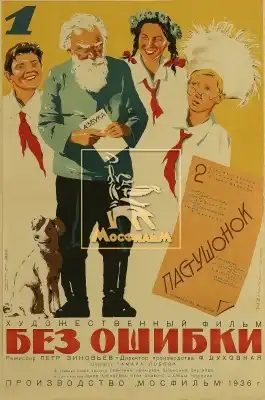
Okay, so "Bez oshibki" – Without Error – is one of those old Soviet films that probably won't be for everyone. If you're into historical curiosities, especially early Soviet cinema with a strong "youth camp" vibe, then you might actually find something here. But if you're looking for fast-paced drama or modern storytelling, you'll probably want to give this a _wide_ berth. Seriously, it's not for a casual watch unless you're prepared for a very specific kind of slow burn.
The film drops you right into this pioneer camp, and honestly, the energy is infectious, _at first_. You see all these kids running around, looking super earnest. It's like they're all in a perpetual state of "learning something important." 🤸♀️
A lot of the film circles around what they call "educating the employees." Which, if you think about it, is a _pretty heavy task_ for a bunch of kids. You get these little vignettes, almost like skits, where a problem pops up, and then a pioneer, often one of the slightly older ones, steps in with a solution.
There's this one bit, I think it's Alyosha Podolin, playing one of the main pioneer boys. He's trying to show some adult, maybe a camp worker, how to do something better. The adult looks so _confused_ at first. It’s not a big dramatic scene, more just a quiet struggle. The camera just kinda sits there, letting you soak it in.
And then there’s the "amusing" part. Now, what was considered amusing back then? 🤔 Sometimes it's a kid correcting an adult with a very serious face, which, okay, maybe a little chuckle. Other times it's just someone realizing their mistake. It's not exactly laugh-out-loud stuff for a modern audience, but you can feel the _intent_ behind it.
The pacing is, well, deliberate. There are long stretches where you're just watching kids do camp things. Building stuff, singing, whatever. It's less about a driving plot and more about atmosphere, really. You see Valya Alekseyeva with her very serious expression in a group shot. What's she thinking? Hard to say, but her presence is strong even when she's not speaking.
One thing that really sticks out is the _attention to detail_ in the camp life. The way the uniforms are pressed, the specific way they set up a bulletin board. It’s like a time capsule of a very specific moment in a very specific culture. You can almost smell the pine trees, you know? 🌲
The problems they solve feel very _of their time_. Like, "how do we organize this work task more efficiently?" or "how do we teach this skill better?" It’s all framed with this unwavering belief in progress and collective effort. There's no real villain, just challenges to be overcome by smart, enthusiastic young people.
Mariya Shlenskaya has a few moments where her character just _beams_ with this pure, innocent conviction. It's quite striking. You almost feel like you're in that moment with her, seeing the world through those optimistic eyes. And Boris Snigiryov, too, he brings this sort of quiet authority, even as a kid.
It’s definitely a film that demands your patience. You won't get huge emotional swings or complex character arcs. It's more like a series of instructional shorts blended together, but with a heart. A very earnest, slightly awkward heart. ❤️
So, is it worth it? If you're a film student, or someone obsessed with Soviet-era daily life, absolutely. For a regular Friday night movie? Probably not. It’s a _niche watch_, for sure. But for what it is, a glimpse into a very particular cultural ideal, it's actually quite **fascinating in its own quiet way**. The lack of big drama means you notice the smaller things, like how one kid helps another tie a knot. Or the way Lyova Semeyko stands just a little too stiffly during a group photo. These little things make it feel real, even if it's a constructed reality.

IMDb —
1935
Community
Log in to comment.