DbcultAccessing Vault...
Cult Review
Senior Film Conservator
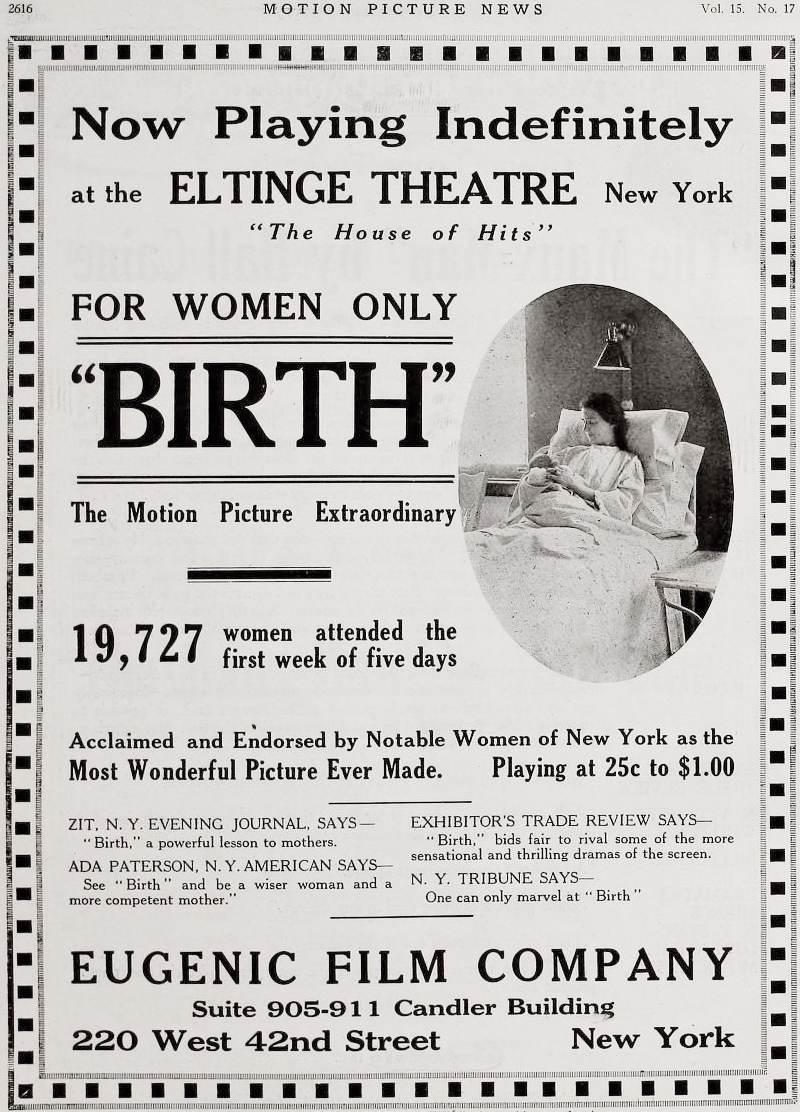
A.C. Abadie’s Birth is less a film than a wound—an exposed nerve scraped across 68 feet of brittle 35 mm stock. Shot in the muggy autumn of 1897 inside the rooftop studio of the Edison Manufacturing Company, this ten-minute vignette feels as though it were siphoned straight from the collective unconscious of a city choking on coal dust and Victorian piety. The camera, bolted to a plank like some cyclops on a leash, stares without blinking as a nameless woman—played by an unknown actress whose pallid beauty recalls the tubercular heroines of The Cinderella Man—is flayed by the very fact of gestation.
There is no plot in the conventional sense. Instead, Abadie orchestrates a procession of obscene tableaux: the expectant mother framed against brick walls oozing with posters half-torn—Chew White’s Yucatan Gum, Castoria Saves Their Lives—so that the frame itself seems to miscarry commercial slogans. Her shadow swells to the size of a parade balloon, detaches, and saunters off without her. In a Bowery saloon reeking of malt and kerosene, a trio of stock toughs—moustaches waxed to dagger points—lay bets on whether she will deliver “a voter or a harlot.” Their laughter ricochets off the tin ceiling like bullets, and you realise the film is anatomising not parturition but spectacle: the nineteenth-century habit of turning female flesh into civic carnival.
Abadie anticipates Buñuel by three decades: when the woman’s water breaks, the liquid puddles into the shape of the continental United States, a cartographic blasphemy that drips off the table edge and is lapped up by a mongrel cur.
Technically, the short is a marvel of proto-expressionism. The interior scenes were shot on a set built on the roof of 41 East 21st Street; sunlight bleaches the actress’s face until her cheekbones resemble cracked alabaster, while the open-air backdrop— laundry lines, chimney stacks, the distant filigree of the Brooklyn Bridge—creates a vertiginous sense that Manhattan itself is a sprawling womb. Abadie double-exposes two passes of film so that spectral children—naked, translucent—orbit the protagonist like taunting moons. The effect predates the ghostly superimpositions in The Exploits of Elaine yet feels more unsettling because the apparitions are not agents of plot but symptoms of a body at civil war with itself.
Sound, though absent on the strip, haunts the viewing experience. Archival accounts describe exhibitors hammering a bass drum in sync with the woman’s contractions; each thud rippled through nickelodeons so violently that patrons reportedly fainted. Contemporary restorations substitute a minimalist score—bowed cymbals, guttural cello—which lands like a bruise. The absence of intertitles is not omission but strategy: Abadie refuses language the power to cauterise what we see. Instead, the film’s grammar is purely corporeal; its rhetoric is the shudder.
Comparisons are inevitable yet slippery. Where Fighting Bob mythologises masculine vigour and The Lone Wolf wallows in sentimental redemption, Birth offers no catharsis, only a widening gyre of shame. It is closer in spirit to the sulphurous guilt that curdles through Slander or the ontological vertigo of The Path Forbidden. Yet even those films grant their victims a scrap of dignity; Abadie’s camera is predatory, a vivisector that keeps the specimen alive just long enough to watch the soul evacuate.
Gender critics will find fertile hunting ground. The film literalises the era’s pseudoscience: the wandering womb, the maternal imagination deformed by public exposure. But Abadie complicates the victim narrative by granting the woman moments of feral agency—she bites the wrist of a policeman who tries to haul her offstage, she spits blood onto the lens until the frame itself appears menstruating. In one hallucinated close-up her pupils dilate until the iris becomes a silent film screen, projecting microscopic cells dividing, twitching, dying. The spectacle of the female body is not passive; it is a cauldron that threatens to spew molten flesh over the voyeur.
Nitrate deterioration has chewed the edges of the sole surviving print, so the screen resembles a daguerreotype left to rot in a flooded attic—appropriate, since the movie is itself a kind of decay.
Cine-historians still duel over Abadie’s intent. Was he a proto-feminist indicting the medicalisation of childbirth? A eugenicist warning against “unfit” reproduction? Or simply a carny showman eager to out-gross the competition? The answer lies in the final shot: the camera ascends a church steeple until the woman is just a punctuation mark on the pavement, then iris-blurs into darkness. The implication is theological: birth is not genesis but original sin, restaged daily under the guise of civic order. The film spits on the nativity, replacing it with a guttering streetlamp that sputters out at the moment of revelation.
Restoration-wise, the Library of Congress 4K scan salvages blistering detail: you can read the label on a patent-medicine bottle—Dr. Morse’s Indian Root Pills—and spot a mole on the actress’s clavicle shaped uncannily like the Edison logo. Tinting follows period convention—amber for interiors, cerulean for dusk—yet the graders inject subliminal pulses of blood-red during contractions, a nod to modern horror syntax without violating archival integrity. The optional commentary track, narrated by a midwife-historian, dissects obstetric instruments that appear for mere seconds, revealing them to be period-accurate prototypes of forceps now banned for barbarity.
Viewers immune to silent cinema may scoff at the staginess, but Birth claws at a primal membrane: the terror of being swallowed by one’s own biology, of becoming a footnote in someone else’s demographic ledger.
Marketing history is its own lurid subplot. Edison’s catalogue peddled the film as “The First Authentic Moving Picture of Life’s Greatest Miracle!”—a tagline so mendacious it borders on Dada. Clergy howled; the NYPD seized prints on obscenity charges; reformers claimed the film induced miscarriages among pregnant spectators. Abadie, ever the prankster, screened it at a 1901 fundraiser for the American Gynecological Society, sending society dames into synchronized swoons. The scandal propelled ticket sales until a warehouse fire in 1912 incinerated most copies, sealing the movie’s reputation as a lost atrocity until a mislabeled canister turned up in a Belgian convent in 1987, fused with footage of monks harvesting honey.
Contemporary resonance? In an era when lawmakers legislate ultrasound probes and social media turns every bump photo into clickbait, Birth feels prophetic. It understands that the moment pregnancy enters public space it ceases to be physiology; it becomes theatre, property, ammunition. The film’s final freeze-frame—those abyssal eyes—demands we confront our complicity. We are not spectators; we are accessories, co-authors of a narrative that reduces creation to commodity and women to cautionary tales.
Essential for scholars of early cinema, gender studies, and medical humanities; mandatory for anyone who still believes the silent era was all slapstick and pie fights.
Verdict: ten minutes that corrode ten decades of sanctimony. Abadie delivered a hate-letter to the fantasy that birth equals blessing, and he did it with a shrug rather than a sermon. The film survives as both artefact and infection—once seen, it gestates in the cranium, waiting for sleepless nights to kick. Do not watch it while pregnant, nursing, or hoping to retain any illusion that your body belongs to you alone. Birth is not the beginning; it is the indictment.
IMDb 4.4
1931
Community
Log in to comment.