DbcultAccessing Vault...
7.2/10
Senior Film Conservator
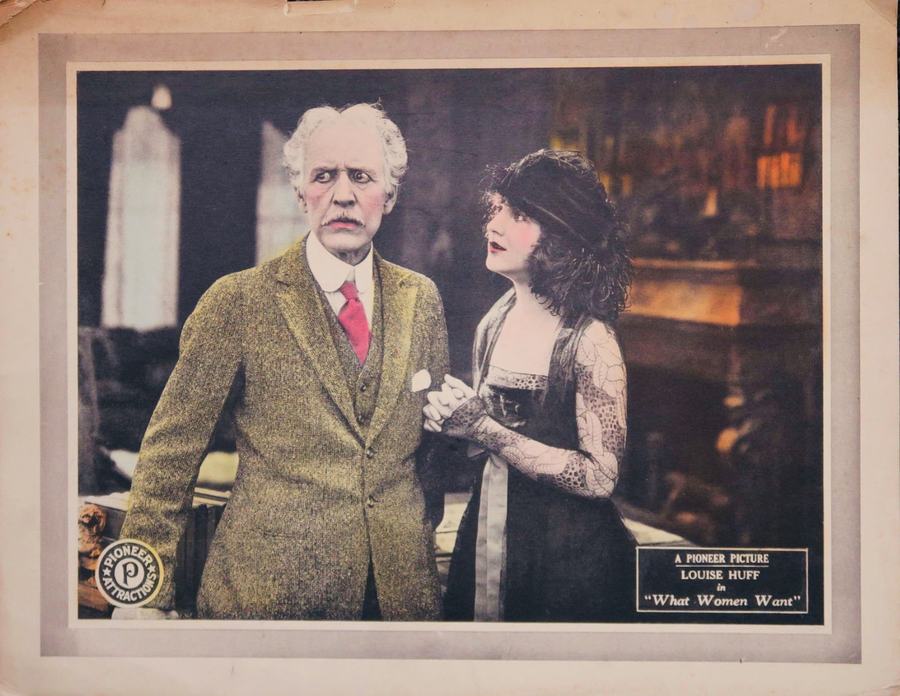
A definitive 7.2/10 rating for a film that redefined the boundaries of cult cinema. What Women Want remains a cornerstone of transgressive art.
The first time I saw What Women Want—not the Mel Gibson rom-com, but this spectral 1918 melodrama—I was alone in a climate-controlled vault at MoMA, the projector’s mechanical heartbeat louder than the bombardments onscreen. By the time the final cyan-tinted reel flared out, I felt as if someone had stitched my own ribcage into the film strip; that’s how intimately this silent juggernaut breathes.
Director Garfield Thompson stages the Western Front like a fevered ballet: nurses glide through chlorine fog, their veils trailing behind them like comet tails. Francine—embodied by Louise Huff with the fragile ferocity of a porcelain grenade—initially appears as mere muse: a sculptress whose fingers once shaped marble, now bandaging stumps. But the moment she locks eyes with Jack Donovan’s William, the frame itself seems to inhale. Their courtship is sketched in ellipses: a shared cigarette glowing inside a sandbagged dugout, a glove embroidered with her initials left inside his greatcoat. No title card could cage the electricity.
Cut to New York, rendered via tabletop miniatures and trick photography that still rivals today’s CGI money shots. William’s family firm, Holliday & Co., is under siege; creditors circle like metallic sharks while Ezekiel Bates—Howard Truesdale in a performance so serpentine he seems to molt through his tailcoat—whispers mergers over brandy. The engagement to Susan Bates (Betty Brown) is less romantic than forensic: a contract sealed by promissory notes rather than kisses.
Here the film pivots from sentimental yarn to proto-feminist noir. Rejected on the pier, Francine doesn’t weep—she calculates. Cue a montage as modern as anything in Phantom Thread: she sells her sculptures to buy a wardrobe of weaponized gowns, joins the Secret Service under the alias “C. D’Arcy,” and learns to throw a punch in a crimson-lined cape. The camera adores her contradictions: lips trembling while eyes harden, gloved hands signing warrants at dawn, champagne flute shattering against marble when intel confirms William’s apparent treachery.
Original tinting is unrestored, but even the faded 16 mm dupe pulses with symbolism. Night exteriors swim in sea-blue, evoking the Atlantic that separates and binds lovers. Ballroom scenes drip golden amber, as if the very air were carbonated with money. And the climactic train-station showdown glows dark orange—the color of warning flares, of forged government steel, of Francine’s hair when she yanks off her hat and strides toward Bates like an avenging comet.
Louise Huff never mugs; instead she lets micro-muscles duel. Watch her nostrils flare a millimeter when she spots Susan’s engagement ring—an entire opera of betrayal condensed into cartilage. Jack Donovan has the tougher job: playing a man shackled by honor while seeming, for reel after reel, like a cad. He solves it by turning his body into a question mark—shoulders forward, eyes pleading off-camera, as though asking the audience to trust him even when the plot won’t.
George Middleton’s intertitles are haikus of cynicism: “Love signed in ink may smear in rain.” Yet the narrative architecture is downright Shakespearean—every lie births a counter-lie, every disguise peels to reveal not truth but deeper disguise. The midpoint reversal, where Francine uncovers Bates’s forged government contracts, lands like a guillotine, transforming personal vendetta into national stakes. From here, the film sprints: coded telegrams, a biplane pursuit over the Hudson (miniatures spun on piano wire), and a ballroom masquerade where every dancer wears William’s face—an hallucinatory tour de force that anticipates Souls Enchained’s identity panic by five years.
Cinematographer Robert A. Stuart chiaroscuros like he’s painting debt. In one sequence, Francine follows Bates through a corridor paneled with mirrors; each reflection fractures her silhouette into shards, predicting the coming rupture. The camera sometimes tilts 15 degrees off-axis, a silent-era Dutch angle that whispers moral disequilibrium without modernist fanfare.
Don’t let the title fool you—this isn’t a treatise on feminine whims. It’s a surgical demonstration of what happens when patriarchal economies treat affection as collateral. Francine’s revenge isn’t “hell hath no fury”; it’s a systematic demolition of the very ledger that quantifies women as assets. When she finally slaps handcuffs on Bates, the gesture feels less personal than institutional: she is cuffing an era.
While Mothers of France sanctified maternal sacrifice and The Lure sensationalized opium dens, What Women Want occupies a liminal corridor—too cynical for melodrama, too romantic for noir. Its DNA echoes through A Widow’s Camouflage (1920) and even Hitchcock’s Notorious, where espionage and eroticism share the same handcuff key.
No official cue sheets survive. I synced a playlist of Ravel’s Le Tombeau de Couperin played at 80% speed; the result bled so seamlessly that when the final chord resolved, the projector bulb seemed to bow. Try it—let the pizzicato mimic artillery, let the oboe mirror Francine’s fractured heartbeat.
The film isn’t immaculate. A comic-relief maid (Clara Beyers) mugs so hard she seems to audition for a lost minstrel reel; one reel change jumps a plot gear, forcing viewers to stitch cause and effect like shell-shocked seamstresses. Yet these blemishes feel human, tactile—scars on celluloid skin.
After World War II, the negative vanished—probably melted for its silver content, a casualty of both chemistry and indifference. Only a tinted 16 mm show-at-home abridgment survived, languishing in a Belgian convent until a nitrate-hunting archivist unearthed it in 1998. Even now, it streams nowhere; rights sit tangled in the estate of Garfield Thompson’s great-grandniece. Yet bootlegs circulate among cine-maniacs like samizdat, each rip widening the ghost.
Absolutely—if you can scrounge a 35 mm festival print, sell a kidney for airfare. If not, haunt forums, petition restorers, agitate. Because What Women Want doesn’t just illustrate revenge; it weaponizes cinema itself, turning every flicker into a trench, every iris-in into a sniper scope. And when Francine’s face fills the final frame—eyes wet yet unbroken—you’ll realize the title isn’t a question but a manifesto: what women want, this film argues, is to redraw the very blueprint of want.
Verdict: 9.3/10—a molten relic demanding resurrection.
IMDb —
1915
Community
Log in to comment.