DbcultAccessing Vault...
Cult Review
Senior Film Conservator
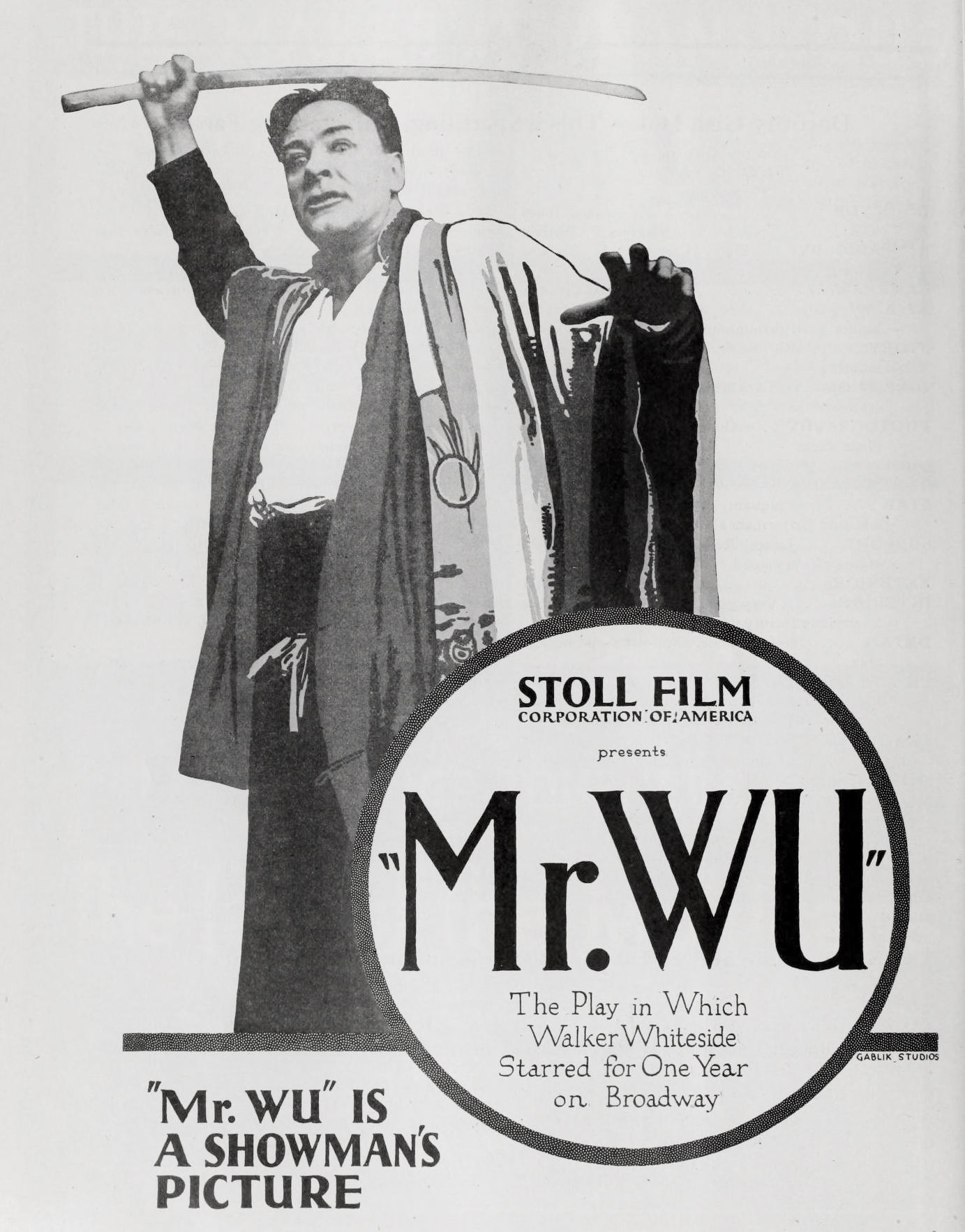
The 1919 iteration of Mr. Wu stands as a monolith of early silent cinema, a production that captures the unsettling intersection of Edwardian anxiety and the burgeoning power of visual storytelling. Directed with a deliberate, almost suffocating pace, the film serves as a vehicle for Matheson Lang, who reprises his stage role with a gravitas that borders on the statuesque. To view this film today is to engage with a relic that is both technically fascinating and ideologically complex, demanding a nuanced understanding of the era's fascination with the 'Oriental' other.
Matheson Lang does not merely play Mr. Wu; he inhabits him as a force of nature. In an era where many silent film performances were characterized by frenetic gesticulation—much like the kinetic energy found in Roaring Lions on the Midnight Express—Lang opts for a profound stillness. His Wu is a man of immense psychological density, a figure whose every blink feels calculated. The sheer economy of motion he employs creates a palpable tension, suggesting a reservoir of fury beneath a veneer of exquisite politeness. This performance provides a stark contrast to the more whimsical or adventurous portrayals of the time, such as those found in The Dancer and the King.
Lillah McCarthy, playing Mrs. Gregory, offers a counterpoint of desperate, maternal fragility. Her performance is the emotional anchor of the film’s second half, providing the human cost to Wu’s abstract calculations of honor. The chemistry between them—if one can call the interaction between a predator and his prey 'chemistry'—is the film’s engine. Unlike the more romanticized entanglements seen in An International Marriage, the relationship here is one of pure, agonizing leverage.
The screenplay, adapted from the stage play by Maurice Vernon and Harold Owen, is a masterclass in the 'well-made play' structure, yet it benefits immensely from the visual expansiveness of film. While it lacks the documentary-like authenticity of A Trip Through China, it creates a stylized, atmospheric version of the East that serves the story’s melodramatic needs. The narrative logic is one of absolute symmetry: a daughter for a daughter, a life for a life. This mathematical approach to morality is what gives the film its enduring chill.
The central conflict—the seduction of Nang Ping by Basil Gregory—is handled with a surprising lack of sentimentality. Roy Royston’s Basil is not a hero but a catalyst for catastrophe, a callow youth whose disregard for cultural boundaries precipitates a bloodbath. Meggie Albanesi, as the doomed Nang Ping, delivers a performance of haunting vulnerability. Her death is not shown with the graphic intensity of modern cinema, but the psychological weight of it hangs over the remainder of the film, much like the lingering shadows in The Hand Invisible.
Visually, Mr. Wu utilizes the chiaroscuro lighting that would later become a staple of German Expressionism. The interior of Wu’s palace is a labyrinth of light and shadow, reflecting the character’s own convoluted morality. The camera work is largely static, but the framing is impeccable, often trapping the characters in corners or behind ornate screens, emphasizing their lack of agency in the face of Wu’s will. This claustrophobia is a far cry from the expansive, outdoor realism of My Partner, creating a sense of inescapable doom.
One cannot discuss the aesthetics of this film without addressing the 'Yellow Peril' trope that was prevalent in 1919. While Mr. Wu certainly indulges in these stereotypes, it also complicates them. Wu is not a mindless villain; he is a man of high culture and deep philosophical conviction. His actions, while monstrous, are rooted in a specific, albeit rigid, ethical framework. In this sense, the film shares a thematic kinship with Peer Gynt, where the protagonist's journey is defined by a personal, often destructive, internal logic.
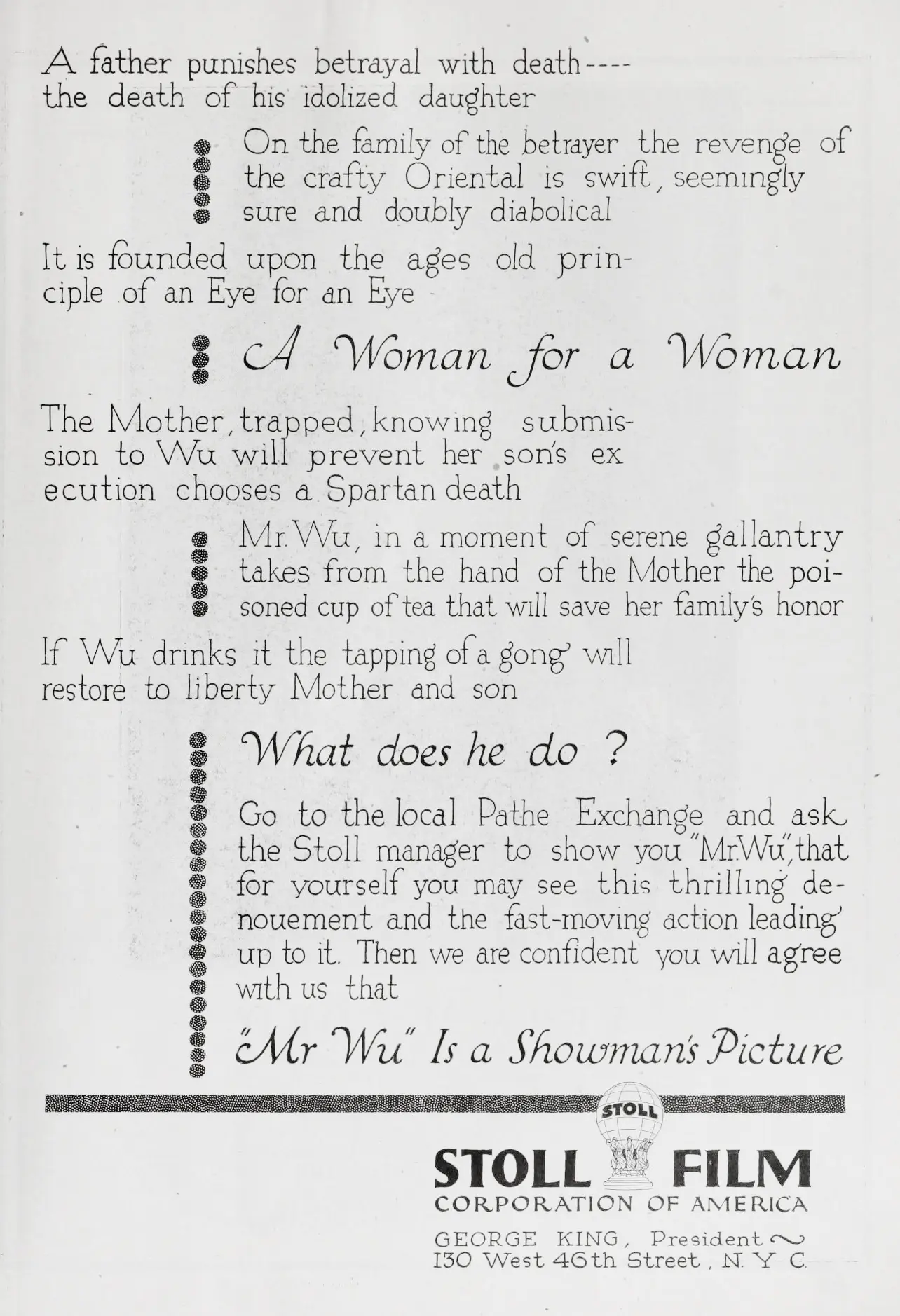
The climax of the film—the confrontation between Wu and Mrs. Gregory—is one of the most harrowing sequences in early cinema. The ultimatum presented is a classic 'no-win' scenario that forces the audience to confront the limits of their own empathy. It is here that the film transcends its melodramatic roots and becomes something more akin to a Greek tragedy. The tension is sustained not through action, but through the agonizing deliberation of the characters. This focus on internal struggle mirrors the social realism found in Shoes, though the stakes here are significantly more operatic.
The resolution of the film, involving a poisoned cup of tea, is a masterstroke of dramatic irony. It provides a sense of closure that is both satisfying and profoundly tragic. The final images of the film, focusing on the aftermath of Wu’s vengeance, leave the viewer with a sense of profound unease. Unlike the redemptive arcs found in L'enfant prodigue, there is no easy path back to normalcy for the survivors of Mr. Wu.
To fully appreciate Mr. Wu, one must consider its place within the landscape of 1919 cinema. This was a year of transition, where the medium was moving away from simple narratives toward more complex psychological portraits. When compared to the crime-focused plotting of The $5,000,000 Counterfeiting Plot, Mr. Wu feels significantly more sophisticated in its character work. It eschews the procedural for the psychological, focusing on the 'why' rather than the 'how'.
Furthermore, the film’s exploration of family secrets and the consequences of past actions can be seen as an early precursor to the domestic dramas like The Tangle or Stepping Out. However, Mr. Wu infuses these themes with a grandiosity that those films lack. It is not merely a family dispute; it is a clash of civilizations, a theme that would be revisited in The Commanding Officer, albeit with less stylistic flair.
The enduring power of Mr. Wu lies in its refusal to offer easy answers. It is a film that lingers in the mind long after the final frame has faded. While modern audiences may find the use of 'yellowface' and certain colonialist attitudes jarring, the core of the story—the destructive nature of rigid honor and the cycle of revenge—remains universally relevant. It is a darker, more cynical exploration of human nature than contemporary works like When Baby Forgot, which sought to comfort rather than confront.
In the pantheon of silent cinema, Mr. Wu deserves a place of prominence. It is a testament to the power of the medium to convey complex emotions and moral dilemmas without the aid of spoken dialogue. The film’s influence can be seen in later cinematic portrayals of anti-heroes and the 'vengeance' subgenre. It is, ultimately, a haunting portrait of a man who, in his quest for justice, loses his humanity, and a family that, in its pursuit of pleasure, loses its soul. For those interested in the evolution of the thriller and the psychological drama, Mr. Wu is an essential, if troubling, chapter in film history.
Final Note: While the 1927 version starring Lon Chaney is perhaps more famous, this 1919 original captures a specific post-war British anxiety that is uniquely its own. It is a film of shadows, both literal and metaphorical, that continues to cast a long silhouette over the history of the silver screen.
IMDb —
1921
Community
Log in to comment.