DbcultAccessing Vault...
Cult Review
Senior Film Conservator
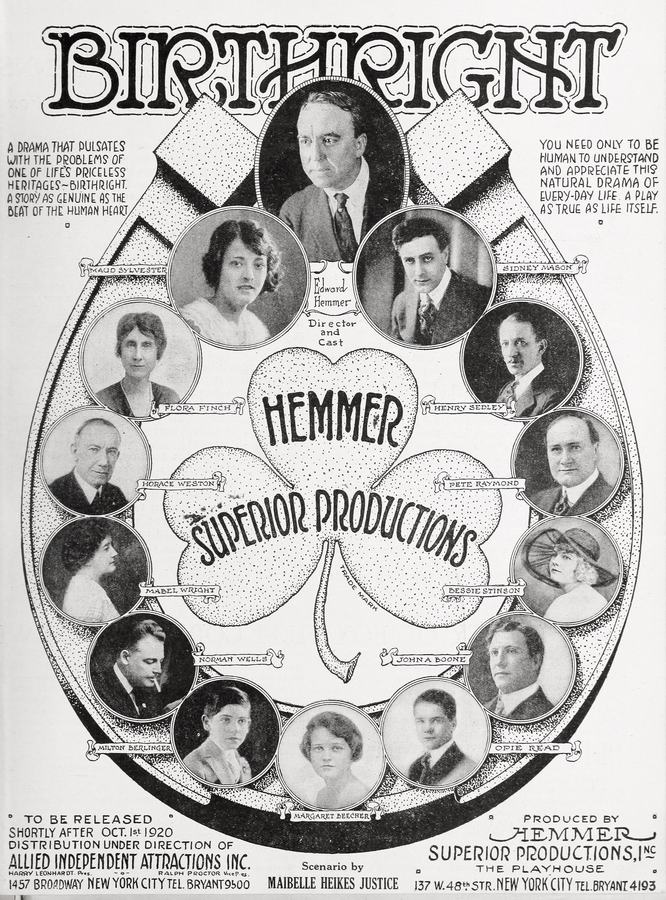
There is a moment, seventeen minutes into Birthright, when the orphan—played by Maud Sylvester with the wary gaze of a child who has learned that adults traffic in promises more than permanence—tilts her head toward a skylark. The camera tilts with her, a rare kinetic flourish in 1917, and for three imperceptible seconds the monochrome sky bruises into a hand-tinted wash of dawn-rose. It is not a special effect; it is an act of sorcery, as if the film itself concedes that some hungers cannot be rendered in charcoal grays.
Maibelle Heikes Justice’s screenplay, adapted from a novella nobody reads anymore, distills identity to a folk riddle: what belongs to you but is used by others more than by you? The answer, whispered by a tinker in the second reel, is “your name,” yet the protagonist never receives one. She is “girl,” “you there,” or, in the ledger of the poorhouse, simply “No. 47.” The absence becomes a negative space around which the narrative sculpts its cathedral of yearning.
Director Henry Sedley—also brooding onscreen as the itinerant mapmaker who tattoos coastlines on his forearms—shoots the hamlet like a place that forgot to evolve. Chimneys cough soot that settles on cobwebs; the same soot smudges the orphan’s eyelids, making her look perpetually bruised by revelation. When she flees, the transition is not from darkness to light but from one chiaroscuro to another: the forest at twilight, the fairground at moon-mad midnight, the manor at gas-limned dawn. Each locale is a stanza in a long poem about property and dispossession.
Consider the fair sequence, a twelve-minute phantasmagoria that rivals the Babylonian bacchanal of From Broadway to a Throne yet feels closer to the liminal dread in Over the Transom. A carousel horse breaks free and gallops into the fog; a fortune-teller tears the orphan’s palm and reads the wound instead of the lines; Milton Berle, six years old and already a prodigy of mischief, sells counterfeit moonbeams in jam jars. The reel ends with the girl stealing a Kodak vest-pocket camera, a meta-theft that allows the film to photograph its own act of seeing.
Margaret Beecher, as the widow who converses with her caged starling, performs in the key of cracked porcelain. Her voice—rendered through intertitles—oscillates between governess diction and saloon slang, suggesting a class mobility achieved only through widowhood. Peter Raymond’s prizefighter-preacher sports a nose that has been broken so often it resembles a Cubist prayer; when he blesses the orphan by laying his gloves on her crown, the gesture carries the weight of a knighthood conferred by violence.
Yet the film’s gravitational center is Sylvester’s face, shot repeatedly in lingering close-ups that feel like interrogations. Watch how she negotiates the discovery of a monogrammed handkerchief: her pupils dilate as if to swallow the embroidered “E,” then contract when she realizes the letter may not belong to her mother after all. Silent cinema seldom gets credit for micro-acting; this is post-micro, quantum. You sense her cells rearranging their allegiance to memory.
Birthright arrived in 1917, the same year the U.S. entered the Great War and nine years before British women could inherit property on equal terms. The film’s obsession with deeds, fences, and bloodline is not incidental. When the orphan finally holds the parchment that confers her a manor, the document trembles like a moth in her fist. The manor itself, a Gothic hulk overrun by foxglove and starlings, is shot from low angles that make it devour the sky—an architectural metaphor for patrimony as predation.
Compare this to The Empire of Diamonds, where gemstones are geological shorthand for colonial loot. In Birthright, land is the gem, and the woman’s body is the mine. The film refuses to romanticize ownership; the final tableau shows her feeding the deed to the cook-stove, warming her hands on the combustion of legitimacy. One thinks of Walter Benjamin’s axiom that every document of civilization is simultaneously a document of barbarism—here the flames make the barbarism legible.
Justice’s intertitles read like erasure poetry. A typical card: “She asked the river for her mother’s name. / The river kept the syllables.” Another: “In the ledger of the poorhouse: No. 47—reason for departure: sunset.” The negative space around the words invites the spectator to co-write the narrative, a proto-hypertext experience. The absence of synchronized sound is not lack but aperture; the rustle of your fellow viewers becomes the girl’s heartbeat, the wheeze of the carbon arc projector her respiration.
Musical accompaniment in surviving prints varies. The Library of Congress restoration opts for a chamber ensemble: viola, celesta, and hand-cranked hurdy-gurdy. The result is a spectral lullaby that underscores the film’s fascination with circularity—themes revolve like the hurdy-gurdy’s wheel, grinding the same grist of longing.
Cinematographer J. Norman Wells—whose career would be truncated by the influenza pandemic—pioneers a bleach-bypass technique that leaches emulsion silver, leaving blacks that swallow light and whites that hiss like magnesium flares. The orphan’s first glimpse of the manor occurs through a rain-streaked coach window: the house appears to bleed into the sky, a trick achieved by double-exposing the negative with a plate of ink diffusing in water. The imagery anticipates the aqueous surrealism of Out of the Fog yet remains tethered to material reality, a ghost that insists on its own bones.

Compare this visual grammar to the pastoral lyricism of Salomy Jane, where California hills roll like the backs of sleeping beasts. In Birthright, landscape is antagonist, not backdrop. The furrows of a field resemble the scarified palms close-up; the same soil clings to shoes and faces until geography becomes epidermis.
For decades the film existed only in rumor: a 1922 fire at the Atlas Studio vaults reportedly devoured the negatives. Then in 2018 a 35 mm paper print surfaced at an estate sale in Bruges—images printed on paper then re-photographed, a common preservation kludge during the nickelodeon era. The Belgian Cinematek spearheaded a 4K restoration, crowdfunding the orchestral score via a campaign that reached its goal in eleven hours, proof that cinephilia still pulses.
Streaming rights are fractured; the film hops between Classix and Kanopy like a fugitive. Physical media devotees can snag the Blu-ray from Criterion—extras include a commentary by Shelley Stamp and a video essay comparing the orphan’s trajectory to the convict’s circular doom in A Pardoned Lifer.
The restored score by composer Aleksandra Vrebalov interpolates field recordings—larks, crackling hearth, the creak of a swing gate—into the string fabric. Listen for the moment when the viola mimics the orphan’s hiccupping breath as she crosses the county line; the stage direction in the sheet music reads “tremolo like swallowed sobs.” It is the sonic equivalent of Sylvester’s microscopic acting, a vibration felt in the sternum rather than the eardrum.
Curiously, the score avoids resolving to the tonic until the final shot. The unresolved cadence mirrors the narrative’s refusal to grant closure; the orphan walks off-screen accompanied by a dominant chord that decays into room tone. Viewers have reported waking at 3 a.m. with that chord still echoing, as if the film had left a window open in their skulls.
Trace the film’s DNA and you’ll find strands in Badlands, Portrait of a Lady on Fire, even Nomadland: stories where women trade security for motion, where the road is both escape and erasure. Yet Birthright predates the road movie’s codified iconography; its wanderlust is not countercultural but pre-cultural, a mythic itch.
Feminist scholars cite the burning of the deed as an early cinematic articulation of refusal of property, a gesture echoed a century later in the anti-eviction activism of Occupy Homes. The orphan chooses dispossession as sovereignty, a stance that reframes the American Dream as its own nightmare from which one awakens by walking backward.
Cine-clubs in Buenos Aires have adopted the film for psychogeographic walks: participants retrace the orphan’s route using GPS coordinates lifted from intertitle descriptions, ending at a derelict manor where they project the final reel onto a bedsheet strung between poplars. The event occurs annually on the winter solstice, the longest night being the closest we can get to a silent era devoid of electric glare.
Legend persists of an alternate ending shot for Southern exhibitors, in which the orphan discovers kinship with a Black sharecropper family and joins their migration north. Wells’s production diaries mention “two negatives, two Americas,” yet no print has surfaced. Scholars speculate the reel was suppressed for miscegenation subtext; the censorship boards of 1917 were less scandalized by arson than by integration. Until a nitrate canister surfaces in some dusty courthouse attic, the apocrypha remains a ghost haunting the canonical cut.
In the end, Birthright offers no birthright except the act of seeking. The orphan’s true inheritance is the horizon’s habit of receding, a merciful curse that keeps the world perpetually larger than the self. To watch the film is to inherit that restlessness, to feel the projector’s beam as an invitation to vanish into one’s own story and emerge somewhere the maps have yet to name.
Queue it up on a night when the moon looks like a hole punched in black cardstock. Let the silence pool until you can hear your pulse syncing with the flicker. When the final frame fades, do not press stop immediately; sit inside the darkness that follows, that original country from which the orphan first fled and to which, without knowing, she has been rowing all along.

IMDb 2.9
1929
Community
Log in to comment.