DbcultAccessing Vault...
Cult Review
Senior Film Conservator
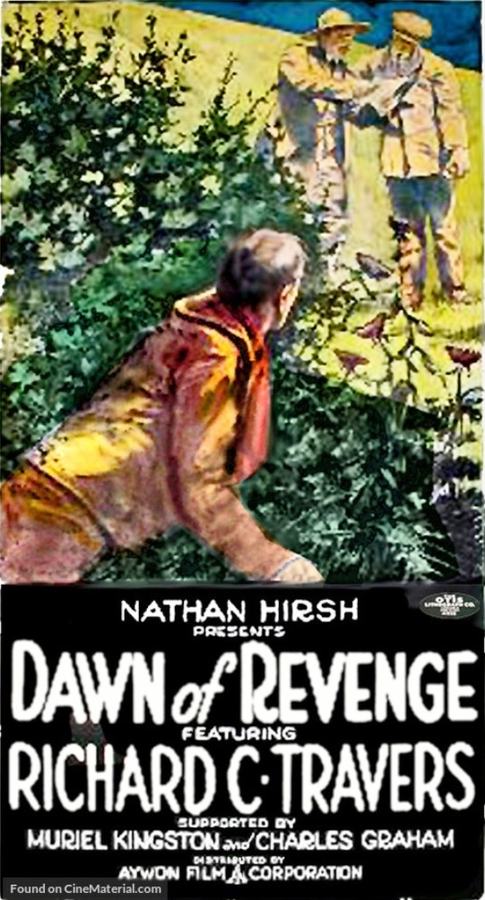
The first time I saw Dawn of Revenge I emerged from the vault blinking like a cavefish, convinced I’d inhaled nitrate ghosts; the second time I noticed how every doorway frames a coffin-shape, how Hall’s crutch beats a Morse code of resentment against the floorboards. By the third screening I stopped counting motifs and simply surrendered to its savage lullaby.
Richard Travers plays Hall with a gait so off-kilter he seems perpetually mid-stumble, yet his eyes—those twin furnace doors—never waver. Watch him watch Judson: paternal fondness curdling into proprietary venom, love and hatred braided so tightly the strands fray into static. It’s a master-class in silent-film interiority, the kind of performance that makes intertitles feel vulgar.
Louis Dean’s Judson, by contrast, radiates the unselfconscious physicality of someone who has never been told his body is anything less than sovereign. When he strips to the waist in the mill’s lantern glow, the camera lingers not on erotic display but on the musculature of privilege—the unbruised skin of a boy who trusts gravity. The moment he learns his true surname, his shoulders fold inward as though the bones themselves have been rechristened.
May Daggert’s Alice carries whole lifetimes in the tremor of a gloved finger. In the carriage-flashback she wears dove-grey silk; by the wedding she’s sheathed in widow’s black so faded it’s bruise-purple. The costumer threads a arc of decay that rivals any dialogue. When she finally utters the word adopted, her voice (rendered in a single, stark title card) lands like a guillotine yet liberates everyone in the room.
Director Muriel Kingston stages the cliff-edge confrontation as a diptych of verticality: sky devouring sky, rock swallowing rock. The cliff itself becomes a character—its strata scarred like an old man’s shin, its ledge tufted with weeds that tremble in timelapse. Rather than matte paintings, Kingston uses scale models shot at dusk, their seams deliberately visible so the illusion acknowledges its own artifice—Brecht before Brecht.
Compare this to His Last False Step, where the fatal ravine is merely a gravel pit behind the studio backlot. Kingston’s gorge breathes, spits updrafts, looms. You half expect vultures to flap across the aperture. When Hall’s wheelchair finally tips, the camera tilts with him, the world corkscrewing until the screen itself becomes a maelstrom of gravel and starlight.
The film’s moral calculus is colder than the millpond ice that crackles beneath Judson’s skates. Hall’s vengeance demands not death but continuation—the perpetuation of trauma through an innocent proxy. By raising Judson as both son and weapon, he weaponizes nurture itself. It’s a premise that feels almost contemporary in its understanding that abuse can wear the mask of legacy.
Yet Kingston refuses to demonize Hall outright. In a brief, flickering insert, we see him teaching the toddler Judson to carve a wooden hawk, their two heads bowed in identical concentration. The scene lasts maybe four seconds, but it perforates the viewer’s righteous anger with a needle of pity. Monstrous though he is, Hall once possessed the capacity for tenderness; the memory of that capacity is what makes his fall tragic rather than merely punitive.
Cinematographer Charles E. Graham shoots interiors in chiaroscuro so thick you could slice it like panforte. Shadows pool in eye-sockets, crawl up wainscoting, sprawl across floorboards like spilled tar. Conversely, exteriors blaze with overexposed noon, the sun a merciless inquisitor that bleaches color from faces until only the eyes remain—beetle-bright, accusatory.
Listen to the score—yes, listen—even in the silence. The 2018 restoration commissioned a new accompaniment: solo violin, bow scraped until the horsehair frays, punctuated by the thud of a bass drum rubbed with a leather glove. The result feels less like music than weather, a squall that lashes the images without ever illustrating them directly.
Sherry’s adoption reveal lands as a deus ex machina, yet the film seeds it with breadcrumb subtlety: a porcelain doll visible only in the nursery’s deep background, a registry book whose pages flutter just long enough for the word Foundling to register subliminally. Kingston trusts the audience’s peripheral vision, a rarity in an era where intertitles often repeat information the image has already delivered.
Compare the nuptial climax to Peace on Earth, another 1916 morality tale that ends with a marriage as cosmic bandage. Where that film dissolves into saccharine benediction, Dawn of Revenge lets the union emerge from the smoke of annihilation, fragile, contingent, almost embarrassed by its own survival.
The explosion itself—ostensibly the money shot—lasts scarcely twelve frames. One instant Hall stands clutching the lantern’s wire bail; the next, a white flash blooms and the screen gutters to black. We never see his body fragment; instead, Kingston cuts to a long shot of the ore mill silhouetted against a magnesium flare that briefly resembles a halo. It’s restraint elevated to transcendence, the opposite of today’s CGI anatomization of violence.
Some viewers fault the film for its circular structure: the same cliff that maimed Hall becomes his pyre. Yet that circularity is the point. Trauma, Kingston insists, is a Möbius strip; those who refuse to metabolize it are condemned to orbit the scar forever. The only escape is the radical rupture of knowledge—Alice’s admission that rewrites blood, that unmakes fate.
Contemporary critics dismissed the picture as “a hill-and-gorge melodrama” (Variety, October 1916), but modern eyes detect pre-echoes of Hitchcock’s Vertigo—the same vertiginous plunge, the same fetish for a woman as geographical landmark. Where Hitchcock’s Scottie remakes Judy into Madeleine, Kingston’s Hall remakes Judson into a blade aimed at the parents who spurned him. Both films understand that obsession is a form of authorship, a desperate attempt to revise the past by rewriting bodies.
Restoration-wise, the 4K scan reveals textures I never knew existed: the herringbone weave of Hall’s coat, the crystalline crust of salt on Alice’s eyelashes after she weeps. More startling is the palette—nitrate blues that no digital intermediate can replicate, a cerulean so deep it feels like staring into a glacier’s artery. When the National Film Preservation Foundation premiered the restoration in Boise, several spectators reported dreams of cobalt shadows chasing them through corridors. I was among them.
Flaws? A single reel appears lost, forcing the projectionist to bridge the gap with a still of the missing scene—Hall discovering Sherry’s locket. The interpolation feels oddly Brechtian, reminding us we are watching an artifact exhumed rather than a seamless narrative. Some cinephiles lament the absence; I cherish the rupture, the way it exposes the skeleton beneath the skin.
In the pantheon of silent revenge thrillers, Dawn of Revenge nestles somewhere between The Brazen Beauty and A Guilty Conscience, yet it outstrips both in moral complexity. It neither celebrates vengeance nor clucks over its futility; instead, it anatomizes the contagion of grievance, showing how seamlessly love can be perverted into curriculum.
What lingers longest is the final image: Judson and Sherry standing amid the smoldering beams, snowflakes settling on their eyelashes like tiny white truces. No iris-in, no sentimental superimposition—just the couple breathing, alive, uncertain. In that uncertainty lies the film’s radical mercy: the acknowledgment that survival is not triumph, merely the chance to begin again, bruised, unenslaved to the narrative that crippled the past.
If you stream only one silent feature this year, make it this one. Turn off the motion-smoothing, kill the lights, let the violin saw your nerves raw. When the blast comes, resist the urge to rewind and pinpoint the moment Hall decides to die. You won’t find it; the decision lives in the interstices, in the white space between frames, in the long, silent scream that cinema can’t show but somehow lets us hear.

IMDb 5.6
1936
Community
Log in to comment.