DbcultAccessing Vault...
5.6/10
Senior Film Conservator
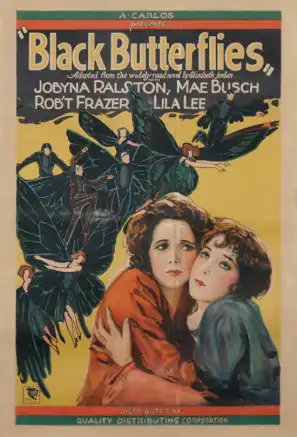
A definitive 5.6/10 rating for a film that redefined the boundaries of cult cinema. Black Butterflies remains a cornerstone of transgressive art.
Okay, so Black Butterflies. If you’re someone who thinks movies *must* have explosions or snappy dialogue every five seconds, you’re probably gonna struggle with this one. It’s a 1924 silent drama, folks. But for those of us who appreciate the craft of early cinema, or just enjoy a good old-fashioned melodrama where every glance means something, this is a solid watch. If you’re curious about how stories were told before sound, definitely give it a shot.
Lila Lee plays Esther, our protagonist, and honestly, she carries so much of the film on her shoulders. Her expressions, the way her eyes dart around in certain scenes—it’s just classic silent acting. You can almost feel the weight of her character’s secrets without a single word being spoken. There’s this one close-up, fairly early on, where she’s just staring into a teacup, and her face tells you everything about her quiet despair. No fancy tricks, just raw emotion from her.
The plot itself is a tangled web, exactly what you’d want from a melodrama. Esther’s past keeps coming back, of course, in the form of an old lover, and it threatens her current, rather comfortable life. Robert Frazer plays the charming, perhaps a bit too charming, suitor who complicates everything. He has this way of smiling that just makes you feel uneasy, even when he’s being perfectly polite. It’s not a huge role, but it really sticks with you. Like The Legion of Death, another film from that period, the drama here is *intense*.
Visually, the film has some moments. There’s a scene set at a fancy garden party, and the way they’ve staged the crowd, everyone in their period finery, it’s quite something. The lighting, too, feels deliberate. You notice the shadows, especially in the more tense, intimate scenes. It adds a layer of moodiness that really works. It’s not flashy like a modern blockbuster, obviously, but it’s got its own kind of beauty.
Pacing-wise, well, it’s a silent film. Things move at their own rhythm. There are moments that might feel a little stretched for a modern viewer. One particular sequence where Esther is trying to make a difficult decision just lingers. It goes on about 20 seconds too long, and the silence starts to feel awkward rather than emotional. But then, that’s part of the charm, isn’t it? It forces you to slow down, to really *look* at what’s happening.
I found myself really drawn into the supporting cast, too. Mae Busch, as the rival, is just fantastic. She doesn’t need much screen time to make an impact. Her character’s subtle eye rolls and a very deliberate, almost predatory, smirk? It’s perfect. You can almost feel the movie trying to convince you this moment matters. She's not just a villain; she's a force. Her energy is just so different from the controlled performances elsewhere. Reminds me a bit of the silent era's version of a character you might find in Mannequin, just with less singing.
The intertitles are pretty straightforward, no flowery language, which I appreciated. They get to the point, letting the actors handle most of the emotional heavy lifting. It’s a good balance. Sometimes, though, you get one that’s a bit on the nose, like ‘A web of deceit slowly spun.’ You just have to roll with it.
I think what makes Black Butterflies hold up, for the right audience anyway, is its commitment to its own drama. It never winks at the camera, never tries to be anything other than a serious tale of love, loss, and difficult choices. It’s earnest, sometimes a little *too* earnest, but that’s part of its unique flavor. You walk away thinking about the characters, not just the plot mechanics.
Didja notice?
IMDb 6.8
1932
Community
Log in to comment.