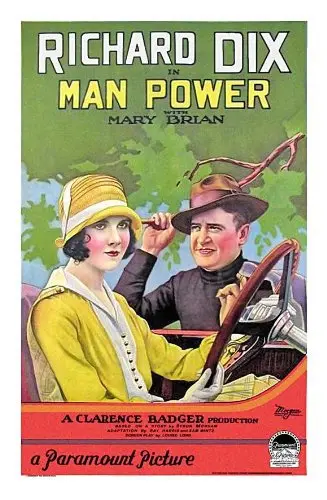
Is Man Power worth watching today? Short answer: surprisingly, yes, but with significant caveats. This 1927 silent drama, while undeniably a product of its era, offers more than just historical curiosity, especially for those willing to engage with its particular rhythms and conventions.
It’s a film best suited for silent cinema enthusiasts, viewers interested in the nascent themes of industrial innovation and post-war societal shifts, and anyone who appreciates a straightforward, earnest tale of heroism. Conversely, if you demand rapid-fire dialogue, complex psychological narratives, or are easily disengaged by the visual storytelling of the silent era, Man Power might prove a challenging watch.
A Drifter's Redemption: The Plot Reimagined
At its core, Man Power is a classic narrative of redemption and ingenuity, cloaked in the industrial anxieties of the Roaring Twenties. We follow Tom Roberts (Richard Dix), a man haunted by his past as a Tank Corps officer, now drifting aimlessly through a civilian world that seems to have little use for his particular skills. His life takes an unexpected turn when he intervenes in a dangerous train crossing incident, saving Alice Stoddard (Mary Brian), the daughter of a struggling machinery magnate.
This act of bravery, a spark of his former self, lands him a job at the Stoddard Machinery Co. and, serendipitously, reunites him with Ptomaine (Oscar Smith), a cook from his old regiment. As Tom finds purpose and a burgeoning romance with Alice, he stumbles upon a sinister conspiracy. Randall Lewis (Philip Strange), the company manager, is deliberately sabotaging the Stoddard tractors, pushing the company towards bankruptcy. It’s a classic corporate espionage plot, made all the more urgent by the real-world implications of financial ruin for Alice and her father.
Tom's military background, specifically his intimate knowledge of tanks and heavy machinery, becomes the unlikely key to unraveling and correcting the mechanical flaws. The film builds to a dramatic crescendo during a devastating flood. Here, Tom and Ptomaine, with their perfected tractor, become the town’s last hope, racing against the clock to save a collapsing dam. It's a grand, heroic gesture that not only secures the town's safety but also cements Tom’s place as a true hero and a worthy partner for Alice.
Is Man Power Worth Watching Today?
This film works because of its surprisingly robust central performance from Richard Dix, which anchors the narrative with a palpable sense of earnestness and capability. The plot, while straightforward, manages to weave together elements of post-war disillusionment, industrial espionage, and classic romance into a cohesive whole that avoids becoming overly saccharine.
Scene from Man Power
Cinematic perspective: Exploring the visual vocabulary of Man Power (1927) through its definitive frames.
This film fails because its melodramatic tendencies, particularly in the villain’s cartoonish malevolence and some of the more overtly sentimental moments, can feel dated to a modern sensibility. Furthermore, the inherent limitations of silent film exposition mean some plot points are conveyed with a broadness that contemporary audiences might find less nuanced.
You should watch it if you have an appreciation for the historical context of cinema, enjoy seeing how early filmmakers tackled themes of industry and heroism, or are simply curious about the career of Richard Dix, a prominent figure of the silent and early sound eras. It’s a window into a different era of storytelling, offering a unique blend of adventure and social commentary.
Richard Dix: Charisma Under Pressure
Richard Dix, as Tom Roberts, is the undeniable linchpin of Man Power. His performance is a masterclass in silent film acting, relying heavily on physical presence and expressive facial work to convey an internal world of past trauma and burgeoning hope. Dix doesn't just play a character; he embodies the archetype of the strong, silent hero, a man of action whose quiet intensity speaks volumes.
Consider the scene where Tom first inspects the faulty tractors. Dix's brow furrows, his hands expertly run over the machinery, and his eyes, even through the grainy film, convey a deep, intuitive understanding. It’s not just an act; it’s a demonstration of expertise. This contrasts sharply with his earlier portrayal of a listless drifter, showing a remarkable range within the confines of silent performance.
Mary Brian, as Alice, provides a compelling counterpoint. She’s not merely a damsel in distress but a woman with agency, concerned for her family’s legacy. Her initial skepticism of Tom, slowly melting into admiration, is conveyed with subtle glances and a growing ease in their shared scenes. Philip Strange, on the other hand, embraces the villainy of Randall Lewis with gusto. His smirks and furtive movements are classic silent film villain shorthand, effective in their straightforward menace, if a little one-dimensional for today’s tastes.
I'd argue that Dix’s performance here, particularly his ability to convey both vulnerability and staunch resolve, elevates Man Power from a simple melodrama to a more engaging character study. He brings a gravitas that makes you believe in Tom’s journey, even when the plot stretches credulity.
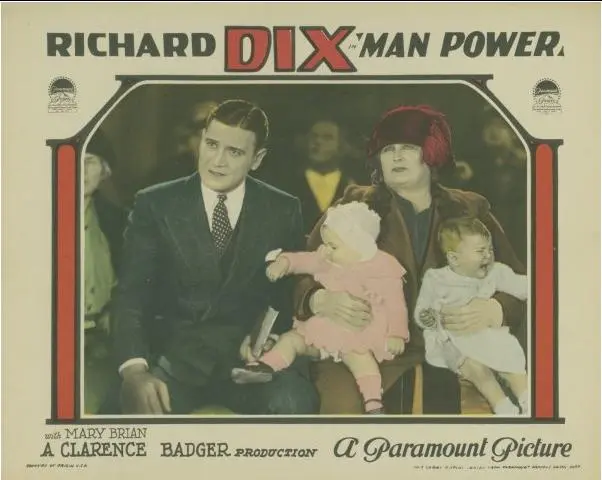
Scene from Man Power
Cinematic perspective: Exploring the visual vocabulary of Man Power (1927) through its definitive frames.
Direction and Cinematography: Silent Era Sensibilities
The direction in Man Power, while not revolutionary, is competent and effective, particularly in its handling of tension and spectacle. The opening train crossing sequence, for instance, is deftly orchestrated. The approaching train, the stalled car, Alice’s frantic struggle – it’s a tightly edited scene that immediately establishes stakes and Tom’s heroic potential. This sequence, with its stark lighting and dramatic angles, sets a tone of impending danger that permeates the film.
Cinematography plays a crucial role in silent film, and here, it’s used to great effect to highlight both the grandeur of industry and the intimacy of human emotion. Close-ups are employed judiciously to capture the nuances of Dix’s expressions or Brian's concern, allowing the audience to connect with the characters without spoken dialogue. The shots of the Stoddard factory, with its bustling machinery and looming structures, evoke a sense of both opportunity and oppressive labor, a visual commentary on the industrial age.
The climax, involving the flood and the dam, showcases the ambition of silent filmmaking. While perhaps not as spectacular as later disaster epics like The Mystery Road, the practical effects and dynamic shots of rushing water and the struggling tractor are impressive for the period. The use of miniatures and forced perspective likely came into play, creating a genuine sense of peril. The visual storytelling here is paramount, conveying the urgency and scale of the disaster without a single word spoken.
Pacing and Tone: A Race Against Time
The pacing of Man Power is surprisingly brisk for a silent film, particularly once Tom settles into the Stoddard company. The initial wandering phase is brief, quickly transitioning into the industrial drama and burgeoning romance. The plot moves with an efficiency that keeps the audience engaged, avoiding the languid stretches sometimes found in films of this era.
The exposition, often delivered via intertitles, is concise and to the point, propelling the narrative forward rather than bogging it down. The shift from the quiet, almost melancholic tone of Tom's drifter days to the bustling energy of the factory and the suspense of the sabotage plot is handled smoothly, creating a dynamic viewing experience.
The tone is largely melodramatic, as is typical for 1927. The stakes are high, the villain is clear, and the hero is unequivocally good. Yet