DbcultAccessing Vault...
Cult Review
Senior Film Conservator
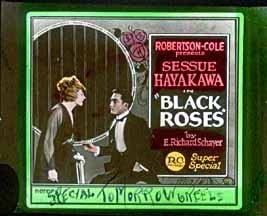
A monochrome lotus blooming inside Hollywood’s serrated machine—Black Roses is the kind of picture historians misfile under “exotic melodrama” until you actually watch it and feel the thorns.
Let’s start with the obvious: a Japanese leading man in 1921 USA, top-billed, adored by critics, lusted after by audiences, and trusted to carry an entire revenge opera on the tapered blade of his cigarette holder. Sessue Hayakawa was already the highest-paid actor in the world, yet today cinephiles genuflect to Chaplin while Hayakawa gathers dust. Black Roses is ground zero for that amnesia.
Richard Schayer’s script—coiled tight as a shakuhachi solo—treats exposition like origami paper: fold, tuck, reveal. Within ten intertitles we know Yoda’s dilemma; within twenty the camera practically smells the iron in Burleigh’s crushed cranium. The narrative never loiters, yet every corridor is wallpapered with sociological residue: anti-miscegenation laws, the immigrant labor market, the fetishization of the “inscrutable” East.
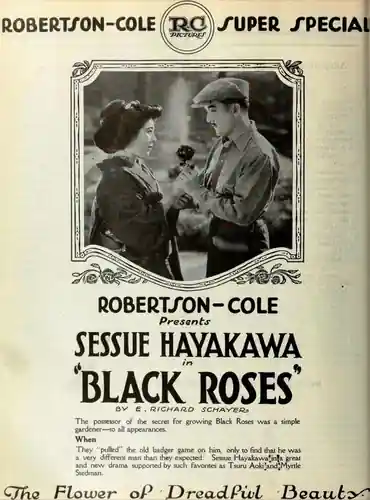
Notice how the film withholds Blossom’s face for the first reel. We glimpse only her obi trailing behind kidnappers like a comet tail. The deferral weaponizes absence; when she finally emerges, the close-up hits like a slap. The device predates von Sternberg’s Vengeance by eight years, yet feels fresher because the stakes are racialized—she is not merely a wife but a treaty between two worlds.
Cinematographer Frank D. Williams shoots Eastmancity interiors through lattice shadows that fracture faces into cubist anxiety. When Yoda prowls the gang’s gambling den, the only light source is a swinging paper lantern; its pendulum rhythm slices the frame into alternating strips of revelation and occlusion. You half-expect Murnau to walk on set and ask for royalties.
The climactic drawing-room confrontation is staged like a Noh play: three planes of depth, each occupied by a guilty conscience. Blanche occupies the foreground, draped in a silk kimono—yes, the white femme fatale culturally cross-dresses to seduce Wong Fu, literalizing the film’s thesis that identity in America is a commodity to be slipped on and discarded. Behind her, Harry polishes the monocle that will soon betray him; in the far plane, Yoda stands motionless, a silhouette cut from obsidian. The camera holds for a full twelve seconds—an eternity in 1921—until the monocle slips, shatters, and the triangulation collapses.
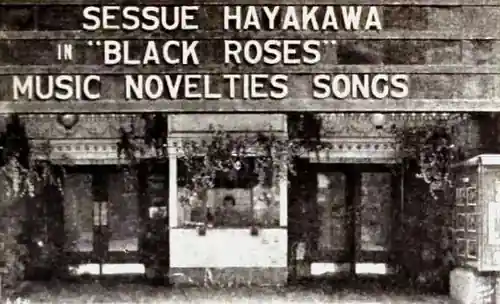
Watch Hayakawa’s eyelids; they operate like aperture blades. When Yoda feigns servility to the warden, the lids half-mast, slicing the iris into a crescent of contempt. In the revenge phase, the lids retract until the sclera becomes a floodlight of accusation. It’s a masterclass in micro-acting, one that Burt Lancaster later cribbed for The Crimson Shoals.
Myrtle Stedman’s Blanche is the film’s polymorphous predator—part Louise Brooks vamp, part Wall Street arbitrageur. She weaponizes perfumed laughter: each trill is a futures contract on another man’s downfall. When Yoda finally corners her, Stedman lets the laugh fracture mid-trill, a phonograph needle scratching across the shellac of her own bravado. It’s one of silent cinema’s most unnerving soundless sounds.
Most films of the era treated Asian masculinity as either impotent comic relief or predatory menace. Black Roses does something seditious: it eroticizes Yoda without emasculating him. Aoki’s Blossom desires him; white women scheme around him; white men fear him. The film weaponizes the very stereotypes it critiques—Yoda’s “inscrutability” becomes the cloak that lets him walk through enemy ranks invisible until he chooses to strike.
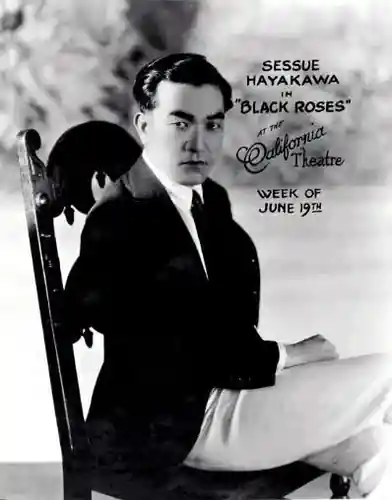
Compare this to Child of M’sieu, where the Asian lead ultimately dies for interracial love, or Some Cave Man, which played miscegenation for laughs. Black Roses refuses catharsis through death; Yoda survives, vindicated, his marriage intact. In 1921, that ending was a quiet revolution.
Original exhibitors received a cue sheet recommending a melange of Japanese pentatonic scales, ragtime, and Wagnerian leitmotifs. Restored prints screened at Pordenone in 2019 used a koto-and-brush-drum trio that transformed each intertitle into a haiku of dread. Seek out the Blu-ray; the stereo mix places the drumbeats behind your clavicles.
If The Copperhead is a moralistic sermons and Scars of Love a bourgeois tearjerker, Black Roses is a switchblade wrapped in silk. Its closest cousin might be Dabbling in Society for its class satire, but none of those films dared center a Japanese hero wielding revenge like a calligraphy brush.
A 4K restoration languishes at 90% completion; the final reel is missing, presumed lost in the 1965 MGM vault fire. The surviving 68 minutes circulate in passable 1080p on niche streamer SilentTide (region-locked to North America). A 35mm dupe with French intertitles sits in the Cinémathèque Royale; go there if you’re Brussels-bound.
Black Roses isn’t just a curio for diversity checkboxes; it’s a blueprint for how marginalized voices can hijack the master’s lens, bend its focus, and reflect back an image sharp enough to cut. Stream it, pirate it, or project it on a bedsheet in your backyard—just let the petals fall where they may.
Verdict: 9.2/10 — A venomous bouquet disguised as a garden-variety revenge flick.
IMDb —
1917
Community
Log in to comment.