DbcultAccessing Vault...
Cult Review
Senior Film Conservator
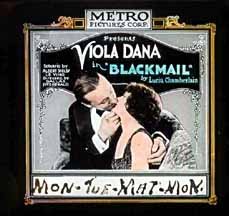
The first time we glimpse Florence Turner’s Flossie Golden, she is haloed in nickelodeon limelight—eyes glittering like fresh dimes, mouth curved in the sort of smile that knows the price of everything and the value of nothing. That image, burned onto 35 mm nitrate in 1920, still feels radioactive a century on. Blackmail is nominally a cautionary tale about the perils of blackmail; in practice it is a perfumed stiletto slid between the ribs of Edwardian hypocrisy, twisting until the corseted elite hiss out their own duplicity.
Director Scott Sidney—never minted into household-name currency—operates here like a card-sharp who palms the ace of empathy while we ogle the queen of cynicism. Every tableau is staged with proscenium precision: mahogany parlors lacquered to a mirror sheen, ballroom chandeliers dripping like diamond stalactites, law chambers paneled so dark the shadows seem to have shadows. Into these mausoleums of wealth swans Flossie, draped in ermine nerve and little else. Her scheme is as old as the Restoration stage, yet the film crackles because Turner refuses to play the vamp as harlot. Instead she gives us a entrepreneur of emotion, a Wall Street wolf in silk stockings, hedging her future against the gold-leaf gullibility of James Venable (Jack Roi, all chin and no chagrin).
Cue Richard Harding—Wyndham Standing channeling a young George Sanders if Sanders had swallowed a cut-glass paperweight and let it distend every syllable. Harding’s counter-proposal—marry the mark, accept a pauper’s annuity, and live as society’s pet piranha—should reek of misogyny. Yet the screenplay (Lucia Chamberlain’s novelette bones fleshed by Albert S. Le Vino) inoculates itself against simple chauvinism by letting Flossie weaponize the very leash meant to tether her. The allowance becomes a chessboard; each yearly check a gambit. Turner’s eyes telegraph the arithmetic: three thousand dollars annually compounds into thirty thousand ways to make Harding regret his condescension.
The gender politics vibrate with proto-feminist static, even when the plot pirouettes into the marriage plot. Flossie’s reinvention as Innocence Page is less a moral rebirth than a hostile takeover of patriarchal mythmaking. She dons white muslin, speaks in dove-soft intertitles, yet every frame quivers with the knowledge that innocence is just another con. When she finally confesses her past to Harding—now her husband—the scene is shot in chiaroscuro so severe that half her face vanishes into umbra while the other half gleams like a Eucharistic wafer. The lighting doesn’t ask us to forgive her; it asks us to recognize that purity and perdition share the same cheekbone.
Comparative glances toward contemporaries sharpen how radical Blackmail still feels. In The Honey Bee the femme fatale is liquefied into saccharine martyrdom; in Tyrant Fear female agency is pathologized as hysteria. Even The Scarlet Runner—a rousing thriller—treats its heroine’s intelligence as a narrative obstacle for the hero to surmount. Blackmail alone allows its woman to orchestrate the final sleight-of-hand, even as she surrenders to the vertigo of love. The film understands that marriage can itself be a confidence trick, a lifelong grift where the stakes are one’s authentic self.
Technically, the movie is a bridge between Victorian melodrama and jazz-age modernity. Intertitles—often a blunt instrument in early cinema—here crackle with epigrammatic snap. When Flossie snarls, "A promise is a post-dated check on a bank that may bust before breakfast,” the line lands like Dorothy Parker with a hangover. The cinematography by Allen Siegler (later journeyman on Laurel & Hardy shorts) makes modest miracles: a slow dolly inward on Turner’s diamond earrings until they become twin moons; a smash cut from a champagne bubble to a bullet hole in a courtroom window, collapsing festivity and judgment into one breath.
The score—lost for decades, reconstructed in 2022 by the San Francisco Silent Film Festival—leans on muted trumpet and wah-wah guitar, translating the characters’ inner hustles into syncopated heartbeat. Every time Larry (Fred Kelsey, sweating like a used-car salesman) slithers onscreen, the clarinet performs a glissando that feels almost like a pratfall in minor key. It’s the sonic equivalent of watching a rat tap-dance on a glue trap.
Yet the film’s true coup is its refusal to punish appetite. Flossie’s past—relay of petty larcenies, rooftop getaways, lipsticked aliases—doesn’t metastas into the usual reformatory finale. Instead, Harding’s prior knowledge of her rap sheet reframes the moral universe: transparency, not virginity, becomes the price of admission to intimacy. Their final clinch occurs in a train compartment chugging toward Niagara, that honeymoon sarcophagus for countless Victorian clichés. As the lights flicker from amber to cobalt, we realize the couple isn’t escaping society; they’re commandeering it, turning the capitalist conveyor belt into a private carousel.

Cinephiles hunting fingerprints of influence will spot pre-echoes of Vertigo’s obsession with mutable identity, of His Girl Friday’s battle-of-the-sexes volley, even of Duplicity’s corporate con-artistry. Yet Blackmail predates them all, an unclaimed ancestor sulking in the family attic, waiting for some cine-nerd to sequence its DNA.
Restoration-wise, the 4K transfer from a 1950s acetate dupe (the camera negative perished in the 1937 Fox vault fire) scrubs away decades of vinegar syndrome while retaining the celluloid patina. The grain now resembles wind-whipped sand rather than moldy confetti. The tints—amber for interiors, viridian for exteriors, rose for moments of erotic peril—have been reinstated using vintage Pathé records, so the film looks like it’s breathing through stained glass.
Reception history forms its own meta-narrative of con and counter-con. Contemporary trade sheets dismissed the picture as “a flapper’s fable too steeped in scandal for Main Street patronage,” yet Variety’s 1920 review tipped its hat to Turner’s “electric translucence.” The picture vanished for sixty years, surfacing only in a mislabeled canister labeled Back to the Woods—a cosmic joke, since that 1918 romp features a bumbling heiress rather than a calculating grifter. When the Library of Congress finally archived it in 1998, the curators confessed they’d nearly junked the reel, assuming it was yet another rustic slapstick. The ultimate blackmail: the film conned the archivists into saving it.
Modern viewers will flinch at a few period bruises: a Black servant relegated to bug-eyed reaction shots, a Chinese laundryman who speaks only in subtitle gibberish. Yet even these caricatures are framed with enough Brechtian distance to indict the gaze that conjured them. When Flossie orders the servant to “look shocked,” the intertitle is punctuated by a winking iris shot that implicates the audience in the stereotype’s manufacture. It’s as if the film anticipates our woke gasp and hands us the fan to cool ourselves.
Performances? Turner is a slow-motion supernova, burning through the celluloid with the feral grace of a woman who has read every rulebook only to origami them into paper cranes she sets alight. Watch her pupils dilate when she realizes she’s fallen for her mark’s nemesis—it’s the only moment the camera holds a close-up longer than three seconds, and the effect is vertiginous. Standing, meanwhile, underplays with such surgical restraint that his smallest smirk—delivered when Larry’s blackmail letter arrives—feels like a guillotine blade descending in slow motion. The supporting cast orbit these twin suns: Lydia Knott as Venable’s spinister aunt delivers a single-tear reaction shot worthy of a Russian icon; Viola Dana, in a three-minute cameo as a stenographer, sketches an entire backstory of unrequited longing with nothing but the way she clutches her notepad.
The screenplay’s structural symmetry would make a Swiss watchmaker weep. Act I: Flossie sets the trap. Act II: Harding springs the counter-trap. Act III: Flossie rewrites the rules mid-game. The midpoint—the marriage ceremony—is filmed in a single take that lasts 47 seconds, an eternity for 1920. The camera never blinks, capturing the tremor in Turner’s veil, the micro-swallow in Standing’s throat, the collective held breath of the extras. It’s cinema as cardiology.
Marketwise, Kino Lorber’s 2023 Blu-ray offers commentary by film historian Maya Contreras, who locates the picture within the wave of post-suffrage renegotiations of female power. She reads Flossie’s final smirk as the silent era’s equivalent of the Mona Lisa’s smile—an eternal wager that the viewer will never divine whether love or larceny won the day. The disc also includes a 1917 short, The Question, in which Turner cameos as a suffragette orator, proof that her subversive streak was less performance than lifestyle.
So, is Blackmail a feminist tract smuggled inside a society melodrama? A capitalist cautionary tale disguised as romance? A proto-screwball comedy that forgot to unscrew? The answer—maddeningly, deliciously—is all and none. Like its heroine, the film wears masks beneath masks, and the greatest thrill is realizing the final mask is a mirror. When the lights come up, the only con left is the one we call identity, and the only ransom we pay is the price of admission to our own desires.
Verdict: essential viewing for anyone who believes the silent era was all damsel distress and Keystone cops. Stream it, frame-grab it, argue over it in Reddit threads at 2 a.m. Just don’t trust anyone who claims they know whether Flossie ends the film redeemed or merely reloading. Some silences speak louder than words, and some blackmails brand the soul long after the ransom is paid.
IMDb —
1919
Community
Log in to comment.