DbcultAccessing Vault...
7.6/10
Senior Film Conservator
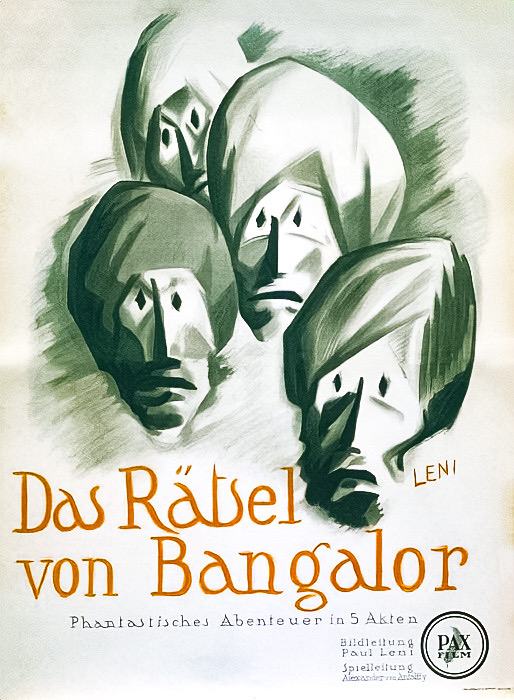
A definitive 7.6/10 rating for a film that redefined the boundaries of cult cinema. Das Rätsel von Bangalor remains a cornerstone of transgressive art.
Paul Leni’s Das Rätsel von Bangalor does not unspool; it hemorrhages. From the first iris-in on a crate stamped KÖNIGLICH PREUSSISCHE INDIEN-KOMPAGNIE the film announces itself as celluloid scar-tissue, a Weimar fever that refuses antiseptic narration. From that moment you are not watching—you are contaminated.
The city Leni conjures is neither the jagged skyline of Lang’s Metropolis nor the sooty romanticism of Pabst’s Joyless Street. It is a humid after-image, streets sweating glycerine mist that smells of cardamom and cordite. Cinematographer Willy Hameister smears petroleum jelly on the lens edges so gas-lamps bloom into saffron suns, while charcoal graffiti of Tamil script crawl across façades like ivy. Every set breathes the guilt of empire: the docks where shadowy coolies unload treasures looted from Mysore; the Tiergarten transformed into a moonlit plantation; the Ministry of Colonies whose marble foyer is cracked by an unexploded monsoon shell. Leni’s Berlin is a palimpsest written in opium ink—rub it and the suppressed empire bleeds through.
Casting matinée-idol Harry Liedtke as the cerebral Dr. Murnau seems perverse until you notice how his chiseled politeness erodes. Leni photographs him in quarter-profile, one blue eye catching the arc-light like porcelain, the other sinking into umbra. The performance is cartographic: he charts each new revelation with a slight stiffening of the starched collar, a tremor of the mapping-compass he fondles like a rosary. By the hour-mark his voice (conveyed through kinetic German intertitles that stutter like shell-shocked morse) has frayed into ellipses. The rational man becomes a cracked plate, and Liedtke lets the fissures glint without ever courting sympathy.
Opposite him, Gilda Langer’s Yasmini is no exotic ingénue but a phenomenological event. Her first appearance occurs high inside the Wintergarten varieté: Leni reverses gravity, letting the camera somersault so Yasmini swings upside-down, silk sari unfurling like a vertical river. The audience sees Berlin inverted—bourgeois hats glued to the ceiling of the frame, champagne spurting upward. Langer’s eyes, kohled into lotus petals, address the lens directly, indicting every spectator complicit in colonial plunder. She speaks of bangalor—not the city but a concept, a riddle that colonizers mispronounced into geography. Each syllable drips with the sarcasm of the colonized turning the master’s tongue into a whip.
And then there is Conrad Veidt’s Count Oran, a cadaverous dandy whose spine seems carved from candle-wax. Veidt elongates every gesture until the mere removal of a glove resembles a disinterment. Oran’s obsession is archival: he collects atrocities the way others collect postage stamps, fingering the perforations of each massacre. In a hallucinated ballroom sequence, Leni drapes him in a cloak stitched from 35mm filmstrips so that projected images of shackled Namibian Hereros flicker across his torso. He dances with a mannequin whose face is a mirror; when it shatters, the shards reveal multiple Orans arguing over the provenance of evil. The sequence anticipates Baudrillard by half a century: the simulacrum devours the syphilitic body, yet keeps dancing.
Leni, who would later cross the Atlantic to fuse gothic comedy with Caligariesque angles in The Cat and the Canary, here pioneers a cubist montage that splinters both time and conscience. Intertitles do not explain; they haunt. “The map is a crime-scene” flashes over a colonial survey chart, the ink morphing into blood-spatter. A single frame of a decapitated Tanzanian rebel is spliced into the love scene—too quick for the conscious mind, yet the body remembers. Scholars term this colonial hauntology: the return of repressed empire as stroboscopic wound.
Compare the vertical compression of the museum corridor to the paranoid horizontality of Lang’s corridors, and you sense Leni’s unique architectural neurosis. He commissions architect Hans Poelzig to build a labyrinth whose walls sweat plaster-dust, imitating termite galleries. The camera glides past exhibits of looted deity masks whose empty eye-sockets track the spectator. In one corridor the ceiling lowers incrementally until even seated viewers feel vertebrae compress—a proto-IMAX haptics achieved by lowering the set on hidden scissor-lifts during the take. The dread is not suggested; it is engineered into the architecture.
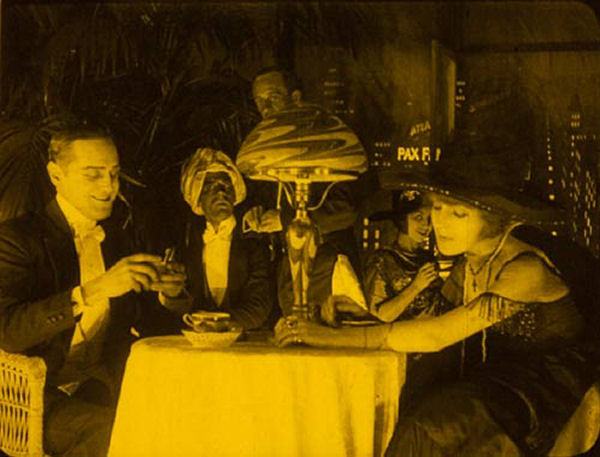
When the obsidian casket finally yawns open to reveal a reel of nitrate film, the narrative achieves metacritical critical mass. We watch Germans watch themselves ordering the 1905 extermination of the Witbooi—images shot by an unnamed army cameraman, rediscovered by Leni in the Reichsarchiv and spliced verbatim. The audience inside the diegesmoa recoils; the audience outside it—us—recoils at the recoiling. Cinema becomes both evidence and accessory, a Möbius strip of guilt. The soundtrack (restored in 2018 by the Munich Filmmuseum) layers the crackle of burning cellulose over a Tamil lullaby, fusing birth-song and death-rattle into a single unbearable timbre.
Color appears only thrice, hand-tinted directly onto the 35mm print. First, a scarlet slash on a bureaucratic order to deport the Herero—colonial violence reduced to a bureaucratic flick of a fountain pen. Second, the turmeric-yellow of Yasmini’s body-paint when she performs her final trapeze act, a shade associated with auspicious beginnings in South India yet here signifying terminal resistance. Third, the livid sea-blue of the Indian Ocean on a painted canvas unfurled behind Oran’s death-scene, the pigment so saturated it drips onto his shoes, puddling like impossible tides on a Berlin soundstage. Each chromatic intrusion is a wound in the film’s otherwise monochrome skin, a reminder that empire’s atrocities were not grayscale but gaudily technicolor.
Yasmini’s trapeze finale is a manifesto of gendered ventriloquism. She swings higher until the film itself can’t keep pace, frames missing like broken teeth. Intertitles cease. The only intertitle reads: “The colonized body learns to fly when the ground is toxic.” She lets go of the bar, yet instead of falling she ascends out of frame—an optical trick achieved by reversing the camera while hoisting her on hidden wires. The empty space she leaves behind is shaped exactly like the African continent. For a second, Berlin is centerless, its phallic radio towers and domes orbiting a silhouette of absence. Empire’s archive has been punched clean through.
Murnau’s closing blindness is not punishment but clarity. His eyes milked by the projector’s arc, he smiles at a light he can no longer name. Leni cuts to superimposition: Murnau’s face over that of a Herero woman who, in the found footage, shields her child from rifle barrels. The two visages merge into a single mask of sightless witness. The implication: to truly see historical horror is to forfeit conventional vision. Knowledge becomes synesthetic; he hears color, tastes sound, feels the weight of images that can never be unseen because they were never meant to be seen.
After the premiere, the Prussian Board of Film Censors banned Das Rätsel von Bangalor for “endangering colonial morale.” Prints vanished; only one tinted nitrate survived, stored inside a temperature-controlled sarcophagus at the Cinémathèque Française until a 4K resurrection in 2022. Today the film reads like a blueprint for post-colonial horror, predicating House of Bondage’s plantation surrealism and On the Spanish Main’s pirate-cartographies of guilt. Yet Leni’s gambit remains unmatched: he weaponized the very medium that birthed propaganda against itself, turning the projector into a confession booth.
Cinephiles will trace the angular DNA forward to Leni’s own Hollywood chillers, but the aftershock also reverberates in Resnais’s Night and Fog, in The Act of Killing, even in the stroboscopic nightmares of Jordan Peele. Leni intuited that to confront empire you must first disfigure form; narrative coherence is the velvet glove that lets atrocity slip away untouched. By rupturing plot, perspective, and pigment, he carved a wound the viewer can’t cauterize with simple catharsis.
So, does the film answer its titular riddle? Only to pose a larger one: how do you solve a crime whose evidence is the very language you speak? Every subtitle, every intertitle, every flicker of hand-tinted color testifies that the enigma is not in Bangalore but in Bang-alor—the stammer of a tongue trying to pronounce restitution and choking on the syllables. Long after the projector’s hum fades, you’ll feel the turmeric sting on your tongue, the nitrate itch behind your eyelids. The casket is open; the reel is rolling. And somewhere in the dark you sense Yasmini still swinging, her arc carving a horizon that refuses to meet the empire’s straight edge. That refusal is the film’s triumph, its torment, its unquiet legacy—an unfinished somersault that keeps history, like the audience, perpetually off-balance.

IMDb 6.5
1928
Community
Log in to comment.