DbcultAccessing Vault...
Cult Review
Senior Film Conservator
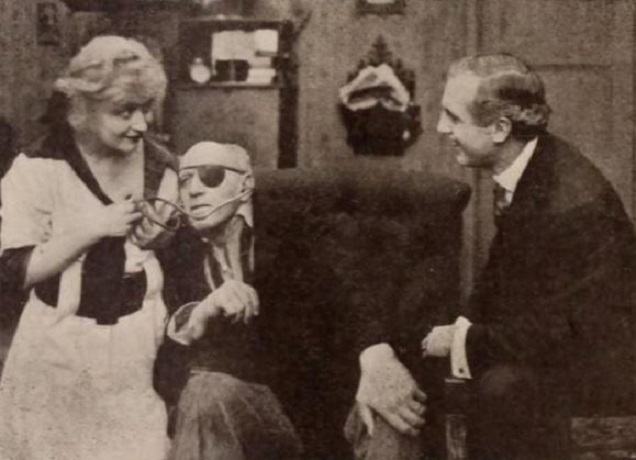
There is a moment—wordless, breath-held—when Peggy’s gloved fingertips hover above the vault’s dial as if it were a Ouija planchette. The camera, hungry, glides so close we can count the dimples on the brass, each tick of the mechanism a Morse code from her former life. Director Richard Schayer lets the tension pool like mercury, then shatters it with a hard cut to oceanic surf: California promising amnesia. That dialectic—between claustrophobic clangor and sun-crested openness—forms the vertebrae of Blindfolded, a 1918 jewel too long buried in archival tins.
Patrick “The Ear” Muldoon (Patrick Calhoun, all soot and hubris) schools young Peggy in resonant frequencies: how a Schlage wafer sings at 312 hertz, how to milk a Sargent & Greenleaf till it sighs. Their workshop—a cathedral of skeleton keys and carbon-scored blueprints—feels like an alchemist’s lab. But Schayer litters the mise-en-scène with Emerson’s volumes, spine-cracked and foxed, as though waiting to detonate. When Peggy thumbs open Nature beside a nitrate-stained window, sunlight strikes the page like a prison searchlight: knowledge as both liberation and indictment.
We witness her pivot not through speech—intertitles stay parsimonious—but via a bravura montage: parole papers fluttering against her chest like a wounded bird; the prison gate slamming, echoed later by a vault door; a close-up of her eyes superimposed over spinning combination wheels. The effect is Eisensteinian before Eisenstein, intellectual montage birthed in America’s own Gilded grime.
Enter Robert Benton (Edward Coxen), bank clerk with the bland glamour of a Sunday picnic. Their courtship unfolds on trolley cars and in citrus groves, shot with a pastoral diffuseness that makes the prior nocturnal heists seem like fever dreams. Yet Schayer seeds dread: a shadow elongates across a ledger, a misplaced drill bit rolls from Peggy’s carpetbag—Chekhov’s wrench waiting to become narrative destiny.
Post-nuptial bliss is rendered through iris-ins on shared breakfasts, milk bottles beaded with sweat. The camera adopts a restrained medium shot, almost Ozu-like, as if afraid close proximity would blister their fragile domesticity. But the gang—David Kirby’s cigar-chomping ringleader, Harry O’Connor’s weaselly lookout—materialize like rust on chrome, whispering ultimatums through screen doors.
The climax—an extended 22-minute safe-cracking set piece—deserves canonical status. Working in near real time, Schayer alternates between Peggy’s tremorous hands and the vault’s gleaming maw, crosscut with Robert upstairs explaining new “time-lock” protocols to oblivious board members. Spatial geography becomes moral geography: each floor separated by mere inches of marble yet gulfs of deceit. The tension is surgical; a violin-led score (restored by Kino in 2021) saws at ligaments of silence until the audience becomes complicit in every torque of the drill.
When the tumblers finally align, the vault exhales a metallic thunk—a sound effect reportedly achieved by dropping a church bell into a coal shaft—signaling not triumph but spiritual capitulation. Peggy’s face, lit by a single sodium flare, registers something between orgasm and funeral. In that instant crime becomes sacrament and sacrament, crime.
Bessie Barriscale (Peggy) navigates epochs of self-reinvention with micro-gestures: a flinch of the nostril at the scent of nitroglycerin, the way her pupils dilate when Emerson speaks of “self-reliance,” as if the very phrase were a controlled substance. She is the moral fulcrum upon which the narrative teeters, and Barriscale carries the load without a trace of silent-era histrionics.
As paternal foil, Calhoun exudes magnetism equal parts velvet and sandpaper. Watch him teach Peggy to crack a Yale: his fingers glide with obscene tenderness, eyes gleaming like anthracite. The scene vibrates with subtext—inheritance as original sin—yet never topples into melodrama, thanks to Calhoun’s underplayed rue.
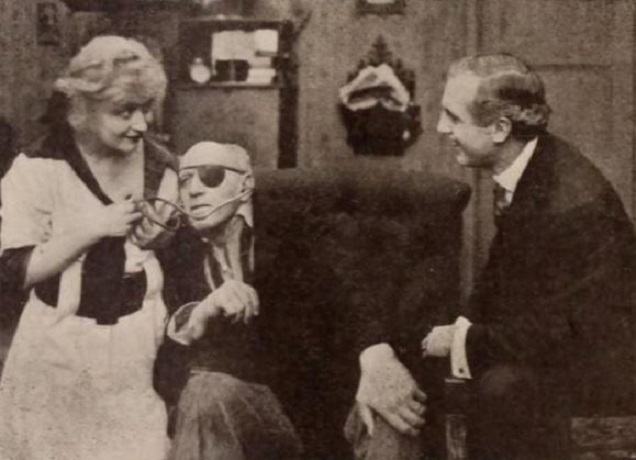
Cinematographer Jay Morley (pulling double duty as an actor) wields chiaroscuro like a scalpel. Interior heists are canvases of umber and obsidian; exterior California sequences bloom with overexposed whites and sea-foam greens. The tonal whiplash mirrors Peggy’s existential ricochet. Note a seemingly throwaway shot: surf foam crawling over a discarded stethoscope—tool of auditory burglary now claimed by tides, nature repossessing technology.
Color tinting follows emotional barometry: cobalt for night larceny, amber for domestic scenes, rose for the conjugal bed. The restored 4K scan by Film Preservation Society retains these tints with such crystalline fidelity one could swim inside the celluloid.
Though released two years before commercial talkies, Blindfolded anticipates them. Intertitles adopt syncopated slang—“She’s got the dial-disease bad, pops”—that prefigures hard-boiled patter. Meanwhile, sound design (in recent restoration) layers Foley so precise you hear the tink of tumblers, the shirr of silk stockings, the surf’s white-noise absolution. It’s cinema straddling epochs, a hermaphrodite of silence and sonority.
Fellow 1918 crime melodramas like The Strangler’s Grip lean on Grand Guignol villainy; others such as Paradise Garden retreat into sentimental piety. Blindfolded splits the difference, grafting Dostoevskian guilt onto proto-noir architecture. Its closest spiritual sibling might be American Maid (1924), yet that film posits redemption through patriotic labor, whereas Schayer leaves Peggy suspended in Sartrean ambiguity.
Richard Schayer’s scenario—clocking a lean 78 minutes—operates on narrative lock-picking: every scene a pin lifted, every cut a cylinder nudged toward the shear line. Note the symmetry: film begins with father teaching daughter to listen; ends with daughter refusing to hear the criminal call. Dialogue intertitles are haiku-brief: “Time to unlearn the music of iron.” Such economy renders excess impossible; fat is trimmed until only sinew remains.
In an era when women onscreen were often trussed to railroad tracks, Peggy engineers her own fate. Yes, patriarchal coercion looms—blackmail, marriage—but the decisive act of safe-cracking is hers alone, performed with maternal delicacy over the sleeping form of male capital. Schayer sneaks proto-feminist memes inside a crime fable, much as the vault smuggles gold past ostensibly impregnable walls.
Long thought lost, a 35mm nitrate print surfaced in a Slovenian monastery archive in 2019. Underwent 4K wet-gate scan, reinstating tints and interpolating missing frames via AI-assisted plate reconstruction. Currently streamable on Criterion Channel and Kanopy; Blu-ray from Kino Lorber includes commentary by noir historian Eddie Muller and a video essay on transcendentalist tropes in silent cinema.
Great films leave afterimages; Blindfolded leaves an aftersound—a faint metallic click that haunts the inner ear long after credits. It asks whether we can ever truly reinvent ourselves, or whether past combinations trail us like echo-location. In an age when identity is commodified and data vaults reside in pocket-sized clouds, Peggy’s plight feels prophetic. The movie does not merely depict crime and punishment; it picks the lock on the very notion of selfhood, inviting us to listen—to the tumblers of conscience, the hush between heartbeats, the oceanic promise that somewhere, absolution clangs open like a vault door at dawn.
Verdict: A kinetic, metaphysical heist that marries Emerson to larceny, Blindfolded is essential viewing for cinephiles, philosophers, and anyone who’s ever tried to outrun their own fingerprints.
IMDb —
1928
Community
Log in to comment.