DbcultAccessing Vault...
5.8/10
Senior Film Conservator
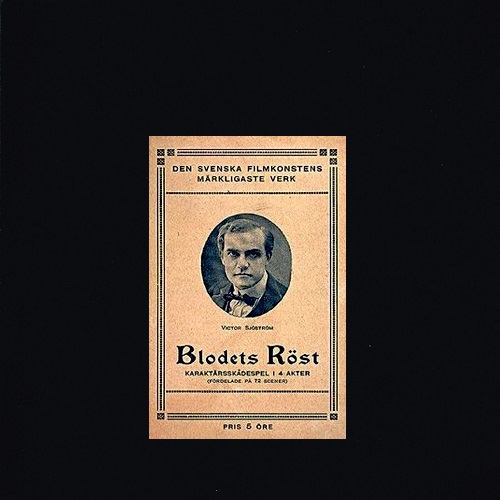
A definitive 5.8/10 rating for a film that redefined the boundaries of cult cinema. Blodets röst remains a cornerstone of transgressive art.
Victor Sjöström opens his camera like a coroner’s scalpel.
From the first iris-in on Stockholm’s snow-flecked gutters, Blodets röst announces itself not as melodrama but as a private autopsy performed on the still-twitching corpse of male respectability. Richard Lund’s unnamed clerk—collar starched to the point of asphyxiation—walks a narrow lane that might have been painted by Zuloaga: ochre gaslight, bruise-blue dusk, the city breathing a cold arsenic on his cheekbones. One senses the timeline buckling; the film is 1913, yet the psychic weather is post-WWII, post-#MeToo, post-everything.
Forget the literal hemorrhage promised by the title. The “voice of the blood” here is memory itself—an inherited litany of Lutheran guilt, mercantile duty, and the tacit Viking law that a man who cannot conquer the world must at least conquer his own parlor. Once Lund’s salary is halved by an off-screen recession, the conquest collapses; he prowls the apartment like a wolf that has misplaced its forest. Watch how Sjöström, doubling as co-writer, refuses to grant the wife (Greta Almroth) a single reaction shot that could be catalogued as “hysterical.” Her silence is the film’s true soundtrack—an aural negative space louder than any Vitagraph orchestra.
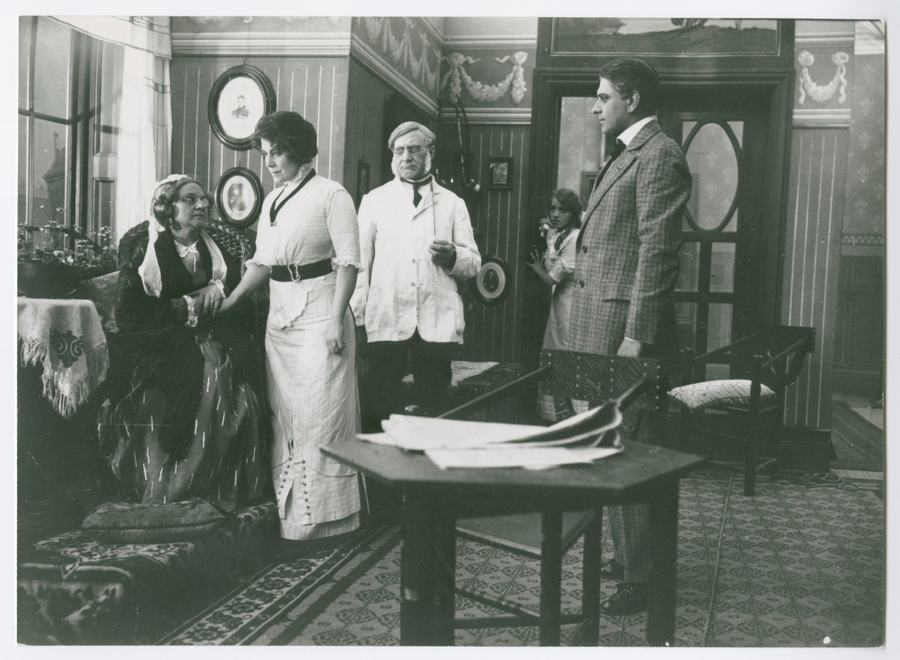
Sjöström keeps framing doorways taller than they are wide, so characters resemble coins sliding into a toll-operated purgatory. When Lund, in a moment of pickled bravado, drags a café danseuse into the marital bedroom, the camera retreats to the corridor, peering through the keyhole like a servant who refuses to be complicit. We never see the seduction—only the aftermath: a child’s porcelain lamb overturned on the rug, its glaze reflecting the ceiling as though heaven itself lay toppled. This ellipsis is more obscene than any tableau the censors feared.
Rather than tipple in real time, Lund’s binges are rendered through jump-cuts that delete whole days. One fade-out swallows a payday; the next iris-in lands him in a debtor’s cell where barred shadows stripe his face like tiger claws. The effect predates Traffic in Souls’ montage by months and feels closer to the stroboscopic blackout of 1960s underground cinema. Sjöström understood that addiction is not continuous—it’s a staccato erasure of self.
Almroth’s wife has a scene—barely forty seconds—where she sells her wedding ring to a pawnbroker. The broker weighs the band on a brass scale; the counter-arm dips, the tiny bell tings, and in that metallic yawn Almroth’s pupils dilate with feral clarity. No intertitle intrudes. The moment vibrates with the same proto-feminist voltage one would later find in What 80 Million Women Want, yet Sjöström stages it half a decade earlier. Meanwhile Ragna Wettergreen, as the cigar-smoking aunt, dispenses arsenic wisdom: “Marriage is a bank where men deposit excuses and women withdraw silence.” The line arrives on a title card lettered in crimson—one of the few instances the film colors its text, as though the sentence itself were hemorrhaging.
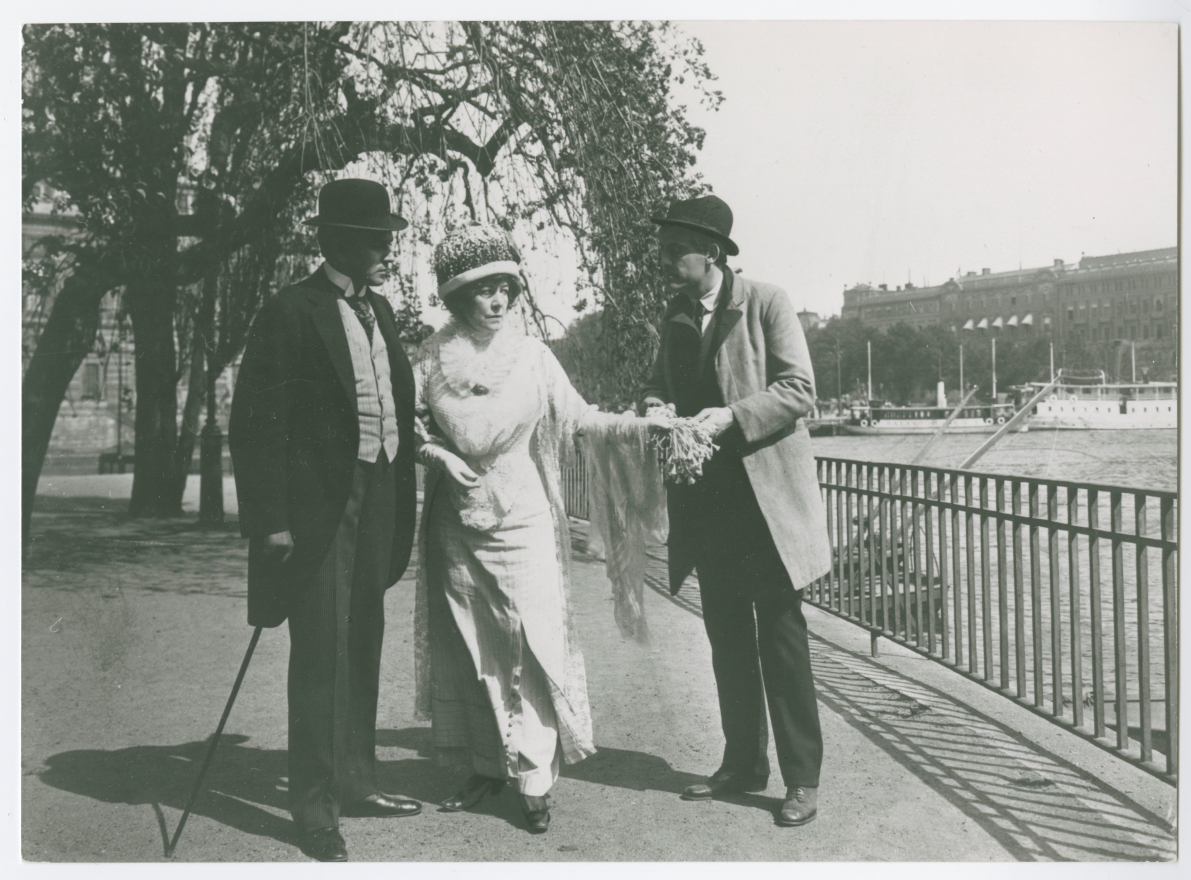
A boy actor—uncredited, probably a Sjöström relative—peers through banister rails while paternal shouts ricochet below. The child’s eyes are filmed in a tight close-up that anticipates the juvenile trauma later canonized by Oliver Twist. Watch how the kid’s pupils track every off-screen crash; the frame rate wavers, making the moment feel like a flip-book of dread. Later, when the father attempts redemption by gifting a tin soldier, the boy pushes the toy away. The soldier lies on the parquet, casting a shadow shaped like a noose—an image as chilling as anything in Hamlet, Prince of Denmark.
Peter Lykke-Seest’s original scenario was a penny-dreadful pamphlet, but Sjöström distills it into chamber horror. Compare this to the epic carnivals of Quo Vadis? or the sentimental piety of From the Manger to the Cross; Blodets röst opts for claustrophobia, for the sour smell of over-boiled coffee in a flat where rent is three weeks late. The film’s austerity makes Griffith’s The Battle of Gettysburg look like a circus parade financed by Barnum himself.
Archival prints screened at Stockholm’s Filminstitutet are mercifully naked: no tinkling Wurlitzer, no anachronistic strings. The silence turns every ticking mantle clock into a bomb, every creak of Lund’s boot into a verdict. When the final title card reads, “Hans blod har talat färdigt” (“His blood has finished speaking”), the absence of music feels like a mercy killing. You walk out hearing your own pulse—a private dubbing session Sjöström engineered across a century.
Legend claims the original negative included a nightmare sequence where Lund’s ancestors rise from their portraits and force him to walk a corridor of flaming ledgers. Studio heads excised it for being “too Germanic,” a euphemism for “too Expressionist before Expressionism existed.” The cut footage allegedly burned in the 1921 SF vault fire. Good. The film’s true terror lies in what we don’t see, in the spectral ledger columns every viewer tallies in the dark.
There is no 4K, no Criterion spine, no convenient Kanlink binge. You haunt the repertory houses, the university archives, the 16 mm print your local cine-club projects in a repurposed church where the heating clanks like chains. Accept the scratches, the vinegar reek, the occasional splice that deletes a micro-expression. These wounds are the film’s stigmata; to Photoshop them away would be to turn Lund’s agony into a Anna Held beauty reel.
Blodets röst ends where many modern indies begin—at the lip of an abyss whose bottom we never see. Yet its refusal to moralize, to deliver the reformatory epilogue Hollywood would demand, places it shoulder-to-shoulder with the bleakest New Hollywood of the 1970s. Watch it beside Satana or The Student of Prague and you’ll sense a Nordic through-line: the conviction that the gravest horror is not external—no gothic castle, no mustache-twirling seducer—but the sound of your own appetite echoing in an empty room.
Sjöström would go on to craft grander canvases—The Phantom Carriage, He Who Gets Slapped—yet here, in this brittle 37-minute nerve-slice, he minted the template for every mid-life meltdown that would clutter twentieth-century fiction. The blood spoke; we’ve been answering ever since.
IMDb —
1931
Community
Log in to comment.