DbcultAccessing Vault...
Cult Review
Senior Film Conservator
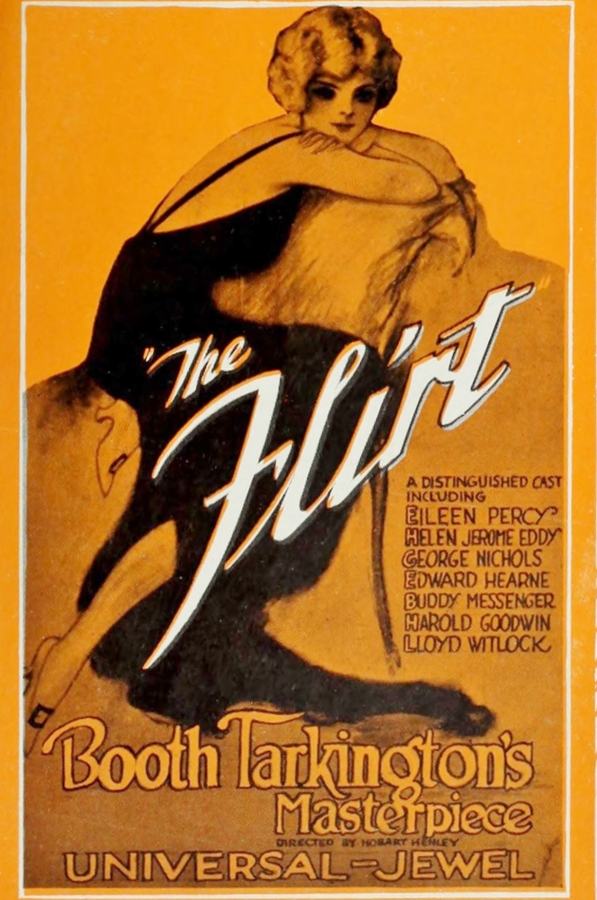
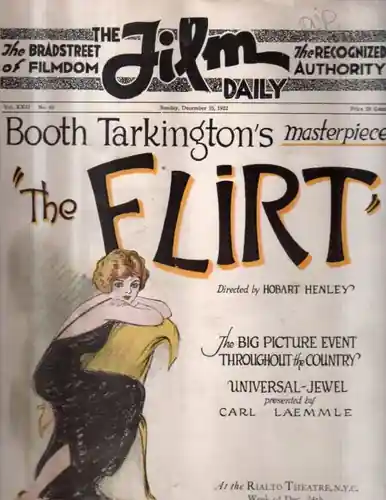
Booth Tarkington’s name on a marquee in 1922 meant mercury in the thermometer: the mercury shot up, the house swelled, and every corseted matron in the Midwest braced for a looking-glass that would show her own drawing-room blemishes magnified to carnival proportions. The Flirt, adapted by Andrew Percival Younger from Tarkington’s Saturday Evening Post serial, is less a morality play than a vivisection—performed with silver nitrate scalpels under carbon-arc glare.
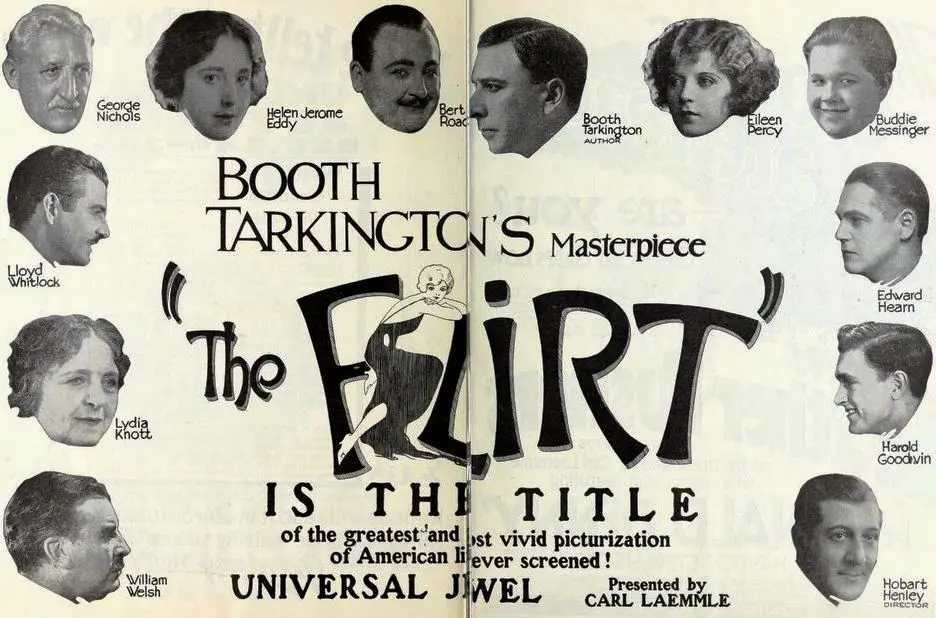
Cora Madison, incarnated by Eileen Percy, arrives in the first medium shot already mid-laugh, a champagne bubble suspended just before the inevitable pop. She is flanked by a bouquet of lesser Madisons: brothers who subsidize her hat bills, a mother who treats each tantrum as operatic cadenza, and Laura—Helen Jerome Eddy’s Laura—whose eyes carry the bruised violet of dusk. The film’s visual grammar is immediately legible: Cora is center-frame, backlit, haloed by doorway ovals; Laura is half-profile, often cropped by doorjambs, a woman literally edged out of her own story.
Enter Valentine Corliss—Lloyd Whitlock in a Panama hat tilted at the angle of a stock-market graph about to nosedive. The intertitles give him adjectives like “magnetic” and “indeterminate,” but Whitlock’s performance supplies the subtext: every handshake lingers half a second too long, every smile resets itself like a cash register drawer. His scheme is the ur-text of 1920s fraud: fold a respected family name into a shell company, inflate shares with hometown trust, then abscond before the ticker reveals the hollow center. The film’s prescience is chilling—only months after its release the Hauser Oil and Refining swindle would replicate the plot in living headlines.
The forged signature—obtained while Papa Madison (William Welsh) dozes over Scientific American—becomes the film’s Rosetta Stone. We see it first in extreme close-up: a spider-thin ink trail crossing the grain of cream bond. Later, when Cora realizes the paper is a death warrant for her father’s honor, the camera executes a slow iris-in until the document fills the screen like a portcullis descending. Silent cinema rarely gets credit for Hitchcockian punctuation; this cut could teach the Master a seminar on guilt-as-spectacle.
Richard Lindley, essayed by True Boardman, is the film’s sacrificial eunuch of decency—too upright to suspect treachery, too bland to ignite the frame. His proposal scene transpires on a porch swing whose chains squeak in metronomic irony. Cora accepts while staring past his shoulder at her own reflection in the window glass, a visual confession that she is engaged not to a man but to an audience. When the engagement shatters, Lindley’s shrug is almost existential: “I suppose it was all a mistake,” he murmurs via intertitle, the passive voice of a man who has never owned his own narrative.
Laura’s revenge, by contrast, is ferocious. She commandeers a Tin Lizzie, barrels down a dirt road like an avenging Valkyrie in gabardine, and drags Cora back to the Madison parlor where confession will be extracted under kerosene lamplight. The blocking here is operatic: Cora stage-left cowering, Laura stage-right declaiming, Papa Madison center-rear framed between them like a judge whose gavel has been stolen. The moment Cora admits complicity, the lamp flickers—an electrician’s flourish that feels like divine intervention captured by sheer luck.
Jimmy Madison (Harold Goodwin) enters for the third-act rescue sporting a Norfolk jacket and a bruised cheek—he has, we infer, already brawled with Corliss on the 3:10 to Penn Station. The fight itself is withheld; we see only the aftermath, a bravura ellipsis that lets imagination sketch the fisticuffs in far more vivid chiaroscuro than any camera of the era could safely stage. Jimmy’s triumphant return, towing a handcuffed Corliss through a mob of depositors baying for blood, is shot from a low angle that makes the hero loom like a colossus of hometown loyalty.
The epilogue is swift, almost cruel. Cora weds the ever-willing second-stringer in a veil the color of old lace, a costume choice that reads like penance. Lindley, having decoded Laura’s devotion via a misdelivered Valentine engineered by child-imp Hedrick (Buddy Messinger), catches Laura on the garden path at dawn. The final kiss is filmed in long shot: two silhouettes dissolving into sunrise, while the intertitle quotes Tarkington verbatim—“And so the world, having made its jest, set about forgetting.” The camera lingers on dewy grass, a visual whisper that tomorrow’s scandal is already germinating.
Technically, the surviving 35mm print—restored by EYE Filmmuseum and released via Kino’s 4K Blu-ray—reveals cinematographer George Nichols’s sophisticated depth staging. Foreground tea services reflect background windows; mirrors double characters until the screen resembles a hall of ethical funhouse glass. The tinting strategy is deliberate: amber for interiors (the color of money), viridian for exteriors (the hue of inexperience), and a startling crimson wash during the moment Cora signs the fateful paper—an early experiment in chromatic synecdoche.
Compared to contemporaneous society farces like Pest in Florenz or The Captivating Captive, The Flirt is less continental confection and more Midwestern muckraker. Its closest cousin may be His House in Order, where matrimonial calculus also masquerades as romance, yet Tarkington’s venomous affection for his characters bleeds colder. One exits The Flirt unsure whether to pity or to prosecute them—a moral vertigo that feels startlingly modern.
Performances range from competent to incandescent. Eileen Percy’s Cora never tips into harpy; she keeps the flirt a wounded child, all appetite and no atlas. Helen Jerome Eddy’s Laura, meanwhile, is the film’s stealth weapon—her transition from wallpaper to whirlwind is so gradual that when she finally slaps Cora the impact echoes like a judge’s gavel. Whitlock’s Corliss is silk over steel; watch how he pockets his watch-chain: thumb and forefinger forming a noose.
The screenplay condenses Tarkington’s sprawling serial into a tight 68 minutes, sacrificing the novel’s riverboat escapade and a subplot involving a German tutor. What remains is a diamond cutter’s study of parasitic charm. Younger’s intertitles deserve special mention: they crackle with flapper slang (“Cora collected hearts the way kids collect marbles—aggies and bloodies alike”) yet never curdle into the cutesy pastiche that sank so many Jazz-Age scripts.
Scholars often pigeonhole 1922 as the lull before Greed and Phantom, yet The Flirt anticipates both Stroheim’s monetary fetish and Murnau’s moral vertigo. The film’s obsession with signatures—written, forged, retracted—feels like a dry run for the contract that devours McTeague. Its final image of lovers silhouetted against dawn prefigures the epilogue of Sunrise, only here the sunrise is not redemption but amnesia.
Contemporary reviewers were divided. Variety called it “a sugarcoated pill for every father who ever footed a daughter’s shoe bill,” while Photoplay sniffed that “Miss Percy’s gowns out-act the plot.” The New York Times, surprisingly, praised the film’s “cynical relish,” claiming it “stabs the heart of boosterism with a hat-pin.” Box office was robust in the Midwest, tepid in New England, and nonexistent south of Richmond—proof that its satire required a prairie vantage.
Modern viewers will note the film’s proto-feminist undercurrent: the men are either dupes or fugitives, while the women engineer both catastrophe and restitution. Laura’s final reclamation of Lindley is not romantic surrender but strategic acquisition—she chooses, therefore she conquers. Cora’s exile into a marriage of convenience reads less as punishment than as societal reset: the village reabsorbs its wayward daughter by shackling her to a man too dim to fear her.
Score recommendations for silent-film festivals: a chamber quartet interpolating Scott Joplin rags with Satie gymnopédies underscores the film’s waltz between froth and menace. Avoid generic stride piano; the emotional palette is too astringent for jaunty pastiche. The 4K restoration offers two optional tracks: a contemporary score by Neighbor’s composer Mont Alto Motion Picture Orchestra and a commentary by historian Shelley Stamp, who excavates production memos detailing Percy’s insistence on a subdued wardrobe palette to keep Cora’s vanity implicit rather than garish.
In the taxonomy of silent cinema, The Flirt occupies a curious genus: too ironic for melodrama, too sincere for farce, it belongs beside Wer unter Euch ohne Sünde ist and Chickens as a study of rural entropy. Stream it on Kino Cult or Criterion Channel, but best experienced via Blu-ray where the amber tinting can glow like whiskey held to lamplight. Pause frequently; the devil here is indeed in the details—a forged signature, a misplaced Valentine, a porch swing that squeaks the exact rhythm of a heart learning shame.
Verdict: 9/10—a surgical satire whose scalpel has only grown sharper with time. Watch it once for the plot, again for the architecture of deceit, and a third time to marvel at how 1922 already knew that the most dangerous flirt is the one who believes her own reflection.
IMDb —
1920
Community
Log in to comment.