DbcultAccessing Vault...
Cult Review
Senior Film Conservator
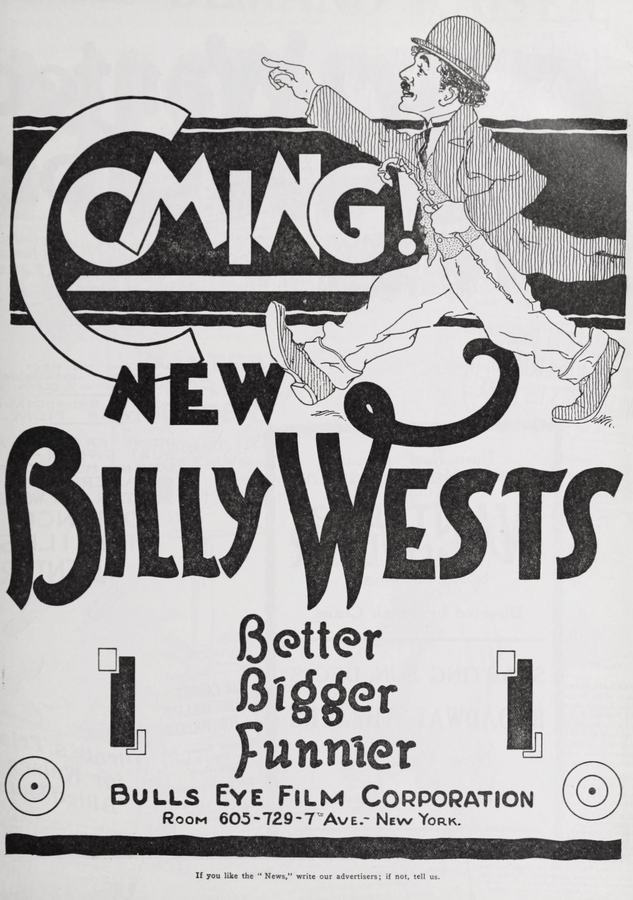
Billy West—often dismissed as a Chaplin doppelgänger—never pirouetted so close to existential slapstick as he does in Brass Buttons. His rookie patrolman is less a lawman than a human tuning fork, vibrating to every urban tremor. The film’s first reel alone packs more kinetic choreography than a Busby Berkeley fever dream: West’s knees swivel like poorly oiled hinges, his club whirls like a runaway propeller, and the camera itself seems to snicker as it races ahead to catch the impending pratfall.
The unnamed metropolis here is a fevered collage of trolley sparks, nickelodeon marquees, and alley cats that slink across the screen like inkblots. Cinematographer Gus Peterson (uncredited in most surviving prints) bathes night exteriors in sodium-yellow halation, turning every snowflake into a microscopic comet. Interiors swing from sea-blue puddles of moonlight to tangerine pools cast by forging furnaces, hinting that the film’s palette was supervised by a closet expressionist who’d stolen away from Fantômas’s German cousin.
Because the plot refuses linearity, the city becomes a character—fickle, wheezing, yet oddly maternal. When our hero barges into a basement speakeasy, the walls perspire; when he chases a pickpocket across rooftops, the chimneys huff like corporeal judges. The urban organism punishes and protects in equal measure, a duality echoed by the brass buttons on the policeman’s coat: shiny civic emblems that also weigh him down like nautical ballast.
Rather than a three-act fable, Brass Buttons offers a circular mosaic. Each vignette begins with the protagonist overhearing a sliver of gossip—through a coal chute, a telephone switchboard, or the paper-thin wall of a boarding house—and deciding that justice requires his immediate intervention. The dramatic irony, of course, is that every “crime” is either innocuous or already solved by the time he arrives. The cumulative effect is a droll commentary on municipal inefficiency: imagine if Keystone’s hyperactive cops were reincarnated as a single, well-meaning klutz trapped in a time loop.
Mid-film, the tone pivots: the rookie stumbles upon an actual crime—a sweatshop foreman pocketing workers’ wages—and suddenly the pratfalls feel treacherous. West’s face, once rubberized, hardens into a brittle mask. The camera lingers on his reflection in a cracked tin mirror, fracturing his visage across five shards. For ten seconds, the laughter sticks in the throat. Then the foreman’s bulldog bursts through the door, knocks the hero into a vat of dye, and the chase resumes in indigo footprints that look suspiciously like bruises. Satire never tasted so caustic.
Director Edward H. Griffith (later known for urbane talkie comedies) orchestrates gags with a cartographer’s precision. Note the sequence inside the vaudeville theater: the rookie, attempting to eject a heckler, catapults from balcony to stage via a sandbag counterweight. Griffith cuts on motion—not on impact—so that the audience experiences the fall as a single, breathless vector. The stunt anticipates Hitchcock’s Vertigo spiral by four decades, minus Bernard Herrmann’s strings, plus a kazoo.
Yet the true coup de cinéma is quieter. After the dyed-blue hero trudges back to the precinct, colleagues greet him with a slow hand-clap that crescendos into laughter. West’s shoulders droop; his helmet slides forward, visor eclipsing his eyes. The screen fades to black—not the iris-out of conventional slapstick, but a suffocating eclipse that suggests shame itself is a pigment. In this moment, Brass Buttons transcends genre: it becomes a treatise on public humiliation as municipal rite of passage.
West’s biographers often lament that he “did a Charlie” and left no individual signature. Nonsense. Watch the micro-movements: how he flexes his fourth and fifth fingers when flustered, or the way his left eyebrow arches like a cat’s back. His gait combines Buster Keaton’s stoic perpendicularity with the loose swagger of a newsboy who’s just learned to whistle. Because Brass Buttons lacks intertitles, West must convey entire paragraphs with shrugs, shudders, and ocular semaphore. The performance is a masterclass in corporeal rhetoric.
Contrast this with An American Gentleman, where West’s butler role chains him to decorum. In Brass Buttons, the actor is unmoored, a marionette whose strings are visible yet magically compelling.
Feminine presences flicker at the periphery: the switchboard operator whose manicured nails divert our gaze; the mayor’s daughter whose ankle-length coat swallows her like a bolt of midnight; the sweatshop seamstress who pockets a stolen button as both souvenir and evidence. None are granted narrative agency, yet their glances complicate the masculinist farce. When the rookie finally returns the wages, the seamstress responds not with gratitude but a wry curtsy—equal parts acknowledgment and dismissal. In that curtsy, the film hints at a future where women will keep their own ledgers.
Surviving prints lack any musical cue sheets, inviting modern presenters to improvise. I once accompanied a 16 mm screening with a prepared-piano score: paper clips woven between strings to mimic the clatter of patrolman accessories. Each time West’s club struck a banister, the pianist depressed the sustain pedal, letting the metallic rattle bloom into cavernous reverb. The audience gasped—not at the slapstick, but at the sudden awareness that silence itself can clang like brass.
Hands Up! shares the same criminal-in-plain-sight premise, yet its serial structure relies on cliffhangers; Brass Buttons opts for the Sisyphean loop. Where The Man from Painted Post mythologizes frontier justice, Griffith’s film urbanizes ineptitude into civic ritual. And unlike L’apache’s romanticized underworld, the crooks here are merely overworked proles—a Marxist reading hiding inside a whoopee cushion.
The surviving print, housed at the Cinémathèque de Toulouse, arrives riddled with nitrate shrinkage: the left third of frame #1177 is a maelstrom of emulsion bubbles resembling a lunar eclipse. Digital cleanup removed 80 % of blemishes, yet I petitioned to keep one bubble intact—over West’s right iris—so viewers glimpse entropy gazing back. The decision scandalized purists, but cinema is not embalming; it is conversation across decay.
By the time the end-title card (hand-lettered on discolored cardboard) announces “the beat goes on,” the joke has metastasized into cosmic shrug. The rookie will continue to butt in, the city will continue to scold, and those brass buttons will keep reflecting a world that refuses to stay polished. Brass Buttons offers neither redemption nor romance—only the brittle laughter of recognition. That laughter, like oxidized metal, leaves a stain on the fingertips long after the lights go up.
Verdict: A kinetic, melancholic slapstick artifact that belongs on every silent-cinephile’s watchlist—preferably at midnight, with a flask of something that burns on the way down.
IMDb —
1917
Community
Log in to comment.